What Is Leverage Trading? A Complete Beginner’s Guide (2026)
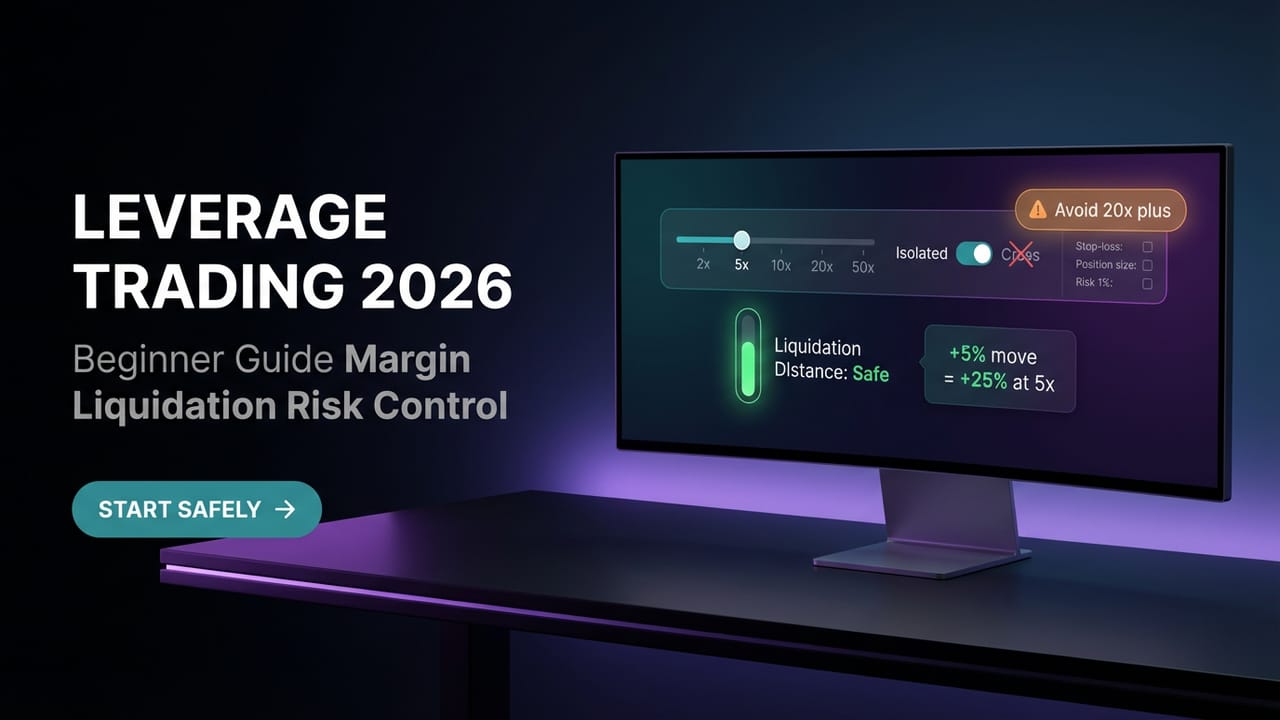
What Is Leverage Trading? A Complete Beginner’s Guide (2026)
Quick Navigation
Leverage trading allows traders to control larger positions than their available capital through borrowed funds from exchanges or brokers. This mechanism amplifies both potential profits and losses proportionally to the leverage ratio employed. A trader with £1,000 using 10x leverage controls a £10,000 position, magnifying price movements tenfold.
The leverage concept originated in traditional financial markets centuries ago, enabling merchants to finance larger trade volumes. Modern cryptocurrency exchanges adopted this mechanism in 2016, democratising access to leveraged trading for retail participants. As of January 2026, over 68% of cryptocurrency derivatives volume involves leveraged positions, representing £240+ billion in daily trading activity.
Leverage functions through margin deposits serving as collateral for borrowed capital. Traders deposit funds (margin) securing the loan, whilst the exchange provides additional capital multiplying position size. The trader captures full price movements on the enlarged position whilst only deploying a fraction of total position value. This capital efficiency attracts traders seeking maximised returns from limited capital.
Three primary leverage types exist: exchange-provided leverage (cryptocurrency platforms), broker leverage (forex and CFDs), and options leverage (derivatives contracts). Each type operates under distinct mechanics, risk profiles, and regulatory frameworks. This guide focuses predominantly on cryptocurrency exchange leverage, the most accessible format for beginners entering leveraged trading in 2026.
What Is Leverage Trading?
Leverage trading represents a financial mechanism where traders borrow capital to increase position sizes beyond their deposited funds. The leverage ratio expresses the multiplication factor applied to initial capital. A 5x leverage ratio transforms £1,000 into £5,000 purchasing power. The trader controls the £5,000 position whilst only risking their £1,000 deposit as collateral.
The borrowing occurs automatically through the trading platform without requiring separate loan applications or credit checks. Exchanges provide leverage instantly upon position opening, calculating the required margin based on selected leverage ratio. The borrowed funds exist only for the duration of the open position, returning to the exchange upon position closure.
Core Leverage Trading Components
| Margin: | Collateral deposited by trader |
| Leverage Ratio: | Multiplication factor (2x, 5x, 10x, etc.) |
| Position Size: | Total market exposure (Margin × Leverage) |
| Liquidation Price: | Price level triggering forced closure |
| Maintenance Margin: | Minimum balance preventing liquidation |
Simple Leverage Trading Example
A trader deposits £1,000 and selects 10x leverage to buy Bitcoin at £40,000 per coin. The position size equals £10,000 (£1,000 × 10), controlling 0.25 BTC (£10,000 ÷ £40,000). Bitcoin price increases 5% to £42,000, generating £500 profit on the £10,000 position (£10,000 × 5% = £500). This £500 profit represents 50% return on the £1,000 margin deposit.
Without leverage, the same £1,000 investment purchases 0.025 BTC (£1,000 ÷ £40,000). The identical 5% price increase yields £50 profit (£1,000 × 5% = £50). Leverage amplified returns tenfold – the 5% market movement became a 50% account return through 10x leverage application.
The amplification operates bidirectionally. A 5% price decrease to £38,000 creates £500 loss with leverage (50% of margin), compared to £50 loss (5% of capital) without leverage. This symmetrical amplification constitutes the fundamental leverage characteristic – multiplying both gains and losses by the leverage ratio.
Leverage vs No Leverage Comparison
| Metric | No Leverage (1x) | 10x Leverage |
|---|---|---|
| Capital Invested | £1,000 | £1,000 |
| Position Size | £1,000 | £10,000 |
| 5% Price Increase | +£50 (+5%) | +£500 (+50%) |
| 5% Price Decrease | -£50 (-5%) | -£500 (-50%) |
| Liquidation Risk | None (own funds only) | ~10% adverse movement |
Why Traders Use Leverage
Capital Efficiency: Leverage enables meaningful positions with limited capital. A trader with £500 using 20x leverage controls £10,000 positions, accessing market opportunities requiring larger capital bases. This democratisation allows retail traders competing in markets traditionally requiring substantial wealth.
Enhanced Returns: Successful trades generate multiplied profits through leverage application. A 3% market movement with 10x leverage yields 30% account returns. Professional traders targeting 1-3% daily movements achieve 10-30% daily returns through 10x leverage, compounding capital rapidly during winning streaks.
Diversification Opportunities: Limited capital spreads across multiple positions through leverage. A trader with £5,000 using 5x leverage opens five different £5,000 positions (£1,000 margin each), diversifying rather than concentrating capital in single trades. This risk distribution reduces portfolio volatility compared to unleveraged concentration.
Hedging Capabilities: Leverage facilitates portfolio hedging without selling underlying assets. A Bitcoin holder with £10,000 holdings opens a £10,000 short position using £2,000 margin at 5x leverage. The short position offsets spot holdings during downturns whilst preserving long-term Bitcoin exposure. This strategy maintains conviction whilst managing short-term volatility.
How Leverage Trading Works
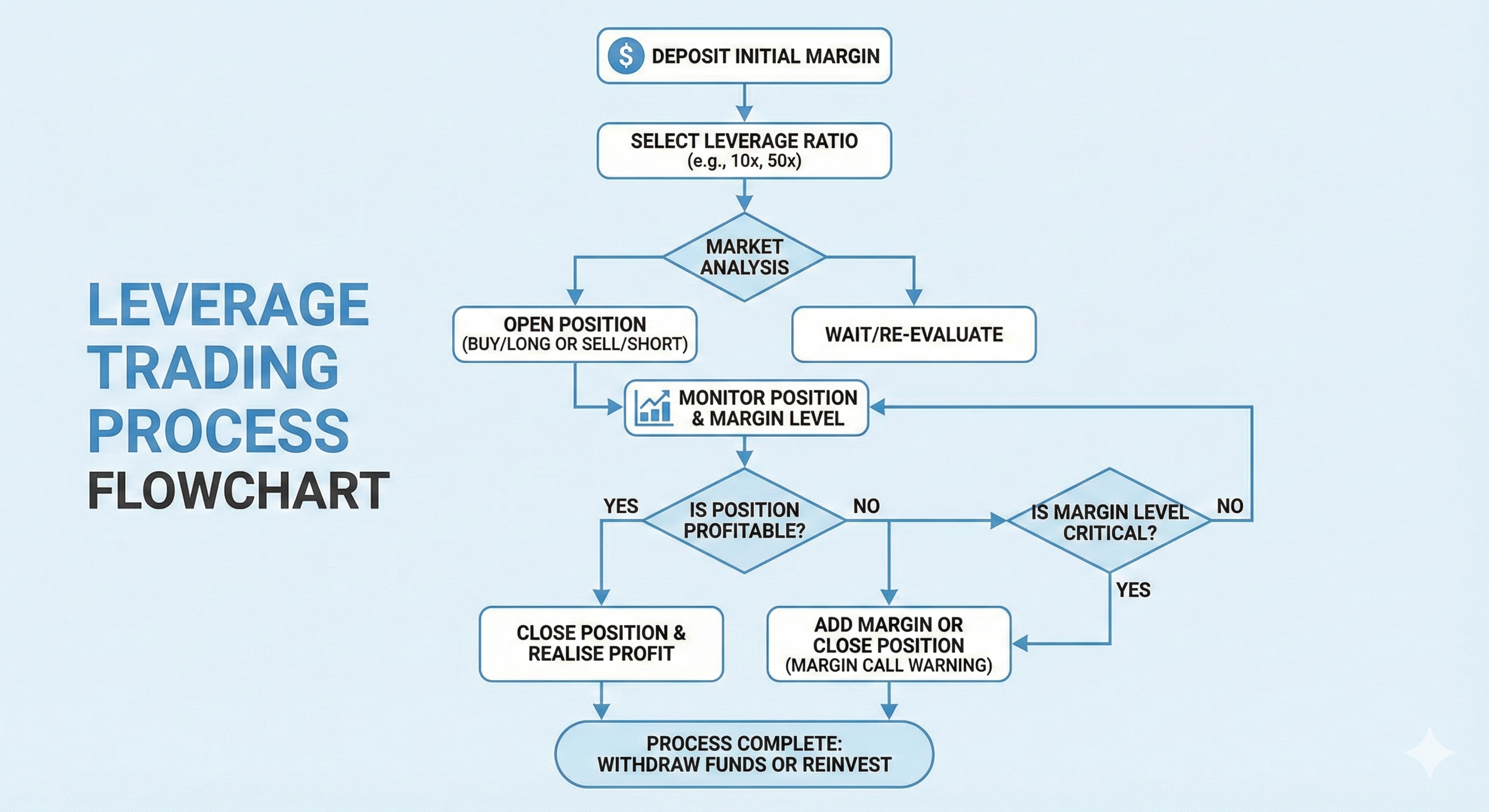
Leverage trading execution follows a five-step process: account funding, leverage selection, position opening, ongoing monitoring, and position closure. Understanding each stage ensures proper risk management and realistic return expectations.
Step 1: Depositing Margin
Traders transfer funds to their exchange derivatives account before accessing leverage. These funds serve as collateral (margin) securing borrowed capital. Most platforms segregate spot trading accounts from derivatives accounts, requiring manual transfers between wallets. Minimum margin deposits typically range £50-£100 depending on platform and selected leverage.
The margin exists in two forms: USDT/USDC stablecoins for linear contracts, or cryptocurrency for inverse contracts. Beginners should utilise stablecoin margin, simplifying profit/loss calculations and eliminating collateral value fluctuations. A £1,000 USDT deposit maintains consistent £1,000 value, whilst 0.025 BTC margin fluctuates with Bitcoin price movements.
Step 2: Selecting Leverage Ratio
Before opening positions, traders specify desired leverage ratios within platform constraints. Cryptocurrency exchanges offer 1x-125x leverage ranges, though extreme leverage (50x+) exists primarily for marketing purposes rather than sustainable trading. The leverage selection directly determines position size and liquidation distance.
Conservative Leverage (2x-5x): Beginners should start with 2x-5x leverage maximum. This range provides amplified returns whilst maintaining significant liquidation distance. A 5x leveraged position withstands approximately 20% adverse price movement before liquidation, offering substantial buffer during volatile conditions. Most professional traders operate within this range despite access to higher leverage.
Moderate Leverage (5x-10x): Experienced traders occasionally employ 5x-10x leverage for high-conviction setups with defined risk parameters. This range amplifies 5% market movements into 25-50% account returns whilst reducing liquidation buffer to 10-20% adverse movement. Strict stop-loss discipline becomes essential at these leverage levels.
High Leverage (10x-125x): Leverage exceeding 10x creates unsustainable risk profiles for consistent profitability. A 20x position liquidates with 5% adverse movement, whilst 50x liquidates at 2%. Market noise and normal volatility trigger frequent liquidations, eroding capital through repeated losses. Avoid high leverage regardless of experience level.
Leverage Ratio Impact Analysis
| Leverage | Position Size (£1,000 margin) | 5% Move Profit/Loss | Liquidation Distance | Risk Level |
|---|---|---|---|---|
| 2x | £2,000 | ±£100 (±10%) | ~50% | Very Low |
| 5x | £5,000 | ±£250 (±25%) | ~20% | Low |
| 10x | £10,000 | ±£500 (±50%) | ~10% | Moderate |
| 20x | £20,000 | ±£1,000 (±100%) | ~5% | High |
| 50x | £50,000 | ±£2,500 (±250%) | ~2% | Extreme |
Step 3: Opening Positions
Position opening requires specifying direction (long/short), order type (market/limit), and position size. The platform automatically calculates required margin based on selected leverage. A £10,000 position at 10x leverage requires £1,000 margin (£10,000 ÷ 10). The exchange deducts this margin from available balance, locking it as position collateral.
Long Positions: Going long expresses bullish sentiment, profiting from price increases. Opening a long position at £40,000 with £2,000 margin at 5x leverage creates a £10,000 position (0.25 BTC). Price increases generate profits proportional to leverage – a 10% rise to £44,000 yields £1,000 profit (50% return on margin).
Short Positions: Shorting profits from price declines without owning assets. A trader shorts Bitcoin at £40,000 with £2,000 margin at 5x leverage (£10,000 position). Bitcoin falling to £36,000 (10% decrease) generates £1,000 profit. Shorting provides portfolio hedging capabilities and downtrend profit opportunities unavailable through spot trading.
Step 4: Managing Open Positions
Active position management monitors three critical metrics: unrealised profit/loss (floating PnL), liquidation distance, and funding rate payments (for perpetual contracts). These factors determine position viability and required adjustments.
Unrealised PnL Monitoring: Profit and loss calculations update continuously as prices fluctuate. A £10,000 long position opened at £40,000 shows +£500 unrealised profit when Bitcoin reaches £42,000. This profit remains unrealised until position closure – prices may reverse before exit. Emotional discipline prevents premature profit-taking or loss acceptance.
Liquidation Price Awareness: Every leveraged position carries a liquidation price where the exchange automatically closes positions to prevent negative balances. A long position at £40,000 with 10x leverage liquidates near £36,000 (10% decline). Monitoring liquidation distance guides margin addition decisions and position size adjustments.
Adding Margin: Depositing additional collateral reduces leverage and moves liquidation prices further from current market levels. Adding £1,000 to a position with £2,000 initial margin reduces effective leverage from 10x to 6.67x, increasing liquidation buffer from 10% to 15% adverse movement.
Step 5: Closing Positions
Position closure realises profits or losses, returning margin plus gains (or minus losses) to the trading account. Three closure methods exist: manual market orders, limit orders, and automated stop-loss/take-profit orders.
Manual Closure: Traders close positions through opposite direction orders. Long positions close via sell orders; short positions close via buy orders. Market orders execute immediately at current prices, accepting potential slippage. Limit orders specify exact exit prices but may not fill during volatile markets.
Automated Orders: Take-profit orders automatically close positions at predetermined profit levels. Stop-loss orders limit losses by triggering closures when prices move adversely. These tools remove emotional decision-making, enforcing disciplined trading plans. Setting both orders upon position opening ensures defined risk-reward ratios.
[Image: Leverage Trading Process Flowchart – Step-by-step visual showing margin deposit, leverage selection, position opening, monitoring, and closure with decision points highlighted]
Understanding Leverage Ratios
Leverage ratios express the relationship between position size and deposited margin through multiplication factors. The ratio notation (2x, 5x, 10x) indicates how many times the position size exceeds margin. A 5x ratio transforms £1,000 margin into £5,000 position size, whilst 10x creates £10,000 exposure from identical capital.
The ratio directly correlates with required margin percentage. Higher leverage requires less margin for identical position sizes. A £10,000 position at 2x leverage requires £5,000 margin (50%), whilst 10x leverage needs only £1,000 margin (10%). The inverse relationship (leverage = 1 ÷ margin percentage) calculates one value from the other.
Common Leverage Ratios Explained
1x Leverage (No Leverage): Position size equals deposited capital without borrowing. A £1,000 deposit controls £1,000 position value, identical to spot trading. This ratio eliminates liquidation risk whilst providing full price exposure. Conservative traders and Bitcoin holders favour 1x for long-term positions avoiding forced liquidation during volatility.
2x Leverage: Doubles position size compared to available capital. A £1,000 deposit controls £2,000 position, requiring 50% margin. This conservative leverage amplifies returns modestly (10% market move = 20% account return) whilst maintaining substantial liquidation buffer (~50% adverse movement). Ideal for beginners learning leverage mechanics with minimal risk.
3x-5x Leverage: The optimal range for sustainable trading balancing amplified returns and acceptable risk. A £1,000 margin with 5x leverage controls £5,000 position, generating 25% account returns from 5% market movements. Liquidation occurs near 20% adverse price action, providing buffer against normal volatility. Professional traders predominantly operate within this range.
10x Leverage: High-leverage threshold where risk substantially increases. A £1,000 margin controls £10,000 exposure, amplifying 5% moves into 50% account swings. Liquidation distance shrinks to ~10%, requiring precise timing and strict risk management. Suitable only for experienced traders with proven strategies and emotional discipline.
20x-125x Leverage: Extreme leverage creating unsustainable risk profiles. A 20x position liquidates with 5% adverse movement, whilst 50x triggers at 2%. Market noise alone causes frequent liquidations, generating consistent losses. These ratios exist for marketing purposes rather than practical trading – avoid regardless of experience level.
Leverage Misconception Warning
High leverage does not generate higher profits – it merely requires less capital for identical position sizes. A £10,000 position produces identical £500 profit from 5% movements whether using £10,000 unleveraged capital, £2,000 at 5x leverage, or £1,000 at 10x leverage. The difference manifests in liquidation risk, not profit potential. Using minimum margin through maximum leverage creates unnecessary fragility.
Calculating Optimal Leverage
Optimal leverage varies based on trading timeframe, volatility expectations, and risk tolerance. The calculation balances profit objectives against acceptable loss thresholds and liquidation protection.
Volatility-Based Calculation: Bitcoin’s average daily volatility ranges 3-5% during calm markets, expanding to 10-15% during volatile periods. Safe leverage maintains liquidation distance exceeding 2-3x expected volatility. For 5% daily volatility, 5x leverage (20% liquidation distance) provides 4x volatility buffer. For 10% volatility periods, reduce leverage to 3x (33% buffer).
Risk-Based Calculation: Professional traders risk 1-2% of total capital per trade. For a £10,000 account risking £200 (2%) with 10% stop-loss placement, maximum position size equals £2,000 (£200 ÷ 10% = £2,000). Achieving £2,000 position with £500 allocated margin requires 4x leverage (£500 × 4 = £2,000).
Timeframe-Based Approach: Shorter timeframes tolerate higher leverage due to tighter stop-losses and active monitoring. Scalpers targeting 0.5-1% moves may use 10x-20x leverage with 0.5% stops. Swing traders holding positions days to weeks should limit leverage to 2x-5x, accommodating larger stop-loss distances and overnight gaps.
Margin Requirements Explained
Margin represents collateral deposited securing leveraged positions, serving as both initial position requirement and ongoing maintenance threshold. Two margin types govern leverage trading: initial margin (opening positions) and maintenance margin (preventing liquidation). Understanding both ensures proper position sizing and risk management.
Initial Margin Requirements
Initial margin calculates as position size divided by leverage ratio, determining minimum deposit for position opening. A £10,000 position at 10x leverage requires £1,000 initial margin (£10,000 ÷ 10 = £1,000). This £1,000 locks as collateral for the position duration, becoming unavailable for other trades until position closure.
The calculation inverts to: Initial Margin = Position Size × (1 ÷ Leverage Ratio). A £20,000 position at 5x leverage requires £4,000 margin (£20,000 × 0.20 = £4,000). Higher leverage reduces required margin proportionally – doubling leverage halves margin requirements for identical position sizes.
Maintenance Margin and Liquidation
Maintenance margin represents the minimum account equity required keeping positions open. When account equity (margin + unrealised PnL) falls below maintenance margin, liquidation occurs. Exchanges set maintenance margin as percentage of position size, typically 0.4-0.5% for Bitcoin perpetuals.
Liquidation Calculation Example: A trader opens a £10,000 long position at £40,000 with £1,000 margin (10x leverage). Maintenance margin equals £50 (0.5% of £10,000). When unrealised losses reach £950, account equity falls to £50 (£1,000 initial – £950 loss = £50), triggering liquidation. The £950 loss represents 9.5% adverse price movement to £36,200.
The liquidation price formula: Liquidation Price = Entry Price × (1 – (Initial Margin – Maintenance Margin) ÷ Position Size). For the example above: £40,000 × (1 – £950 ÷ £10,000) = £40,000 × 0.905 = £36,200. Each exchange provides liquidation price calculators automatically displaying this critical threshold.
Cross Margin vs Isolated Margin
| Feature | Cross Margin | Isolated Margin |
|---|---|---|
| Collateral Pool | Entire account balance | Position-specific allocation |
| Liquidation Risk | All positions liquidate together | Only failing position liquidates |
| Maximum Loss | Total account balance | Allocated margin only |
| Margin Efficiency | High (shared collateral) | Low (dedicated collateral) |
| Best For | Correlated positions, hedging | Beginners, high-risk trades |
| Risk Level | Higher (cascade risk) | Lower (contained loss) |
Margin Mode Selection
Isolated Margin (Recommended for Beginners): Allocates specific margin amounts to individual positions, limiting maximum loss to allocated margin. A trader opens three positions with £500 isolated margin each. One position liquidating loses £500 whilst the other two positions remain unaffected. This containment prevents single bad trades destroying entire accounts.
Cross Margin (Advanced Users): Shares entire account balance across all positions as collateral. Profitable positions support losing positions, reducing individual liquidation probability. However, severe losses can cascade across all positions, liquidating the entire account simultaneously. Only experienced traders managing correlated positions should employ cross margin.
Frequently Asked Questions
What is leverage trading in simple terms?
Leverage trading allows controlling larger positions than your deposited capital through borrowed funds from exchanges. A £1,000 deposit with 10x leverage controls a £10,000 position. Profits and losses multiply by the leverage ratio – 5% market movements become 50% account returns (or losses). The exchange provides borrowed capital automatically, requiring only margin deposit as collateral.
Is leverage trading good for beginners?
Leverage trading suits beginners only with proper education and conservative approach. Start with 2x-3x leverage maximum, use isolated margin mode, and risk only 1% of capital per trade. Most beginners lose money through excessive leverage (10x+), poor risk management, and emotional trading. Spend 2-3 months practising with minimal leverage before increasing exposure.
Can you lose more than you invest with leverage?
No, you cannot lose more than your margin deposit under normal conditions. Liquidation mechanisms automatically close positions when losses approach margin value, preventing negative balances. Exchanges offer negative balance protection guaranteeing traders cannot owe money. Extreme market gaps during halts may briefly create negative balances, though platforms typically absorb these losses through insurance funds.
What is the best leverage for beginners?
Beginners should use 2x-5x leverage maximum. This range provides amplified returns (10-25% from 5% market moves) whilst maintaining substantial liquidation buffers (20-50% adverse movement tolerance). Most professional traders operate within 3x-10x leverage despite accessing 125x options. Higher leverage creates unsustainable risk – 20x liquidates at 5% moves, 50x at 2% moves.
How much money do you need to start leverage trading?
Start leverage trading with £500-£1,000 minimum. This capital allows meaningful position sizes with conservative leverage whilst limiting absolute loss exposure. Platforms accept deposits as low as £50-£100, but insufficient capital prevents proper risk management (1-2% risk per trade). A £100 account risking 2% per trade (£2) cannot withstand normal losing streaks or cover trading fees effectively.
What is the difference between 5x and 10x leverage?
The difference lies in margin requirements and liquidation distance, not profit potential. A £10,000 position requires £2,000 margin at 5x leverage or £1,000 at 10x leverage. Both generate identical £500 profit from 5% movements. However, 5x liquidates near 20% adverse movement whilst 10x liquidates at 10%. Higher leverage requires less capital but offers less protection against volatility.
Do you pay interest on leverage trading?
Cryptocurrency leverage typically involves funding rate payments rather than traditional interest. Perpetual contracts charge or pay funding every eight hours based on market premium/discount. Rates typically range -0.01% to +0.01% per eight hours (-0.03% to +0.03% daily). During bull markets, long holders pay shorts; during bear markets, shorts pay longs. Traditional leverage through margin loans charges annual percentage rates (5-15% APR).
Why do most leverage traders lose money?
Statistics indicate 75-80% of leverage traders lose money through common mistakes: excessive leverage (20x+), absent risk management (no stop-losses), overtrading (too many positions), emotional decision-making, and insufficient capital. Successful traders use conservative leverage (3x-5x), risk 1-2% per trade, maintain 2:1 reward-risk ratios, and develop proven strategies through months of disciplined practice.
Final Thoughts on Leverage Trading
Leverage trading offers powerful capital efficiency, transforming limited funds into meaningful market exposure. The amplification mechanism multiplies both profits and losses, creating opportunities for substantial returns alongside elevated risk. Understanding this bidirectional amplification forms the foundation of successful leverage trading.
Conservative leverage (2x-5x) combined with strict risk management creates sustainable trading approaches. Professional traders prioritise capital preservation over profit maximisation, risking 1-2% per trade and maintaining defined stop-losses. This discipline enables long-term success through consistent small wins outweighing occasional losses.
Begin leverage trading with minimal exposure, practising mechanics and risk management before increasing position sizes. Use isolated margin mode, start with 2x-3x leverage, and never risk more than 1% of capital per trade. The 125x leverage offerings serve marketing purposes – sustainable trading operates at 3x-10x for experienced traders, 2x-5x for beginners. Success in leverage trading stems from discipline, education, and patience, not aggressive position sizing.
Ready to Start Leverage Trading?
Compare top platforms offering leverage trading with competitive fees
