How to Read Crypto Charts: A Beginner’s Step-by-Step Guide (2026)
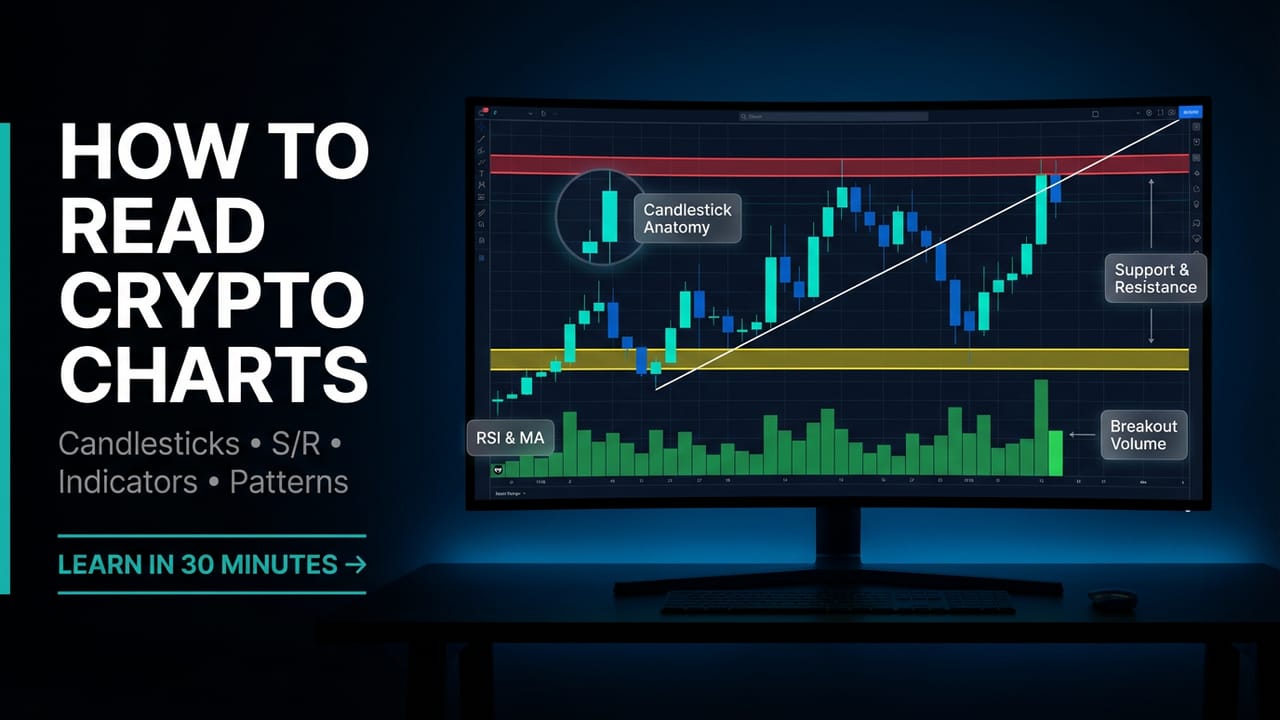
How to Read Crypto Charts: A Beginner’s Step-by-Step Guide (2026)
Master crypto chart reading with our comprehensive guide. Learn candlesticks, support/resistance, indicators, and patterns for profitable trading.
30 Minutes
Learn Basic Chart Reading
5 Candlestick Patterns
Essential for Beginners
3 Key Indicators
Start Trading Confidently
Free Tools
TradingView & Exchange Charts
- Understanding Crypto Chart Basics
- Types of Crypto Charts
- Reading Candlestick Patterns
- Choosing the Right Timeframes
- Support and Resistance Levels
- Drawing Trend Lines Correctly
- Understanding Volume Analysis
- Essential Technical Indicators
- Common Chart Patterns
- Best Platforms for Chart Analysis
- Practising Chart Reading
- Common Mistakes to Avoid
- Frequently Asked Questions
Learning how to read crypto charts represents the foundation of successful cryptocurrency trading. Price charts visualise historical and real-time market data through candlesticks, lines, and technical indicators. A Bitcoin chart displaying price movements from £38,000 to £42,000 over 24 hours reveals market sentiment, buying pressure, and potential reversal points. Traders interpreting these signals identify optimal entry and exit positions, managing risk whilst maximising profit potential.
Cryptocurrency markets operate 24/7 across global exchanges, generating continuous price data. This creates unique chart patterns differing from traditional stock markets. Bitcoin’s volatility produces 50-100% annual price swings compared to 15-25% for major stock indices. Understanding crypto chart dynamics enables traders to navigate volatility, recognising bullish trends during accumulation phases and bearish signals preceding corrections.
This comprehensive guide covers chart fundamentals from basic candlestick interpretation through advanced pattern recognition. Beginners learn essential concepts including support/resistance identification, trend line construction, and volume analysis. The step-by-step methodology transforms chart reading from overwhelming data visualisation into systematic decision-making framework. Charts become actionable intelligence rather than confusing lines and colours.
Professional traders combine multiple analytical approaches – price action analysis, technical indicators, and pattern recognition – creating comprehensive market perspectives. A rising trend line confirming RSI momentum signals plus increasing volume validates bullish continuation. Conversely, bearish divergence between price highs and indicator weakness warns of potential reversals. Mastering chart reading requires understanding these interconnections, not memorising isolated patterns.
Understanding Crypto Chart Basics
Crypto charts plot price movements over time using vertical (price) and horizontal (time) axes. The vertical axis displays price levels in pounds, dollars, or other currencies. The horizontal axis represents time periods – minutes, hours, days, or weeks depending on selected timeframes. This two-dimensional representation transforms numerical price data into visual patterns recognising trends, reversals, and consolidation phases.
Chart Components Explained
- ✓ Price Axis (Y-Axis): Vertical scale showing cryptocurrency price levels
- ✓ Time Axis (X-Axis): Horizontal timeline displaying dates/hours
- ✓ Candlesticks/Bars: Visual representations of price action within timeframes
- ✓ Volume Bars: Trading activity levels shown at chart bottom
- ✓ Indicators: Mathematical calculations overlaying price data
- ✓ Drawing Tools: Trend lines, support/resistance markers, annotations
Price Scale Types
Linear Scale: Price axis uses equal spacing between values. A £1,000 move from £40,000 to £41,000 occupies same vertical distance as £50,000 to £51,000. Linear scales work well for short-term analysis and range-bound markets. Beginners typically start with linear scaling due to intuitive interpretation.
Logarithmic Scale: Price axis uses percentage-based spacing. A 10% move from £10,000 (£1,000 gain) displays identically to 10% move from £40,000 (£4,000 gain). Logarithmic scales prove superior for long-term analysis and volatile assets. Bitcoin charts spanning multiple years require logarithmic scaling preventing early price movements from compressing into unreadable baselines.
Reading the Chart Grid
Most charting platforms overlay grids helping identify price levels and time periods. Horizontal grid lines mark significant price points (£40,000, £41,000, £42,000). Vertical lines separate time periods (days, weeks, months). This grid structure enables quick visual assessment – Bitcoin trading above £40,000 grid line signals bullish momentum, whilst consolidation between £39,000-£40,000 indicates indecision.
Types of Crypto Charts
Three primary chart types visualise cryptocurrency price data: line charts, bar charts, and candlestick charts. Each offers distinct advantages depending on analysis objectives and trader experience levels. Understanding chart type differences optimises information extraction and pattern recognition capabilities.
Line Charts
Line charts connect closing prices across selected timeframes with continuous lines. A Bitcoin 24-hour line chart plots closing prices for each hour, connecting these points creating smooth curves. Line charts provide clearest visualisation of overall price trends, removing intraday volatility noise. Ideal for beginners learning basic trend identification and long-term investors tracking multi-year performance.
Line Chart Advantages
- ✓ Simplest interpretation – clear trend direction
- ✓ Removes short-term price fluctuation noise
- ✓ Perfect for identifying major support/resistance levels
- ✓ Best for multi-month or multi-year analysis
Line Chart Limitations
- ✗ Hides intraday price volatility information
- ✗ Cannot display opening, high, and low prices
- ✗ Misses important reversal patterns forming intraday
Bar Charts (OHLC Charts)
Bar charts display four price points per period: Open, High, Low, Close (OHLC). Each vertical bar represents one timeframe with top marking period high, bottom marking low. Small horizontal ticks extend left (opening price) and right (closing price). Bar charts reveal price action details invisible on line charts whilst maintaining cleaner presentation than candlesticks.
Reading Bar Charts: Green/hollow bars indicate closing prices above opening prices (bullish periods). Red/filled bars show closing prices below opening prices (bearish periods). Tall bars represent high volatility; short bars indicate consolidation. Experienced traders prefer bars over candlesticks for futures and forex markets, though cryptocurrency traders overwhelmingly favour candlestick charts.
Candlestick Charts
Candlestick charts dominate cryptocurrency trading, offering superior visual pattern recognition. Each candlestick displays identical OHLC data as bar charts but uses coloured rectangular “bodies” with thin “wicks” (shadows). Bodies span opening to closing prices. Wicks extend from bodies to period highs/lows. Green/white candles show bullish closes above opens; red/black candles indicate bearish closes below opens.
Candlestick Anatomy
Body: Rectangle spanning open to close prices
Upper Wick: Line from body top to period high
Lower Wick: Line from body bottom to period low
Colour: Green (bullish) / Red (bearish)
Why Candlesticks Dominate Crypto
Pattern Recognition: Dozens of named patterns (doji, hammer, engulfing)
Visual Clarity: Instant sentiment identification through colours
Momentum Signals: Body size indicates buying/selling pressure
Reversal Detection: Wick lengths warn of rejection and exhaustion
Beginners: Start with line charts learning trend identification, progress to candlesticks after mastering basics
Day Traders: Use candlestick charts exclusively for pattern recognition and precise entries
Long-Term Investors: Combine line charts (big picture) with weekly candlesticks (entry timing)
Professional Traders: Multi-monitor setups displaying candlesticks across multiple timeframes simultaneously
Reading Candlestick Patterns
Candlestick patterns reveal market psychology through visual formations. Single candlestick shapes signal sentiment shifts whilst multi-candle patterns predict reversals or continuations. Mastering candlestick interpretation dramatically improves entry/exit timing and risk management capabilities.
Single Candlestick Patterns
Doji Candlestick
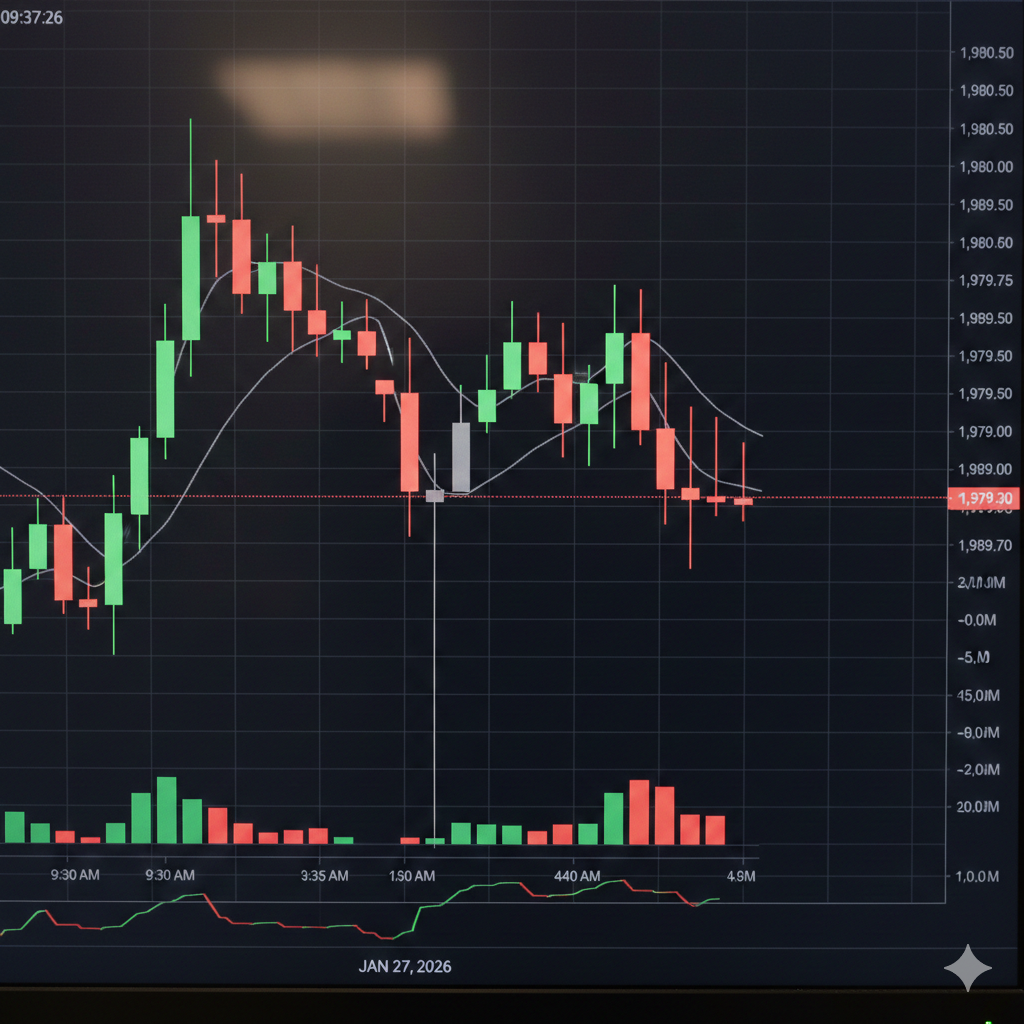
Formation: Opening and closing prices nearly identical, creating small or no body with long wicks both directions.
Signal: Market indecision – bulls and bears equally matched. Potential trend reversal when appearing after strong moves. Requires confirmation from next candle direction.
Trading Application: Wait for next candle to break doji high (bullish) or low (bearish) before entering positions. Bitcoin forming doji after £5,000 rally suggests exhaustion, consider taking profits.
Hammer & Hanging Man
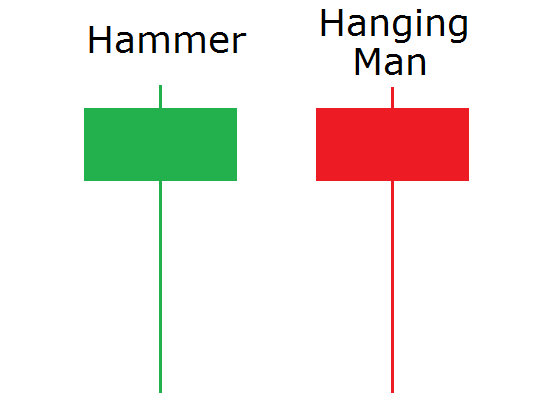
Formation: Small body at upper range with long lower wick (2-3x body length). Minimal or no upper wick. Colour matters – green hammer bullish, red hanging man bearish.
Signal: Hammer at downtrend bottom signals bullish reversal – sellers pushed price lower but buyers recovered. Hanging man at uptrend top warns of bearish reversal – buyers losing control.
Trading Application: Buy when hammer forms near support with confirmation candle. Sell when hanging man appears at resistance followed by bearish candle. Volume increase validates signals.
Shooting Star & Inverted Hammer
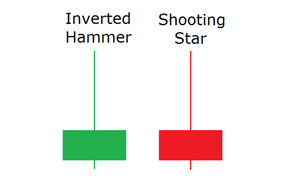
Formation: Small body at lower range with long upper wick. Minimal lower wick. Mirror image of hammer patterns.
Signal: Shooting star at uptrend peaks indicates rejection of higher prices – bearish reversal warning. Inverted hammer at downtrend bottoms suggests potential bullish reversal.
Trading Application: Shooting stars at resistance levels offer short entry opportunities. Inverted hammers require next-day confirmation before buying. Both patterns gain significance with increased volume.
Marubozu Candlestick
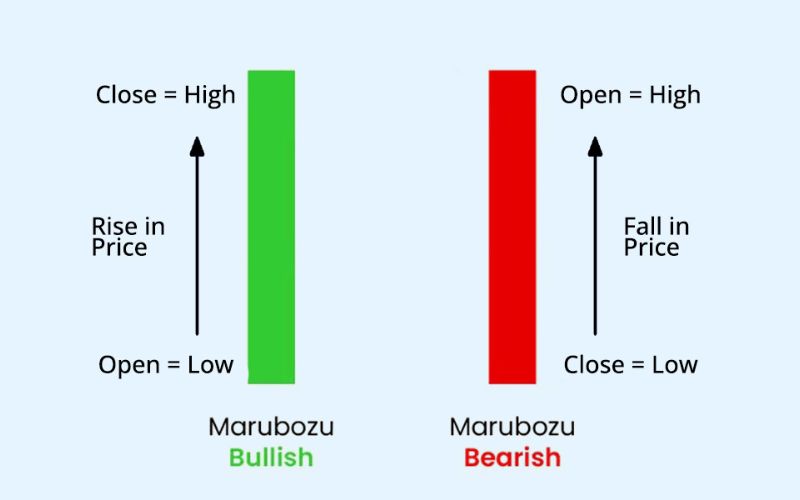
Formation: Large body with minimal or no wicks. Opens at low and closes at high (bullish) or opens at high and closes at low (bearish).
Signal: Extreme bullish or bearish sentiment. Bulls/bears dominated entire period without opposition. Strong continuation signals during established trends.
Trading Application: Bullish marubozu breaking resistance confirms uptrend continuation – enter long. Bearish marubozu breaking support validates downtrend – enter short or exit longs immediately.
Spinning Top
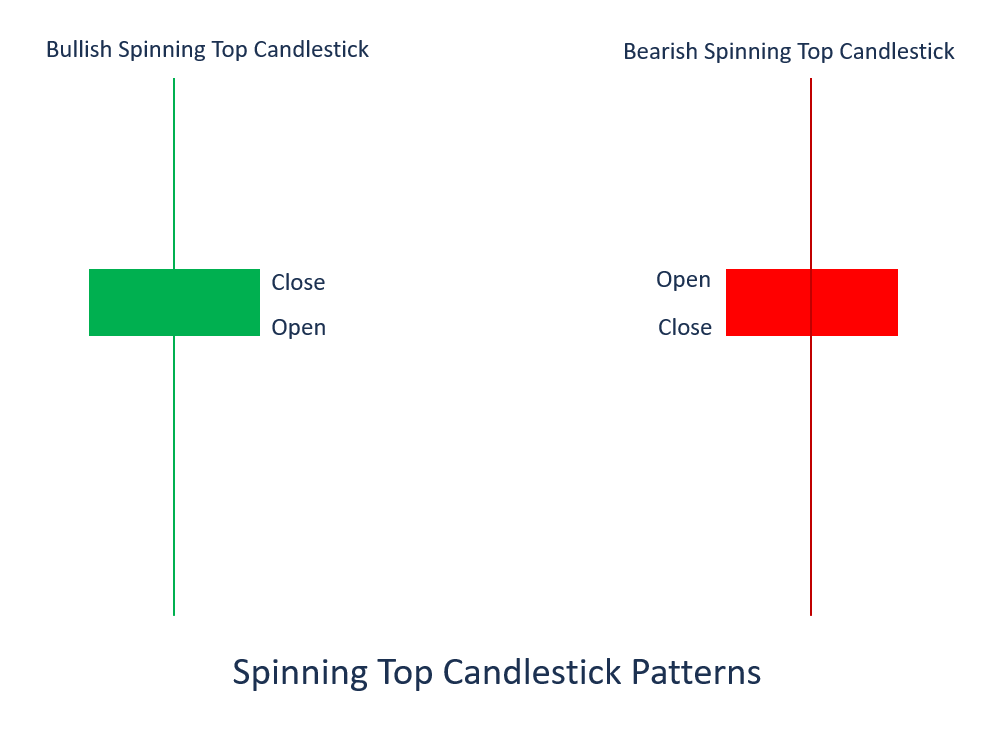
Formation: Small body (green or red) with long wicks both directions. Similar to doji but has visible body.
Signal: Market indecision with neither bulls nor bears controlling. Often appears during consolidation phases or trend exhaustion. Less significant than doji.
Trading Application: Avoid trading during spinning top formations – wait for directional clarity. Multiple consecutive spinning tops suggest impending breakout. Trade breakout direction with volume confirmation.
Multi-Candlestick Patterns
Bullish Engulfing Pattern
Formation: Two candles – small red candle followed by larger green candle completely engulfing previous candle’s body.
Signal: Powerful bullish reversal pattern. Bears controlled first period but bulls overwhelmed sellers, pushing prices above previous open. Signals potential trend change from down to up.
Trading Strategy: Buy when bullish engulfing appears at support levels or downtrend bottoms. Set stop-loss below pattern low. Target resistance levels or previous swing highs. Pattern strengthens with volume increase on green candle.
Bearish Engulfing Pattern
Formation: Small green candle followed by larger red candle engulfing previous body completely.
Signal: Strong bearish reversal. Bulls exhausted, bears seized control pushing prices below previous open. Warns of downtrend beginning.
Trading Strategy: Sell or exit longs when pattern forms at resistance or uptrend peaks. Place stop-loss above pattern high. Targets support levels or previous swing lows. Confirm with increased volume on red candle.
Context Matters: Patterns gain significance at support/resistance levels, not random price points. Hammer at strong support powerful; hammer mid-trend less reliable.
Confirmation Required: Never trade single candlestick patterns alone. Wait for next candle confirming direction. False signals common without confirmation.
Volume Validation: Patterns with increasing volume significantly more reliable. Reversal patterns on low volume frequently fail.
Timeframe Consideration: Daily and weekly patterns stronger than hourly. Multiple timeframes showing same pattern increase probability.
Choosing the Right Timeframes
Chart timeframes determine candlestick duration – each candle represents specified time period from 1 minute to 1 month. Timeframe selection dramatically impacts signal reliability, trade duration, and strategy suitability. Professional traders analyse multiple timeframes simultaneously, ensuring short-term trades align with long-term trends.
Timeframe Categories
Short-Term Timeframes
Duration: 1-minute to 15-minute candles
Best For: Day trading, scalping, quick profits
Advantages: Maximum trading opportunities, quick feedback, small stop-losses
Disadvantages: High noise ratio, false signals frequent, stressful monitoring required
Recommended: Experienced traders only with strict discipline
Medium-Term Timeframes
Duration: 1-hour to 4-hour candles
Best For: Swing trading, multi-day positions
Advantages: Clearer trends, fewer false signals, manageable monitoring
Disadvantages: Slower trade execution, overnight risk exposure
Recommended: Intermediate traders balancing work/trading
Long-Term Timeframes
Duration: Daily to weekly candles
Best For: Position trading, long-term investing
Advantages: Strongest signals, minimal monitoring, clear major trends
Disadvantages: Fewer opportunities, larger stop-losses required, patience needed
Recommended: Beginners and investors seeking quality over quantity
Multiple Timeframe Analysis
Professional methodology examines three timeframes simultaneously: long-term (trend), medium-term (entry), short-term (precision). This layered approach ensures trades align with dominant trends whilst optimising entry timing. A trader might use weekly charts identifying uptrends, daily charts spotting pullback entries, and 4-hour charts timing exact entry points.
Higher Timeframe (Trend Identification)
Start analysis on weekly or daily charts determining overall market direction. Bitcoin showing higher highs and higher lows on weekly charts confirms bull market regardless of short-term corrections. Only take long positions when higher timeframe trends bullish; only short when bearish. This single rule dramatically improves win rates.
Medium Timeframe (Pattern Recognition)
Drop to 4-hour or daily charts identifying specific patterns and support/resistance levels. Locate pullbacks to support during uptrends or rallies to resistance during downtrends. These become potential entry zones. Wait for reversal patterns (hammer, engulfing) confirming continuation of higher timeframe trend.
Lower Timeframe (Entry Timing)
Switch to 15-minute or 1-hour charts pinpointing exact entries. After identifying long opportunity on daily chart, monitor hourly chart for bullish engulfing pattern or hammer confirmation. Enter when lower timeframe confirms higher timeframe bias. Set stop-loss based on lower timeframe structure.
Scalpers (Minutes-Hours): 1-min, 5-min, 15-min charts | 10-50+ trades daily | Requires full-time monitoring
Day Traders (Hours-Days): 15-min, 1-hour, 4-hour charts | 2-10 trades daily | Close all positions daily
Swing Traders (Days-Weeks): 4-hour, daily charts | 3-10 trades monthly | Check charts 2-3 times daily
Position Traders (Weeks-Months): Daily, weekly charts | 1-5 trades monthly | Weekly chart reviews sufficient
Long-Term Investors (Months-Years): Weekly, monthly charts | 1-4 trades yearly | Monthly analysis adequate
Support and Resistance Levels
Support and resistance represent horizontal price levels where buying or selling pressure concentrates, preventing further price movements. Support levels attract buyers halting declines. Resistance levels draw sellers preventing rallies. Identifying these zones provides high-probability entry points and profit targets essential for systematic trading.
Understanding Support Levels
Support forms where buying demand exceeds selling pressure, creating price floors. When Bitcoin declines to £38,000 three times without breaking lower, £38,000 becomes identified support. Each test strengthens the level – more bounces indicate stronger support. Traders buy near support anticipating bounces, placing stop-losses slightly below to limit losses if support breaks.
Support Level Characteristics
- ✓ Previous Lows: Historical price bottoms where reversals occurred
- ✓ Multiple Tests: Price touches level 2-3+ times without breaking
- ✓ Volume Spikes: Increased buying activity at level confirms strength
- ✓ Round Numbers: Psychological levels (£40,000, £50,000) attract orders
- ✓ Moving Averages: 50-day, 200-day MAs frequently act as dynamic support
Understanding Resistance Levels
Resistance exists where selling pressure overwhelms buying demand, creating price ceilings. Bitcoin reaching £45,000 four times without breaking higher establishes £45,000 as resistance. Sellers accumulate positions near resistance expecting reversals. Breakouts above strong resistance on high volume signal powerful bullish momentum, converting old resistance into new support.
Resistance Level Characteristics
- ✓ Previous Highs: Historical price peaks where selling initiated
- ✓ Failed Breakouts: Multiple attempts to break higher failed at level
- ✓ Volume Analysis: High volume rejections confirm strong resistance
- ✓ Psychological Barriers: All-time highs, major round numbers (£100,000)
- ✓ Fibonacci Levels: 61.8%, 50%, 38.2% retracement zones
Support/Resistance Role Reversal
Broken support becomes resistance; broken resistance becomes support. Bitcoin breaking below £40,000 support converts this level to resistance on subsequent rallies. Conversely, breaking above £45,000 resistance transforms this ceiling into support floor. Role reversal provides excellent entry opportunities – buy pullbacks to broken resistance (now support) during uptrends.
Identifying Support/Resistance Zones
Rather than exact prices, professionals identify zones spanning 2-5% ranges. Bitcoin support exists at £39,000-£40,000 zone, not precisely £39,500. Zones account for market noise and psychological barriers. Trading zones provides flexibility – buy anywhere within £39,000-£40,000 support zone rather than waiting for exact £39,500 touch that may never occur.
Drawing Trend Lines Correctly
Trend lines connect series of price points revealing directional momentum. Uptrend lines connect ascending lows; downtrend lines connect descending highs. Properly drawn trend lines identify trend strength, potential reversal points, and breakout opportunities. Mastering trend line construction separates profitable trend traders from those constantly fighting market direction.
Uptrend Lines
Uptrend lines connect minimum two swing lows during rising price movements. More touches validate strength – three touches confirm established uptrend. Draw line from first significant low to second low, extending forward. Price bouncing off this line multiple times confirms uptrend continuation. Breaking below uptrend line warns of potential reversal or consolidation.
Identify Swing Lows
Locate minimum two higher lows on chart. Bitcoin bouncing from £35,000 then £37,000 then £39,000 creates three swing lows. Each low must be higher than previous for valid uptrend. More swing lows strengthen trend line reliability.
Connect the Lows
Draw straight line connecting identified swing lows. Use charting platform’s trend line tool. Ensure line touches wicks or bodies depending on preference (wicks more conservative, bodies more aggressive). Extend line forward projecting future support levels.
Validate and Adjust
Monitor price action relative to trend line. Each successful bounce strengthens validity. Adjust angle slightly if new lows forming slightly above/below original line. Two failed touches within short period suggests trend weakening – redraw or abandon line.
Downtrend Lines
Downtrend lines connect descending swing highs during falling prices. Minimum two lower highs required; three confirmations establish strong downtrend. Draw from first significant high to second high, extending forward. Price rejection at this resistance line confirms bearish momentum continuation. Breaking above downtrend line signals potential reversal to upside.
Trend Line Angle Significance
Steep Angles (60-80°): Unsustainable momentum, expect correction or consolidation soon. Too aggressive for reliable support/resistance.
Moderate Angles (30-50°): Healthy sustainable trends. Most reliable for trading. Provides clear support/resistance with room for continuation.
Shallow Angles (<30°): Weak trends, possible consolidation forming. Less reliable for trading signals. Often precedes range-bound markets.
Trend Line Trading Strategies
Forcing Connections: Don’t force trend lines through random points. Only connect clear swing highs/lows with multiple touches.
Changing Angles: Avoid constantly redrawing lines to fit price action. If trend line breaks, acknowledge potential reversal rather than adjusting to maintain bias.
Ignoring Timeframes: Trend lines on daily charts stronger than 15-minute charts. Match trend line significance to trading timeframe.
Over-Reliance: Trend lines are guidelines, not guaranteed support/resistance. Always confirm with additional indicators and price action patterns.
Understanding Volume Analysis
Volume measures total cryptocurrency traded during specified periods, displayed as vertical bars beneath price charts. High volume confirms price movement strength; low volume suggests weak momentum vulnerable to reversals. Volume analysis validates trends, identifies accumulation/distribution phases, and warns of potential reversals before price confirms.
Volume Basics
Volume bars display trading activity levels. Taller bars indicate higher participation; shorter bars show reduced interest. Green volume bars typically accompany price increases; red bars correlate with declines (colour coding varies by platform). Comparing current volume to average volume (moving average) determines relative strength – volume 2x average signals significant market interest.
Key Volume Principles
- ✓ Trend Confirmation: Rising prices with increasing volume confirm uptrend strength
- ✓ Trend Weakness: Rising prices with decreasing volume warn of exhaustion
- ✓ Breakout Validation: High volume breakouts more reliable than low volume
- ✓ Reversal Signals: Volume spikes at trend extremes suggest potential reversals
- ✓ Support/Resistance: Volume surges at key levels confirm their importance
Volume Patterns
Accumulation Phase
Characteristics: Price consolidates horizontally whilst volume gradually increases. Smart money accumulating positions before breakout.
Signal: Bullish – expect upward breakout when accumulation completes. Volume expansion during consolidation indicates preparation for rally.
Trading Strategy: Buy during consolidation before breakout. Volume breakout above range confirms accumulation success. Target measured move equal to range height.
Distribution Phase
Characteristics: Price consolidates after rally whilst volume remains elevated. Insiders selling to late buyers at tops.
Signal: Bearish – expect downward breakdown when distribution completes. High volume near highs without progress warns of selling pressure.
Trading Strategy: Exit longs during distribution. Short when price breaks below range on high volume. Target equal to range height downward.
Volume Divergence
Bullish Divergence: Price makes lower lows whilst volume decreases. Selling pressure diminishing despite falling prices. Signals potential upside reversal. Occurs at downtrend bottoms – buyers stepping in whilst sellers exhausted. Combine with oversold RSI for strongest signals.
Bearish Divergence: Price makes higher highs whilst volume declines. Buying enthusiasm waning despite rising prices. Warns of impending downside reversal. Common at uptrend tops – fewer buyers chasing increasingly expensive assets. Reduce positions or tighten stop-losses when detected.
Essential Technical Indicators
Technical indicators apply mathematical calculations to price and volume data, generating signals identifying trends, momentum, and reversal points. This section covers three essential indicators beginners should master before exploring advanced tools. Each indicator serves distinct purposes – trend identification, momentum measurement, or volatility assessment.
Moving Averages (MA)
Moving averages smooth price data creating trend-following indicators. Simple Moving Average (SMA) calculates average closing prices over specified periods. 50-day SMA sums 50 recent closing prices dividing by 50. Price above MA signals uptrends; below indicates downtrends. MAs also provide dynamic support/resistance levels.
Popular Moving Average Periods
20-Day MA: Short-term trend, day trading, quick signals but prone to whipsaws
50-Day MA: Medium-term trend, swing trading, balanced signal quality and frequency
200-Day MA: Long-term trend, position trading, strongest signals but slower reaction
EMA (Exponential MA): Weights recent prices heavier, responds faster than SMA
Golden Cross (Bullish Signal)
Formation: 50-day MA crosses above 200-day MA. Indicates long-term uptrend beginning.
Trading Application: Buy when golden cross forms. Hold positions until death cross appears. Bitcoin’s 2020 golden cross preceded 400%+ rally to £50,000.
Death Cross (Bearish Signal)
Formation: 50-day MA crosses below 200-day MA. Signals long-term downtrend starting.
Trading Application: Exit longs when death cross forms. Avoid new long positions until golden cross appears. Protect capital during bear markets.
Relative Strength Index (RSI)
RSI measures momentum on 0-100 scale. Readings above 70 indicate overbought conditions (potential reversal down); below 30 signal oversold (potential reversal up). RSI identifies divergences between price and momentum, warning of reversals before price confirms. Default 14-period setting suits most timeframes.
RSI Trading Signals
Overbought (>70): Consider taking profits or tightening stops. Not immediate sell signal – strong trends remain overbought extended periods.
Oversold (<30): Potential buying opportunity approaching. Wait for RSI rising back above 30 before entering. Downtrends stay oversold extensively.
Midline (50): Bullish momentum above 50, bearish below 50. Crossovers generate trend-following signals.
RSI Divergence
Bullish Divergence: Price lower lows whilst RSI higher lows. Momentum improving despite falling prices. Buy signal.
Bearish Divergence: Price higher highs whilst RSI lower highs. Momentum weakening despite rising prices. Sell signal.
Hidden Divergence: Trend continuation signals. Bullish: higher lows price, lower lows RSI during uptrends.
Moving Average Convergence Divergence (MACD)
MACD tracks relationship between two exponential moving averages (12-period and 26-period). MACD line crossing above signal line (9-period EMA of MACD) generates buy signals. Crossing below creates sell signals. Histogram displays difference between MACD and signal lines – expanding histogram confirms momentum; contracting warns of weakening.
Trend + Momentum: Use 50-day MA determining trend direction, RSI timing entries during pullbacks. Buy when RSI oversold during uptrend above 50-MA.
Confirmation Strategy: Require minimum two indicators agreeing before trading. MACD bullish cross plus RSI rising above 50 stronger than either alone.
Avoid Overload: Maximum 3-4 indicators per chart. Too many creates conflicting signals and analysis paralysis. Master few indicators deeply rather than many superficially.
Common Chart Patterns
Chart patterns form recognisable shapes predicting future price movements with measurable accuracy. Patterns categorise as continuation (trend resumes) or reversal (trend changes). Professional traders identify patterns early, entering positions before breakouts occur, maximising reward whilst minimising risk through precise stop-loss placement.
Continuation Patterns
Bull Flag Pattern
Formation: Strong rally (flagpole) followed by slight downward consolidation (flag). Flag slopes against previous trend, forming parallel channels.
Signal: Bullish continuation – uptrend pauses before resuming. Breakout above flag confirms continuation.
Trading Strategy: Buy when price breaks above flag resistance on volume. Measure flagpole height, add to breakout point for profit target. Stop-loss below flag support.
Example: Bitcoin rallies £5,000 in two days, consolidates £500-£1,000 downward for week forming flag. Breakout targets additional £5,000 gain (flagpole height).
Bear Flag Pattern
Formation: Sharp decline (flagpole) followed by slight upward consolidation (flag). Flag slopes against downtrend.
Signal: Bearish continuation – downtrend pauses before resuming lower.
Trading Strategy: Short when price breaks below flag support on volume. Target equals flagpole height subtracted from breakdown point. Stop-loss above flag resistance.
Ascending Triangle
Formation: Horizontal resistance line with rising support line creating triangle. Price makes higher lows whilst failing at resistance.
Signal: Bullish continuation (usually) – buyers increasingly aggressive, eventually overcoming resistance.
Trading Strategy: Buy when price breaks above horizontal resistance. Volume expansion confirms breakout validity. Target equals triangle height added to resistance level.
Descending Triangle
Formation: Horizontal support line with descending resistance creating triangle. Price makes lower highs whilst bouncing at support.
Signal: Bearish continuation – sellers growing stronger, eventually breaking support.
Trading Strategy: Short when price breaks below horizontal support on increased volume. Target equals triangle height subtracted from support.
Reversal Patterns
Head and Shoulders (Bearish Reversal)
Formation: Three peaks – left shoulder, higher head, right shoulder at similar height to left. Neckline connects lows between peaks.
Signal: Uptrend reversal – buyers exhausted after making final high (head). Right shoulder fails matching head, confirming weakness.
Trading Strategy: Sell when price breaks below neckline on volume. Measure head to neckline distance, subtract from neckline for target. Stop-loss above right shoulder.
Reliability: One of most reliable reversal patterns, especially on daily/weekly timeframes with volume confirmation.
Inverse Head and Shoulders (Bullish Reversal)
Formation: Three troughs – left shoulder, lower head, right shoulder similar to left. Neckline connects highs between troughs.
Signal: Downtrend reversal – sellers exhausted, buyers strengthening.
Trading Strategy: Buy when price breaks above neckline. Add head-to-neckline distance to neckline for profit target. Stop-loss below right shoulder.
Double Top (Bearish)
Formation: Two peaks at similar height separated by trough. Second peak fails breaking first peak high.
Trading: Sell when price breaks below trough (neckline). Target equals peaks-to-trough distance.
Double Bottom (Bullish)
Formation: Two troughs at similar depth separated by peak. Second bottom holds first bottom low.
Trading: Buy when price breaks above peak. Target equals trough-to-peak distance.
Wait for Completion: Don’t anticipate patterns – wait for confirmed breakouts. Premature entries frequently stopped out.
Volume Matters: Breakouts without volume expansion (2x average) unreliable. Low-volume breaks often fail.
Measure Targets: Use pattern geometry calculating profit targets. Provides objective exit points rather than emotional decisions.
Invalidation Levels: Know pattern invalidation points. Head and shoulders invalid if right shoulder exceeds head height.
Best Platforms for Chart Analysis
Chart analysis quality depends heavily on platform capabilities. Leading platforms offer advanced tools including multiple timeframes, extensive indicators, drawing tools, and customisable layouts. This section compares top charting platforms for cryptocurrency traders from beginners to professionals.
TradingView
Industry-leading charting platform with advanced tools and social features
Key Features
- ✓ 100+ technical indicators and drawing tools
- ✓ Multi-timeframe analysis (1-min to monthly)
- ✓ Unlimited chart layouts and saved templates
- ✓ Real-time data from major crypto exchanges
- ✓ Community ideas and educational content
- ✓ Mobile app with full functionality
- ✓ Free tier available (limited indicators)
Pricing
Free: 3 indicators per chart | Pro: £12.95/month | Pro+: £24.95/month
Serious traders wanting professional-grade analysis tools
Binance Advanced Charts
Integrated exchange charts with TradingView integration
Key Features
- ✓ Built-in TradingView charts on platform
- ✓ One-click trading from charts
- ✓ 600+ cryptocurrency pairs
- ✓ Real-time order book integration
- ✓ Drawing tools and 50+ indicators
- ✓ Free with Binance account
Advantages
Seamless chart-to-trade workflow, no separate platform needed, instant execution
Beginners wanting simple chart analysis with direct trading
Coinigy
Multi-exchange charting platform with unified interface
Key Features
- ✓ 45+ exchange integrations in one platform
- ✓ Advanced technical analysis tools
- ✓ Portfolio tracking across exchanges
- ✓ Price alerts and notifications
- ✓ API access for automated trading
Pricing
Premium: $18.66/month | Pro: $99.99/month
Multi-exchange traders managing diverse portfolios
Platform Comparison
Practising Chart Reading
Chart reading mastery requires deliberate practice beyond passive observation. Systematic training methodology accelerates skill development whilst avoiding costly mistakes during learning phases. This structured approach transforms beginners into competent chart analysts within 2-3 months dedicated study.
Paper Trading (Weeks 1-4)
Open free TradingView account. Analyse Bitcoin, Ethereum daily charts identifying support/resistance levels, trend lines, candlestick patterns. Record predicted moves in trading journal. After 24 hours, review outcomes comparing predictions to actual results. Focus on pattern recognition accuracy before risking capital.
Goals: 60%+ directional accuracy, identify 10+ patterns weekly, maintain detailed journal documenting reasoning and outcomes.
Demo Account Trading (Weeks 5-8)
Open Binance or exchange demo account with virtual funds. Execute trades based on chart analysis. Practise position sizing (2-5% per trade), stop-loss placement (below support/above resistance), profit targets (previous resistance/support). Track win rate, average profit/loss, maximum drawdown.
Goals: Positive expectancy (average winner > average loser), 50%+ win rate, maximum 20% drawdown on demo account.
Backtesting Strategies (Weeks 9-12)
Use TradingView replay function analysing historical charts. Test trading strategies across 50-100 setups. Document entry signals, stop-losses, targets, and outcomes. Calculate strategy win rate, profit factor (total wins ÷ total losses), expectancy (average trade result). Refine approaches based on data.
Goals: Identify 2-3 high-probability setups with 2:1+ reward-risk ratios, 55%+ win rates validated across 100+ trades.
Live Micro Trading (Weeks 13-16)
Start live trading with minimum position sizes (£10-£50 per trade). Apply learned patterns, support/resistance trading, indicator signals. Focus on process execution over profits. Maintain strict risk management – maximum 2% account risk per trade, stop-losses mandatory every position.
Goals: Execute 30+ trades following rules consistently, achieve break-even or small profits, build psychological resilience handling real money.
Progressive Scaling (Month 5+)
Gradually increase position sizes as confidence and competence grow. Every 20 profitable trades, increase position size 25-50%. Maintain consistent risk percentage (2-5% account) regardless of position size changes. Continue journal documentation tracking performance metrics monthly.
Goals: Achieve consistent profitability (3+ consecutive profitable months), scale to full-size positions whilst maintaining discipline.
- ✓ TradingView Replay: Replay historical price action for backtesting strategies
- ✓ BabyPips School: Free forex education applicable to crypto (technical analysis concepts)
- ✓ Investopedia Academy: Technical analysis courses with certificates
- ✓ YouTube Channels: The Chart Guys, Benjamin Cowen for daily chart analysis examples
- ✓ Discord Communities: Join trading groups for peer review and pattern discussions
Common Mistakes to Avoid
Beginner chart readers repeatedly commit predictable errors undermining trading performance. Recognising these pitfalls enables proactive avoidance, accelerating progression from novice to competent analyst.
Frequently Asked Questions
How long does it take to learn to read crypto charts?
Basic chart reading competency develops within 4-8 weeks dedicated study (10-15 hours weekly). Understanding candlesticks, support/resistance, and trend lines requires 30-40 hours practise. Advanced pattern recognition and multi-indicator analysis needs 3-6 months consistent application. Professional-level expertise demands 1-2 years active trading experience. Accelerate learning through paper trading, backtesting, and maintaining detailed journals documenting patterns and outcomes.
What is the best timeframe for reading crypto charts?
Optimal timeframes depend on trading style. Day traders focus 15-minute to 4-hour charts executing 2-10 trades daily. Swing traders analyse 4-hour and daily charts holding positions days to weeks. Long-term investors examine daily and weekly timeframes for multi-month positions. Beginners should start with daily charts learning basics before progressing to shorter timeframes. Always analyse higher timeframes (weekly/daily) before trading lower timeframes ensuring alignment with dominant trends.
Do I need paid software to read crypto charts?
No. TradingView’s free tier provides adequate tools for beginners – basic indicators, drawing tools, multiple timeframes. Most cryptocurrency exchanges (Binance, Coinbase Pro, Kraken) offer free integrated TradingView charts. Paid TradingView subscriptions (£12.95-£24.95 monthly) unlock unlimited indicators, advanced alerts, and multiple chart layouts. Upgrade to paid plans after mastering basics and requiring advanced functionality. Free tools sufficient for 90% of traders.
How accurate are candlestick patterns?
Candlestick pattern accuracy varies significantly by pattern, timeframe, and context. Single candlestick patterns (hammer, doji) achieve 50-60% accuracy requiring confirmation. Multi-candle patterns (engulfing, morning star) reach 60-70% reliability when appearing at support/resistance. Pattern accuracy increases substantially on higher timeframes (daily/weekly versus hourly) and with volume confirmation. Never trade patterns alone – combine with support/resistance, trend direction, and volume analysis improving win rates to 65-75%.
What’s the difference between support and resistance?
Support represents price levels where buying demand prevents further declines, creating floors. Resistance exists where selling pressure halts rallies, forming ceilings. Support forms at previous lows where buyers previously entered; resistance at previous highs where sellers dominated. Broken support becomes resistance; broken resistance becomes support (role reversal). Both identify high-probability trade locations – buy near support, sell near resistance, or trade breakouts when levels breach on high volume.
Should beginners use technical indicators?
Yes, but start with 1-2 essential indicators avoiding overload. Begin with moving averages (50-day and 200-day) identifying trend direction. Add RSI measuring momentum and overbought/oversold conditions after mastering MAs. Introduce MACD for momentum confirmation once comfortable with RSI. Avoid using 5-10 indicators simultaneously – creates conflicting signals and analysis paralysis. Master few indicators deeply rather than many superficially. Price action and support/resistance more important than indicators for beginners.
How do I know if a breakout is real or fake?
Genuine breakouts display three characteristics: (1) Volume 2-3x recent average confirming participation, (2) Strong momentum candle (large body, small wicks) closing beyond level, (3) Retest holding broken level as new support/resistance. False breakouts show low volume, small indecisive candles, and quick reversals back within range. Wait for closing price confirmation rather than entering intraday spikes. Bitcoin breaking resistance at £45,000 requires daily close above £45,000, not brief wick touching £45,100 before reversing.
Can chart reading predict crypto prices accurately?
Chart reading identifies high-probability scenarios, not guaranteed outcomes. Technical analysis provides framework assessing market sentiment, momentum, and potential reversals based on historical patterns. Win rates of 55-65% considered excellent – meaning 35-45% trades still lose despite proper analysis. Charts reveal what traders collectively doing (buying/selling pressure) but cannot predict black swan events, regulatory announcements, or market manipulation. Combine technical analysis with fundamental research and strict risk management. Charts guide decision-making; they don’t predict futures with certainty.
Mastering Crypto Chart Reading
Learning how to read crypto charts transforms price data from confusing visualisations into actionable trading intelligence. This comprehensive guide covered essential concepts from basic candlestick interpretation through advanced pattern recognition and multi-timeframe analysis. Charts reveal market psychology – support and resistance levels showing where buyers and sellers concentrate, trend lines displaying momentum direction, and volume confirming price movement validity.
Successful chart reading requires systematic approach rather than random pattern hunting. Begin with higher timeframe trend identification (daily/weekly charts), progress to medium timeframe entry timing (4-hour charts), and refine execution on lower timeframes (15-minute/1-hour). This layered methodology ensures trades align with dominant trends whilst optimising entry precision. Trading with trend dramatically improves win rates versus countertrend speculation.
Technical indicators enhance chart analysis when applied judiciously. Moving averages identify trends, RSI measures momentum and divergences, MACD confirms directional changes. Limit indicator usage to 2-3 core tools avoiding analysis paralysis. Remember indicators lag price action – they confirm moves rather than predict them. Price action and support/resistance analysis provide foundation; indicators offer confirmation.
Chart reading mastery demands consistent practice spanning months, not days. Paper trade testing patterns and strategies before risking capital. Maintain detailed journals documenting setups, reasoning, and outcomes. Review performance monthly identifying strengths and weaknesses. Continuous improvement through systematic analysis separates profitable traders from perpetual beginners. Start simple, master basics thoroughly, then progressively add complexity as competence grows.
Start Practising Chart Reading Today
Open free charting accounts and begin your journey to profitable crypto trading
Get TradingView Free →
Trade on Binance →
Compare Platforms →
📈 Weekly Chart Analysis Updates
Receive chart patterns, technical analysis tutorials, and trading strategies directly to your inbox
Unsubscribe anytime. We respect your privacy.
