Perpetual Contracts Explained – Complete Trading Guide 2026
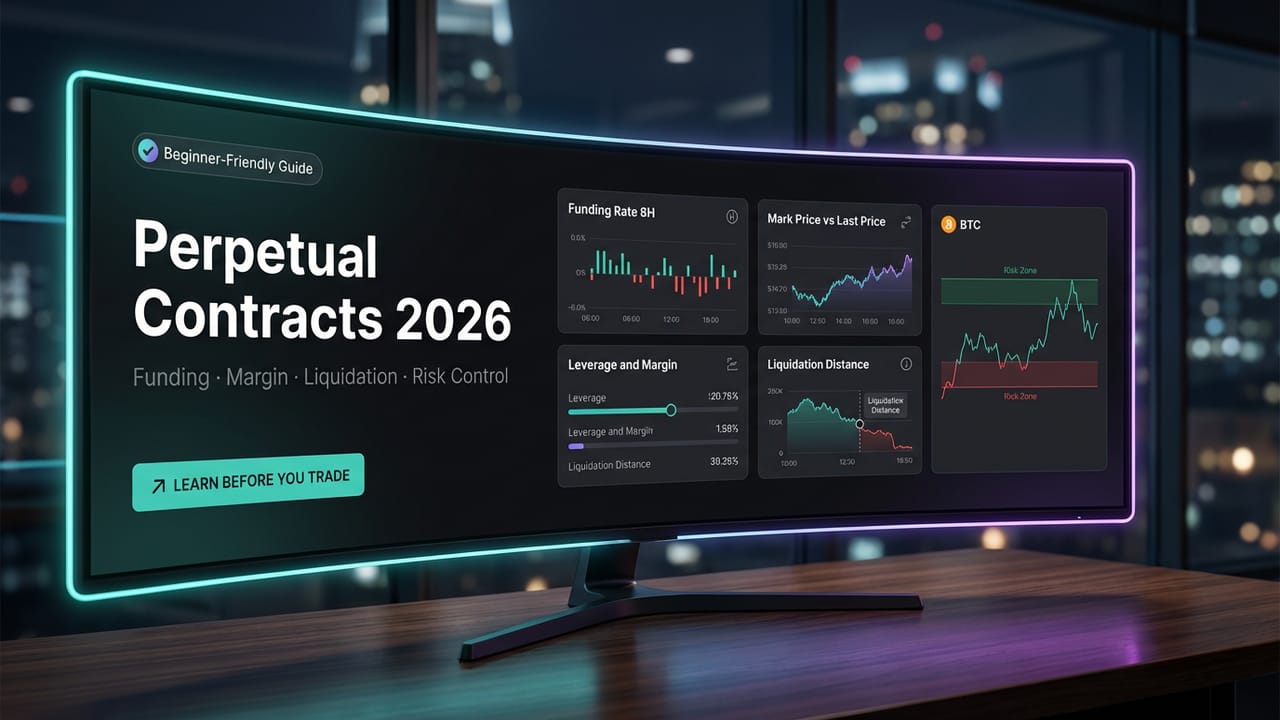
Perpetual Contracts Explained – Complete Trading Guide 2026
Quick Navigation
Perpetual contracts represent derivative instruments allowing traders to speculate on cryptocurrency prices without expiration dates. Unlike traditional futures contracts with fixed settlement dates, perpetual contracts remain open indefinitely until the trader closes the position. This mechanism creates continuous price exposure similar to spot trading but with leverage capabilities.
BitMEX introduced the first Bitcoin perpetual contract in 2016, revolutionising cryptocurrency derivatives trading. The innovation addressed the limitation of traditional futures requiring contract rollovers every month or quarter. As of January 2026, perpetual contracts account for 65% of total cryptocurrency derivatives volume, surpassing £180 billion ($225 billion) in daily trading across major exchanges.
The perpetual contract mechanism employs a funding rate system to anchor contract prices to underlying spot markets. Every eight hours, traders holding positions pay or receive funding based on the difference between perpetual contract prices and spot prices. This funding mechanism prevents perpetual prices from diverging significantly from spot markets.
Three primary components define perpetual contracts: leverage multipliers (1x-125x), margin requirements (initial and maintenance), and funding rate payments. Major platforms including Binance, Bybit, OKX, and Bitget offer perpetual trading with varying fee structures, leverage limits, and risk management tools.
What Are Perpetual Contracts?
Perpetual contracts function as agreements between traders and exchanges to buy or sell cryptocurrency at leveraged positions without expiration constraints. The contract tracks underlying asset prices through continuous settlement mechanisms rather than fixed delivery dates. This structure eliminates the complexity of rolling positions between contract periods.
A perpetual contract operates as a synthetic spot position with embedded leverage. Traders deposit collateral (margin) and control larger position sizes through leverage multipliers. For example, a £1,000 margin with 10x leverage creates a £10,000 position. The exchange holds the margin as security while the trader captures price movements on the full position size.
Core Perpetual Contract Characteristics
| Expiration: | No fixed settlement date |
| Leverage Range: | 1x – 125x (platform dependent) |
| Funding Interval: | Every 8 hours (00:00, 08:00, 16:00 UTC) |
| Settlement Currency: | USDT, USDC, or cryptocurrency |
| Position Types: | Long (buy) and Short (sell) |
Long and Short Position Mechanics
Long Positions: Opening a long perpetual contract expresses a bullish view, profiting from price increases. A trader opens a long position at £40,000 with £2,000 margin at 10x leverage, controlling £20,000 worth of Bitcoin. If Bitcoin rises to £44,000 (10% increase), the position gains £2,000 (100% return on margin). The trader closes the position, receiving £4,000 total (initial £2,000 margin plus £2,000 profit).
Short Positions: Short perpetual contracts profit from price declines without owning the underlying asset. A trader shorts Bitcoin at £40,000 with £2,000 margin at 10x leverage. Bitcoin falls to £36,000 (10% decrease), generating £2,000 profit (100% return on margin). Short positions face unlimited theoretical risk – prices can rise indefinitely while profits cap at 100% (asset price reaching zero).
Mark Price vs Last Price: Exchanges calculate liquidations using mark price rather than last traded price. Mark price represents a weighted average between spot index prices and perpetual contract prices, preventing manipulation through sudden price spikes. This protection ensures traders face liquidation only from genuine market movements, not artificial wicks from low-liquidity trading.
[Image: Perpetual Contract Position Diagram – Visual showing long and short positions with profit/loss scenarios at different price points, including margin, leverage, and liquidation levels]
Settlement and Collateral Types
Perpetual contracts settle in two primary formats: linear contracts (settled in stablecoins) and inverse contracts (settled in cryptocurrency). The settlement type determines profit calculations, margin requirements, and exposure dynamics.
Linear Perpetuals (USDT/USDC-Margined): Linear contracts use stablecoins as collateral and calculate profits in the same stablecoin. A trader deposits 1,000 USDT, opens a 10x long Bitcoin position, and receives profits or losses in USDT. Linear contracts provide straightforward profit calculations – a 10% Bitcoin price increase with 10x leverage yields exactly 100% return in USDT terms.
Inverse Perpetuals (Coin-Margined): Inverse contracts use the underlying cryptocurrency as collateral. Profits and losses settle in Bitcoin, Ethereum, or the traded asset. A trader deposits 0.5 BTC as margin, shorts Bitcoin at £40,000, and receives profits in Bitcoin if prices fall. Inverse contracts create complex calculations because the collateral value fluctuates with position profit/loss.
Linear contracts dominate perpetual trading, representing 78% of total volume in 2026. Traders prefer linear settlement for simpler accounting, stable collateral values, and direct profit realisation. Inverse contracts appeal to Bitcoin holders seeking to maintain cryptocurrency exposure while trading derivatives.
How Perpetual Contracts Work
Perpetual contract execution involves four sequential steps: margin deposit, position opening, ongoing management through funding payments, and position closure. Understanding each component ensures effective trading and risk management.
Opening a Perpetual Contract Position
Traders deposit collateral into their derivatives account before opening positions. The exchange calculates maximum position size based on deposited margin and selected leverage. Position size equals margin multiplied by leverage (£1,000 margin × 20x leverage = £20,000 position).
Order Types: Market orders execute immediately at current prices, providing instant position entry with potential slippage during volatile conditions. Limit orders specify exact entry prices, executing only when markets reach the designated level. Stop-market orders trigger market orders when prices hit predetermined levels, useful for entering breakout trades or stopping losses.
Initial Margin Calculation: Opening a £10,000 position at 10x leverage requires £1,000 initial margin (£10,000 ÷ 10 = £1,000). Exchanges calculate initial margin as position size divided by leverage multiplier. Higher leverage reduces initial margin requirements but increases liquidation risk.
Position Size Calculation Example
Scenario: Long Bitcoin perpetual contract
Entry Price: £40,000 per BTC
Margin Deposited: £2,000 USDT
Leverage: 10x
Position Size: £2,000 × 10 = £20,000
Bitcoin Quantity: £20,000 ÷ £40,000 = 0.5 BTC
10% Price Increase to £44,000: Profit = £2,000 (100% on margin)
10% Price Decrease to £36,000: Loss = £2,000 (100% of margin, liquidated)
Ongoing Position Management
Open perpetual positions require active monitoring across three dimensions: unrealised profit/loss, funding rate payments, and liquidation distance. Each factor impacts position viability and required margin.
Unrealised PnL Tracking: Profit and loss calculations update in real-time as prices fluctuate. A £20,000 long position opened at £40,000 shows +£1,000 unrealised profit when Bitcoin reaches £42,000 (5% gain × £20,000 position). This profit remains unrealised until position closure – prices may reverse before the trader exits.
Margin Ratio Monitoring: Maintenance margin represents the minimum account balance required to keep positions open. When account equity (margin + unrealised PnL) falls below maintenance margin requirements, liquidation occurs. Most exchanges set maintenance margin at 0.4-0.5% for Bitcoin perpetuals, meaning 10x leverage positions liquidate with approximately 10% adverse price movement.
Adding Margin: Traders deposit additional collateral to reduce liquidation risk and lower leverage. Adding £1,000 to a position with £2,000 initial margin and £20,000 size reduces effective leverage from 10x to 6.67x (£20,000 ÷ £3,000). This adjustment increases the required adverse price movement for liquidation.
Closing Positions
Position closure converts unrealised profits or losses into realised returns, releasing margin back to the trader’s account. Three methods exist for closing perpetual contracts: market orders, limit orders, and automated liquidation.
Manual Closure: Traders close positions by placing orders in the opposite direction of their initial entry. Long positions close through sell orders; short positions close through buy orders. Market orders provide immediate exit at current prices, accepting potential slippage. Limit orders specify exact exit prices but may not fill during fast-moving markets.
Partial Position Closure: Reducing position size without complete exit allows profit-taking while maintaining market exposure. A trader holding 1 BTC long position closes 0.5 BTC at profit, leaving 0.5 BTC exposed to potential further gains. This strategy manages risk while preserving upside potential.
Take-Profit and Stop-Loss Orders: Automated order types execute position closures at predetermined profit or loss levels. Take-profit orders lock in gains when prices reach target levels. Stop-loss orders limit downside by closing positions when losses exceed acceptable thresholds. These tools remove emotional decision-making from exit timing.
[Image: Trading Interface Screenshot – Annotated perpetual contract trading screen showing order entry, position monitoring, PnL tracking, and risk metrics with labels explaining each component]
Understanding Funding Rates
Funding rates anchor perpetual contract prices to underlying spot markets through periodic payments between long and short position holders. This mechanism prevents sustained price divergence without requiring contract expiration or settlement. The funding rate represents the cornerstone innovation distinguishing perpetual contracts from traditional futures.
Every eight hours (00:00, 08:00, 16:00 UTC), exchanges calculate funding rates based on the premium or discount between perpetual contract prices and spot index prices. When perpetual prices exceed spot prices (premium), long position holders pay short holders. When perpetual prices trade below spot (discount), short holders pay long holders.
Funding Rate Calculation
Most exchanges employ the formula: Funding Rate = Premium Index × (Time Period / 24 hours). The premium index measures the eight-hour time-weighted average premium between perpetual and spot prices. A typical funding rate ranges from -0.01% to +0.01% per eight-hour period, translating to -0.03% to +0.03% daily.
Positive Funding Example: Bitcoin perpetual contracts trade at £40,200 while spot price sits at £40,000. The 0.5% premium generates a +0.01% funding rate. A trader holding a £100,000 long position pays £10 in funding (£100,000 × 0.01% = £10) to short position holders. This payment incentivises closing long positions or opening shorts, bringing perpetual prices back toward spot levels.
Negative Funding Example: During bearish sentiment, perpetual contracts trade at £39,800 versus £40,000 spot price. The -0.5% discount creates a -0.01% funding rate. Long holders receive £10 per £100,000 position from short holders. This payment rewards long positions and discourages shorts, encouraging price convergence.
Funding Rate Scenarios
| Market Condition | Perpetual Price | Funding Rate | Who Pays | Market Effect |
|---|---|---|---|---|
| Strong Bull Market | Premium to spot | +0.03% to +0.10% | Longs pay shorts | Incentivises short positions |
| Neutral Market | At or near spot | -0.005% to +0.005% | Minimal payments | Balanced positioning |
| Strong Bear Market | Discount to spot | -0.03% to -0.10% | Shorts pay longs | Incentivises long positions |
Funding Rate Trading Strategies
Funding Arbitrage: Traders exploit extreme funding rates through market-neutral strategies. During bull markets with +0.10% funding rates, a trader simultaneously buys spot Bitcoin and shorts perpetual contracts in equal amounts. The position remains delta-neutral (no directional exposure) while collecting funding payments from short perpetual holders. This strategy generated 5-8% monthly returns during the 2024 bull market.
Funding Rate as Sentiment Indicator: Persistently positive funding rates signal excessive bullish positioning, often preceding corrections. The May 2021 Bitcoin crash followed four weeks of +0.05% to +0.15% daily funding rates. Conversely, sustained negative funding indicates oversold conditions. The November 2022 bottom coincided with -0.08% daily rates for three consecutive weeks.
Timing Position Entries: Opening positions immediately after funding payments maximises the time until the next payment. A trader entering just after the 00:00 UTC funding avoids payment for eight hours. This timing consideration matters particularly for large positions where funding costs accumulate significantly.
Funding Rate Risks
Extreme market conditions produce funding rates exceeding 0.30% per eight hours (0.90% daily, 329% annualised). The March 2020 COVID crash generated -0.375% funding rates as perpetual contracts traded at steep discounts. Holding leveraged positions during such periods rapidly erodes margin through funding payments, potentially forcing liquidation even without adverse price movement.
Perpetual Contracts vs Traditional Futures
Perpetual contracts and traditional futures contracts share fundamental derivative characteristics but diverge significantly in structure, pricing dynamics, and trading mechanics. Understanding these distinctions guides appropriate instrument selection based on trading objectives and timeframes.
Structural Differences
Expiration and Settlement: Traditional futures contracts expire on predetermined dates (monthly, quarterly, annually), requiring physical settlement, cash settlement, or position rollover. CME Bitcoin futures settle quarterly on the last Friday of March, June, September, and December. Traders must close positions before expiry or accept automatic settlement at the final reference price.
Perpetual contracts eliminate expiration entirely. Positions remain open indefinitely until manual closure or liquidation. This structure removes rollover costs and complexity, allowing traders to maintain positions through extended trends without interruption. The 2024-2025 Bitcoin bull run benefited perpetual traders who held positions for 8-12 months without forced exits.
Price Convergence Mechanisms: Traditional futures converge to spot prices as expiration approaches through arbitrage. Traders simultaneously buy underpriced futures and sell spot (or reverse), capturing the premium. This activity forces futures prices toward spot as settlement nears, eliminating basis by expiry.
Perpetual contracts employ funding rates rather than expiration-driven convergence. The continuous funding mechanism maintains tighter correlation with spot prices compared to quarterly futures, which can trade at 2-5% premiums or discounts mid-cycle. Perpetual funding rates typically keep price divergence below 0.1-0.3%.
Perpetuals vs Futures Comparison
| Feature | Perpetual Contracts | Traditional Futures |
|---|---|---|
| Expiration Date | None (indefinite) | Fixed (monthly/quarterly) |
| Funding Mechanism | 8-hour funding rate payments | Convergence at expiry |
| Maximum Leverage | Up to 125x | Up to 50x (typically 20x) |
| Trading Volume | £180B+ daily (2026) | £55B daily |
| Price Tracking | Spot index (±0.1-0.3%) | Spot +/- basis (±2-5% mid-cycle) |
| Rollover Costs | None (continuous) | Slippage + spread during rollover |
| Regulation | Offshore exchanges primarily | Regulated venues (CME, ICE) |
| Best Use Case | Short-term trading, high leverage | Institutional hedging, long-term |
Liquidity and Trading Volume
Perpetual contracts dominate cryptocurrency derivatives markets, accounting for 65-70% of total volume. Binance Bitcoin perpetual (BTCUSDT) alone processes £80-120 billion daily volume, dwarfing CME Bitcoin futures at £4-6 billion daily. This liquidity concentration creates tighter spreads (0.01-0.02% on perpetuals vs 0.05-0.10% on futures) and superior execution quality.
The liquidity advantage proves particularly significant for large positions. A £10 million perpetual market order executes with 0.02-0.05% slippage during normal conditions. Equivalent futures orders face 0.10-0.25% slippage due to fragmented liquidity across multiple contract months. This differential compounds for high-frequency strategies executing dozens of trades daily.
Choosing Between Perpetuals and Futures
Select Perpetual Contracts When: Trading timeframes span hours to weeks, high leverage (20x+) provides necessary position sizing, continuous positions avoid rollover friction, or funding rate arbitrage opportunities exist. Retail traders overwhelmingly prefer perpetuals for accessibility, simplicity, and capital efficiency.
Select Traditional Futures When: Institutional compliance requires regulated venues, hedging strategies extend multiple months or years, accounting standards favour defined settlement dates, or basis trading exploits calendar spread opportunities. Regulated futures offer superior legal clarity and custody solutions for institutional capital.
Leverage and Margin Requirements
Leverage amplifies both potential profits and losses by allowing traders to control positions larger than their deposited capital. A £1,000 margin deposit with 10x leverage controls a £10,000 position. Margins come in two types: initial margin (required to open positions) and maintenance margin (minimum balance to avoid liquidation).
Frequently Asked Questions
What is a perpetual contract in simple terms?
A perpetual contract functions as a leveraged derivative tracking cryptocurrency prices without expiration dates. Traders bet on price movements (up for long, down for short) using borrowed capital through leverage. The contract mirrors spot price movements through funding rate payments every eight hours, keeping perpetual prices aligned with underlying market values.
How much leverage should beginners use?
Beginners should start with 2x-5x leverage maximum. Low leverage allows learning position management, funding rates, and liquidation mechanics without catastrophic losses. Most experienced traders rarely exceed 10x leverage. Higher leverage (20x-125x) creates unsustainable risk profiles where 1-5% adverse price movements trigger liquidation.
Can you lose more than your initial investment in perpetual contracts?
No. Liquidation mechanisms prevent negative balances. When positions reach maintenance margin levels, exchanges automatically close positions to preserve remaining margin. Some platforms offer negative balance protection, guaranteeing traders cannot owe exchanges money. However, rapid price movements during extreme volatility may pierce liquidation prices, though exchanges typically absorb these losses through insurance funds.
What happens if funding rates are extremely high?
Extreme funding rates (above 0.10% per eight hours) indicate unsustainable market positioning. Long holders pay substantial fees to maintain positions during positive funding, potentially eroding profits despite favourable price action. During the May 2021 peak, funding rates reached 0.30% per eight hours (0.90% daily), costing long holders 329% annualised. These extremes typically precede sharp reversals as funding costs force position closures.
Final Thoughts on Perpetual Contract Trading
Perpetual contracts revolutionised cryptocurrency derivatives by removing expiration constraints and simplifying position management. The funding rate mechanism maintains price accuracy while enabling indefinite holding periods. This innovation created the dominant derivative format, processing £180+ billion daily across major exchanges.
Successful perpetual trading requires understanding leverage dynamics, funding rate implications, and rigorous risk management. Start with low leverage (2x-5x), implement strict stop-losses, and never risk more than 1-2% of capital per trade. The 125x maximum leverage offerings serve marketing purposes – sustainable trading operates at 5x-10x for experienced traders, 2x-3x for beginners.
Platform selection impacts trading success through fee structures, liquidation engines, and order execution quality. Binance, Bybit, and OKX offer industry-leading liquidity and competitive fees (0.02% maker, 0.05% taker). Begin with small position sizes, verify understanding through testing, then scale gradually as competence develops.
Ready to Trade Perpetual Contracts?
Compare top exchanges offering perpetual contract trading
