How to Buy Bitcoin in 2026: Step-by-Step Guide for Beginners (5 Methods Compared)
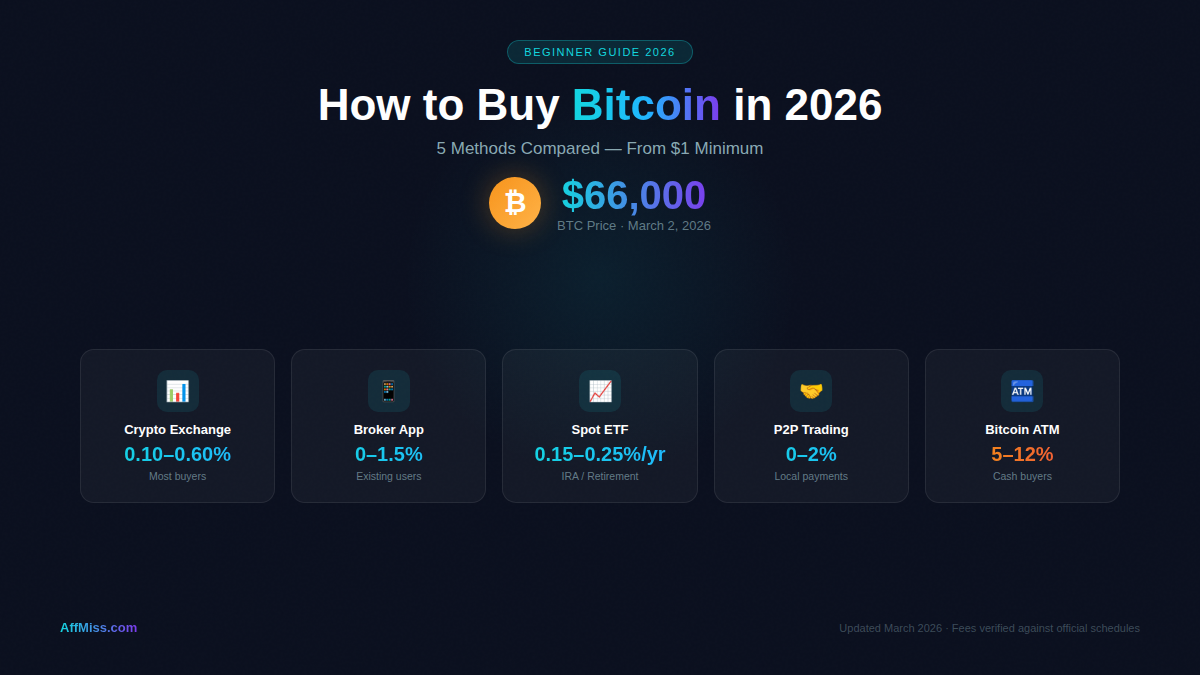
Bitcoin trades at approximately $66,000 (£52,500) in March 2026, down from its all-time high of $126,025 in October 2025. Over 280 million people hold BTC globally. The process of buying Bitcoin takes under 10 minutes on most platforms: choose an exchange or broker, verify your identity, deposit funds, and place a buy order. You can start with as little as $1 — Bitcoin divides into 100 million units called satoshis, so buying a fraction is standard practice. This guide compares 5 methods to buy Bitcoin, breaks down fees from 0% to 7%, and explains how to store BTC after purchase. Whether you use a crypto exchange, a broker app, a spot ETF, P2P trading, or a Bitcoin ATM — the steps below cover each path from account creation to first purchase.
Bitcoin Price in March 2026
One Bitcoin costs approximately $66,000 (£52,500 / €59,400) as of March 2, 2026. You do not need $66,000 to buy Bitcoin — most exchanges allow purchases from $1. Bitcoin is divisible to 8 decimal places. The smallest unit, a satoshi, equals 0.00000001 BTC. A $100 purchase at current prices buys approximately 151,500 satoshis (0.001515 BTC).
| Metric | Value |
|---|---|
| Current Price (March 2, 2026) | ~$66,000 / £52,500 / €59,400 |
| All-Time High | $126,025 (October 6, 2025) |
| Decline from ATH | ~47% |
| 2026 Range | $60,126 – $71,901 |
| Total Supply Cap | 21,000,000 BTC |
| Currently Mined | ~19,996,000 BTC (95.2%) |
| Market Capitalisation | ~$1.3 trillion |
| Market Dominance | ~60% |
Bitcoin reached $126,025 in October 2025, then entered a decline driven by US tariff announcements, Middle East geopolitical tensions, and $6.39 billion in ETF outflows over four consecutive months. The Fear & Greed Index sits in “Extreme Fear” territory — historically, buying during these periods has produced better average entry prices than buying during euphoria. This context matters for timing decisions, which we cover in the DCA section below.
What Is Bitcoin?
Bitcoin (BTC) is a decentralised digital currency secured by blockchain technology. It was created in 2009 by the pseudonymous developer Satoshi Nakamoto. No government, bank, or company controls Bitcoin. Transactions are verified by a global network of miners who solve cryptographic puzzles approximately every 10 minutes.
Three properties make Bitcoin distinct from traditional currencies. First, fixed supply: only 21 million BTC will ever exist, with 95.2% already mined. Second, divisibility: 1 BTC divides into 100 million satoshis, making micro-purchases practical. Third, portability: BTC transfers across borders in minutes without intermediary approval, with fees typically under $5 regardless of amount. These properties underpin the investment thesis that drives 280 million holders and $1.3 trillion in market capitalisation.
5 Ways to Buy Bitcoin in 2026
Each method carries different fees, speed, and levels of control over your Bitcoin. The table below compares all five.
| Method | Typical Fee | Speed | KYC Required | You Own BTC? | Best For |
|---|---|---|---|---|---|
| Crypto Exchange | 0.10%–0.60% | Instant (after deposit) | Yes | Yes (withdrawable) | Most buyers |
| Broker App (Robinhood, eToro) | 0%–1.5% (spread) | Instant | Yes | Varies (some allow withdrawal) | Existing brokerage users |
| Spot Bitcoin ETF | 0.15%–0.25% annual expense ratio | Instant (market hours) | Yes (brokerage KYC) | No (fund shares, not BTC) | IRA/retirement accounts |
| P2P Trading | 0%–2% | 5–30 minutes | Varies | Yes | Local payment methods |
| Bitcoin ATM | 5%–12% | Instant | Varies (often required above $250) | Yes | Cash buyers |
For most first-time buyers, a crypto exchange offers the best combination of low fees, full BTC ownership, and withdrawal capability. The sections below focus on the exchange method with a complete step-by-step walkthrough, followed by brief overviews of each alternative.
How to Buy Bitcoin on a Crypto Exchange — Step by Step
Step 1: Choose an Exchange
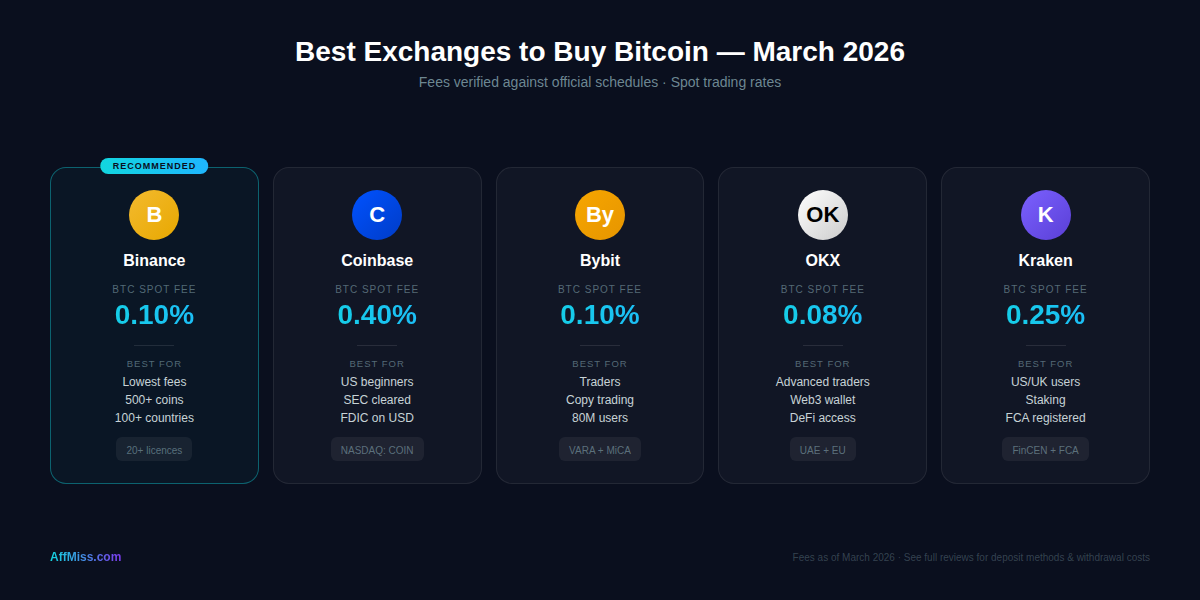
Select an exchange based on four factors: fees, regulation, coin selection, and deposit methods available in your country. The table below compares the top exchanges for buying Bitcoin in 2026.
| Exchange | BTC Spot Fee | Deposit Methods | Regulation | Best For |
|---|---|---|---|---|
| Binance | 0.10% (0.075% w/ BNB) | SEPA, Card, P2P, Apple Pay | 20+ global licences | Lowest fees, most coins |
| Coinbase | 0.40%–0.60% (0.15% Advanced) | ACH, Wire, PayPal, Apple Pay | SEC cleared, FDIC on USD | US beginners, regulated custody |
| Bybit | 0.10% | Card, P2P, Bank Transfer | VARA (UAE), MiCA (EU) | Traders, low fees |
| OKX | 0.08%–0.10% | Card, P2P, SEPA | UAE, EU licences | Advanced traders, Web3 |
| Kraken | 0.25%/0.40% | ACH, Wire, SEPA | US (FinCEN), UK (FCA) | US/UK users, staking |
Best for Low Fees
Binance — 0.10% spot fee (0.075% with BNB). Zero-fee BTC trading on select pairs. 500+ coins. Available in 100+ countries.
Best for Beginners
Coinbase — SEC cleared, FDIC on USD. Clean interface with guided onboarding. Higher fees (0.40%–0.60%) but strongest regulatory protection for US users.
→ Full exchange breakdown: Best Crypto Exchange for Beginners
Step 2: Create and Verify Your Account
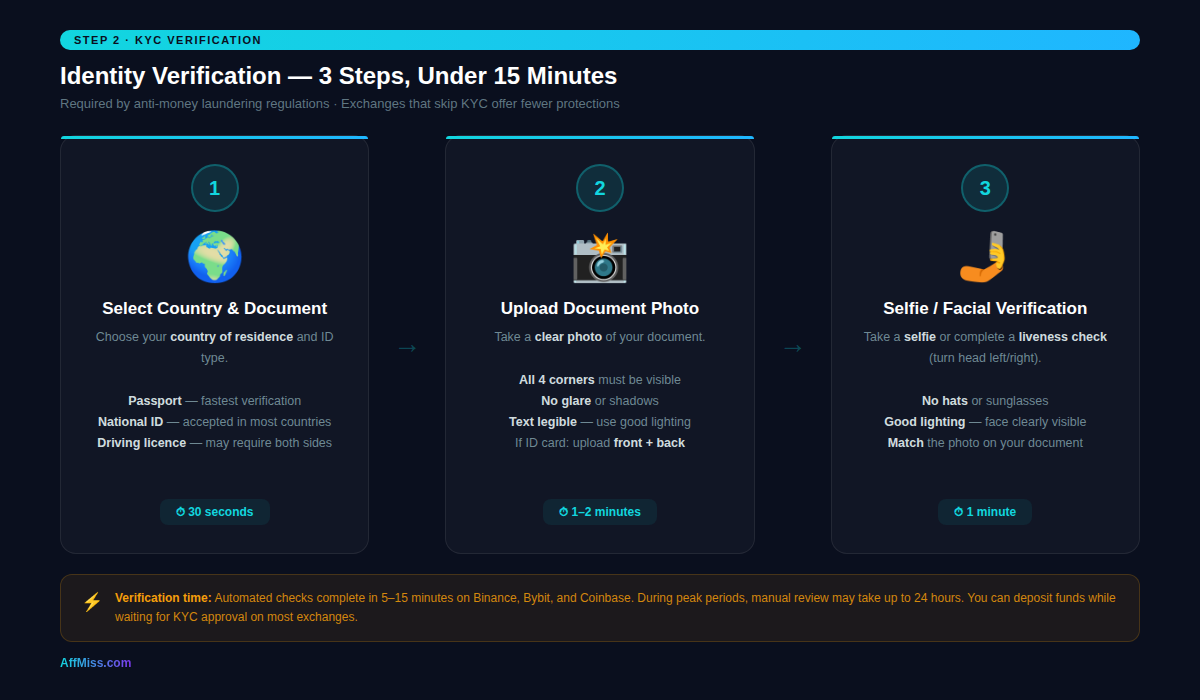
Registration on most exchanges takes 2–5 minutes. You need an email address (or phone number), a strong password, and a government-issued ID for identity verification (KYC). The KYC process requires a photo of your passport or driving licence plus a selfie. Most platforms verify within 5–15 minutes using automated checks. Binance and Bybit offer instant verification for standard documents.
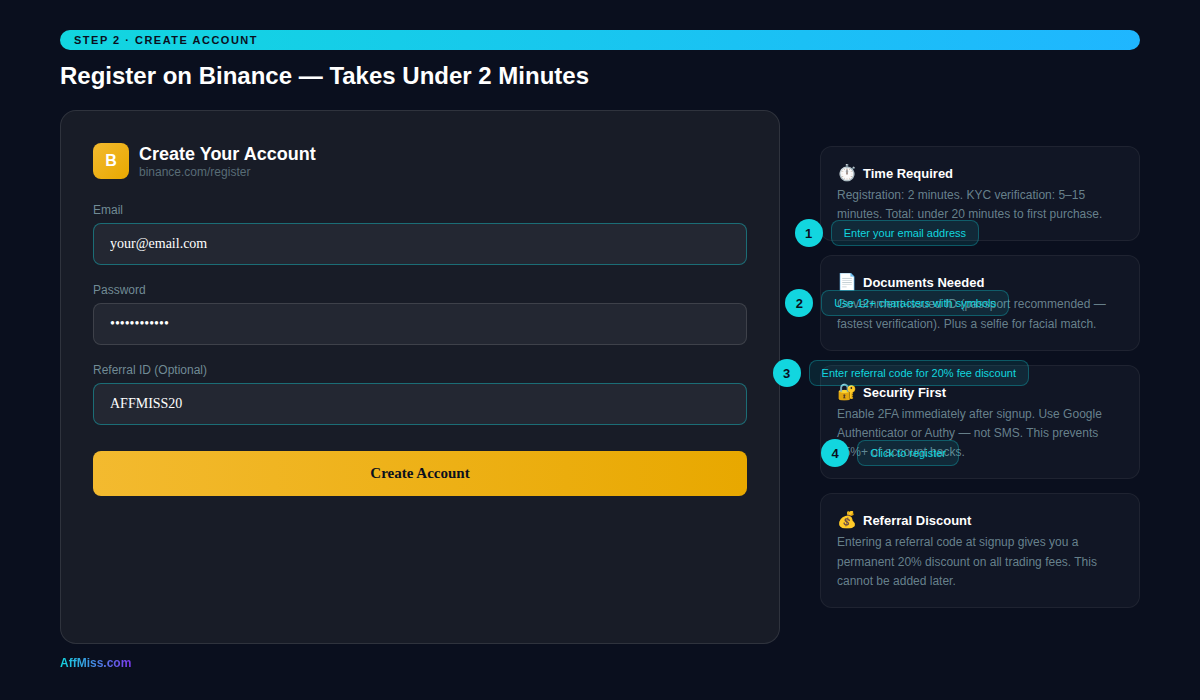
After registration, enable two-factor authentication (2FA) immediately. Use an authenticator app (Google Authenticator, Authy) rather than SMS — SIM-swap attacks remain a common vector for account compromise. This single step prevents the majority of account-level security breaches.
Step 3: Deposit Funds
Deposit fiat currency using the method that matches your region and budget. Fee and speed vary by method:
| Deposit Method | Typical Fee | Speed | Available On |
|---|---|---|---|
| Bank Transfer (ACH/SEPA) | Free–$1 | 1–3 business days (ACH) / Instant–1 day (SEPA) | Coinbase, Binance, Kraken, OKX |
| Debit/Credit Card | 1.8%–3.99% | Instant | All major exchanges |
| PayPal / Apple Pay | 1.5%–3% | Instant | Coinbase, some via third-party |
| P2P (Peer-to-Peer) | 0% | 5–30 minutes | Binance, Bybit, OKX |
| Wire Transfer | $0–$25 | 1–3 business days | Coinbase, Kraken |
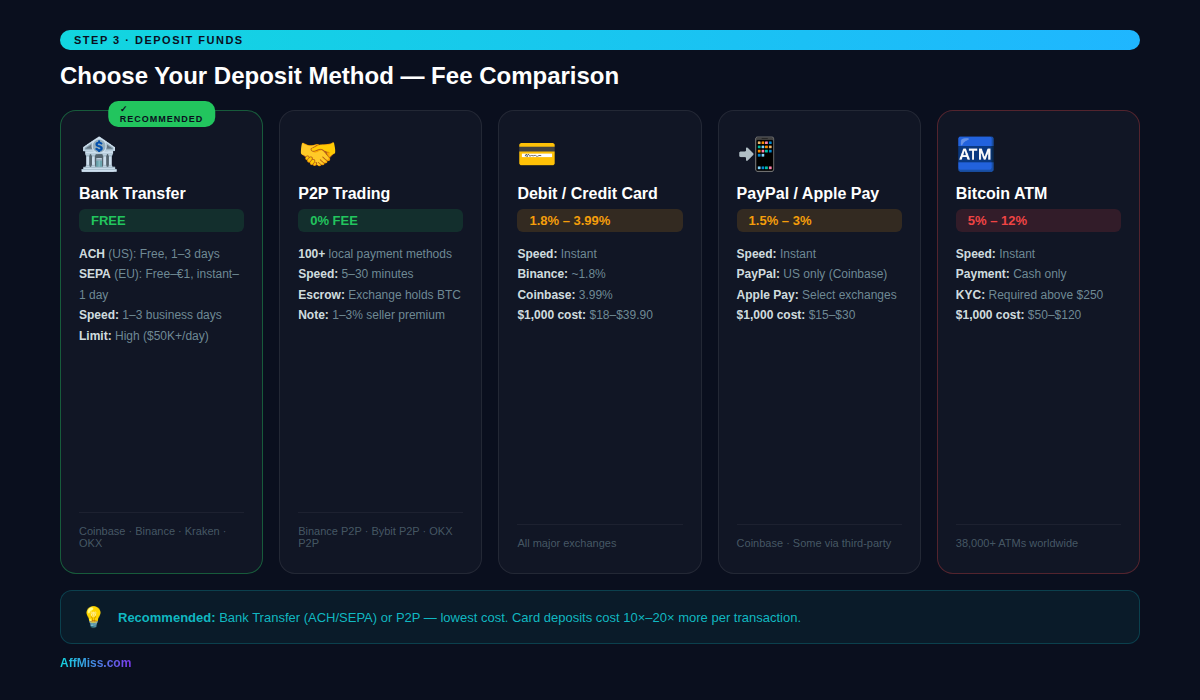
Bank transfer is the cheapest option for most buyers. Card deposits are instant but carry fees of 1.8%–3.99% depending on the exchange. For a $1,000 deposit, the difference between a free bank transfer and a 3.99% card fee is $39.90 — meaningful for smaller portfolios. P2P trading on Binance, Bybit, and OKX allows zero-fee deposits through local payment methods (bank transfer, mobile money, cash) with escrow protection.
Step 4: Buy Bitcoin
Navigate to the BTC trading page. You have two order types:
Market Order — buys Bitcoin at the current price. Executes instantly. Best for first-time buyers who want immediate execution. On Binance: Go to Trade → Spot → BTC/USDT → Market → enter amount → Buy BTC.
Limit Order — sets a target price. The order fills only when BTC reaches your price. Use this to buy at a specific level (e.g., set a limit at $64,000 when BTC trades at $66,000). On Binance: Go to Trade → Spot → BTC/USDT → Limit → set price → enter amount → Buy BTC.
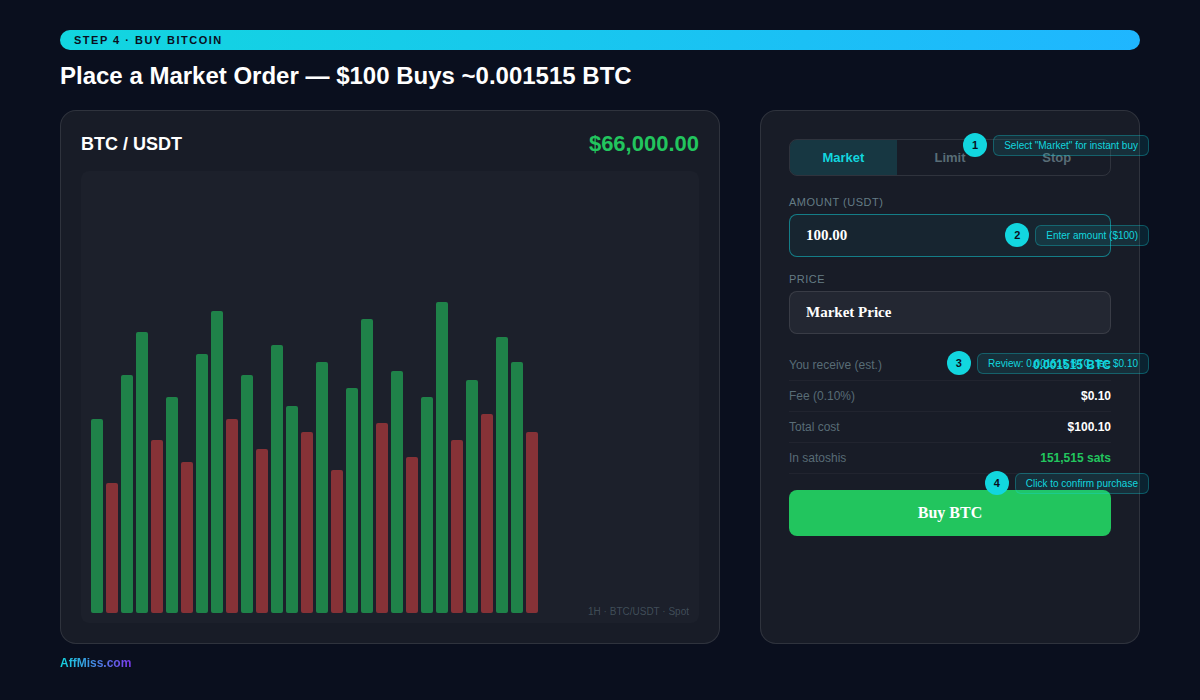
For a first purchase, a market order is the simplest path. Enter the amount in your local currency (e.g., $100, £100, €100) or in BTC. Confirm the order. The exchange executes the trade and credits BTC to your exchange wallet within seconds.
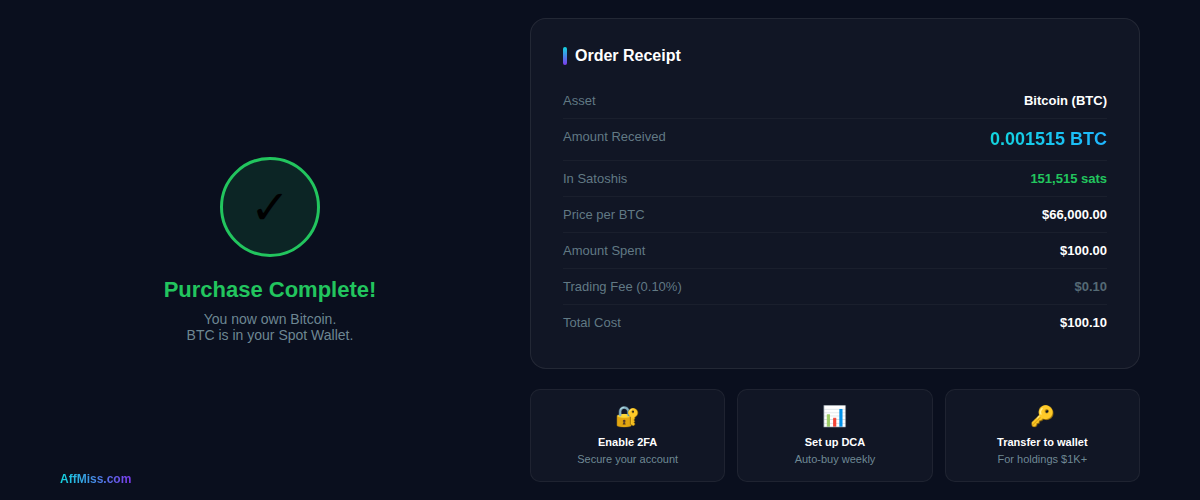
A $100 purchase on Binance costs $0.10 in fees (0.10%). The same purchase on Coinbase Standard costs up to $0.60 (0.60%). On Coinbase Advanced at high volume, the fee drops to $0.15. These differences compound with repeated purchases — a monthly $500 DCA strategy costs $6/year on Binance versus $36/year on Coinbase Standard.
Step 5: Secure Your Bitcoin
After buying, decide where to store your BTC. You have three options, each with different trade-offs between convenience and security.
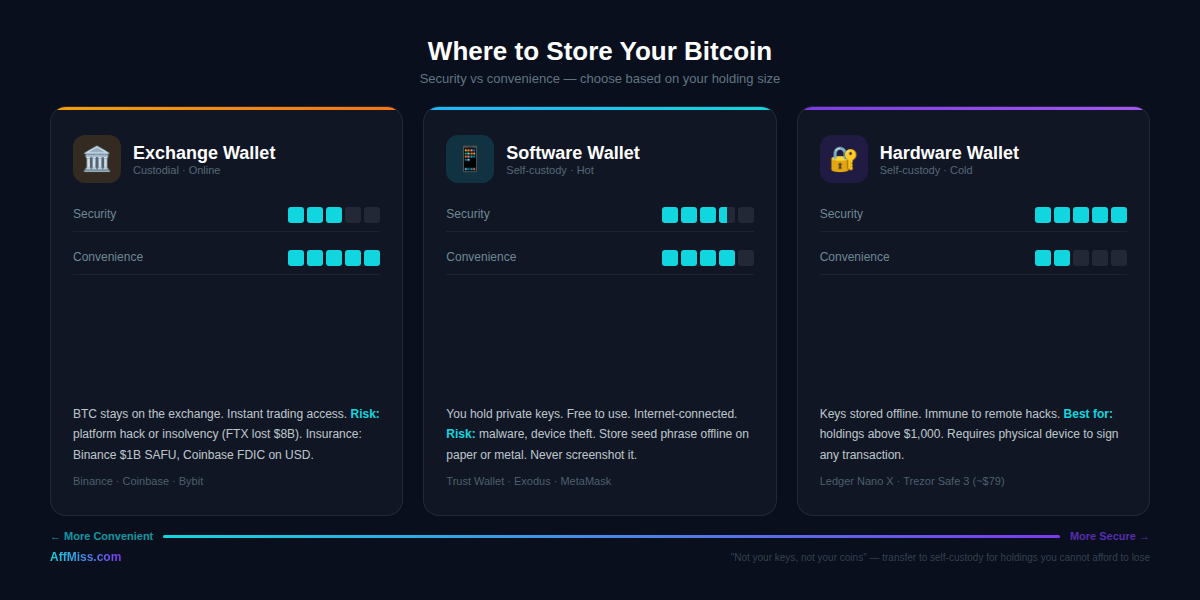
Exchange Wallet
Security: 3/5
Convenience: 5/5
BTC stays on the exchange. Suitable for small amounts and active trading. Risk: if the exchange is compromised, your funds are exposed. Major exchanges (Binance, Coinbase) maintain insurance funds ($1B SAFU, FDIC on USD).
Software Wallet (Hot)
Security: 3.5/5
Convenience: 4/5
Apps like Trust Wallet, MetaMask, or Exodus. You hold the private keys. Free to use. Connected to the internet — vulnerable to malware. Write down and store your seed phrase offline.
Hardware Wallet (Cold)
Security: 5/5
Convenience: 2/5
Devices like Ledger Nano X ($79 / £65) or Trezor Safe 3 ($79 / £65). Private keys stored offline. Immune to remote hacks. Recommended for holdings above $1,000 / £800. Requires physical access to sign transactions.
The crypto industry phrase “not your keys, not your coins” reflects a real risk. Exchange-held Bitcoin depends on the platform’s solvency and security. FTX’s collapse in November 2022 resulted in $8 billion in customer losses. For amounts you cannot afford to lose, transfer BTC to a wallet where you control the private keys. For small, active trading balances, a reputable exchange wallet with 2FA and withdrawal whitelisting provides adequate protection.
Alternative Methods to Buy Bitcoin
Spot Bitcoin ETFs
The SEC approved spot Bitcoin ETFs in January 2024. Approximately $110 billion flowed into these funds in their first year. ETFs let you gain exposure to Bitcoin’s price through a standard brokerage or retirement account (IRA, 401k) without handling private keys or crypto wallets. Major providers include BlackRock (iShares Bitcoin Trust, ticker: IBIT), Fidelity (Wise Origin Bitcoin Fund, ticker: FBTC), and Grayscale (GBTC). Annual expense ratios range from 0.15% to 0.25%. You own shares in the fund — not Bitcoin itself. You cannot withdraw BTC from an ETF to a personal wallet.
ETFs suit investors who want Bitcoin exposure within existing tax-advantaged accounts or who prefer the regulatory protections of traditional securities. For direct ownership and the ability to send, spend, or self-custody BTC, use a crypto exchange instead.
Broker Apps
Fintech apps like Robinhood, eToro, Revolut, and Cash App offer Bitcoin purchases within their existing platforms. Fees are often hidden in the spread (the difference between buy and sell price) rather than displayed as a percentage. Spreads typically range from 0.5% to 1.5%. Some apps (Robinhood, Cash App) now allow BTC withdrawal to external wallets; others (eToro for certain regions) restrict withdrawals. Broker apps suit users who already hold stocks or cash on these platforms and want a single dashboard for all investments.
P2P Trading
Peer-to-peer platforms match buyers and sellers directly. Binance P2P, Bybit P2P, and OKX P2P support 100+ payment methods (bank transfer, mobile money, cash deposit, gift cards) with zero platform fees. The exchange holds BTC in escrow until the seller confirms payment. P2P suits buyers in regions where bank deposits to exchanges are restricted or where local payment methods (M-Pesa, UPI, local bank transfer) are preferred. Prices may carry a 1%–3% premium over spot rates, set by individual sellers.
Bitcoin ATMs
Over 38,000 Bitcoin ATMs operate worldwide (Coin ATM Radar, 2026). You insert cash, scan a wallet QR code, and receive BTC. Fees are the highest of any method: 5%–12% per transaction. Many ATMs require identity verification for purchases above $250 / £200. Bitcoin ATMs suit cash-only buyers or those without bank accounts. For any other scenario, an exchange or P2P platform offers significantly lower costs.
How Much Bitcoin Should You Buy?
Bitcoin has no minimum purchase requirement on most exchanges. Binance allows orders from $1 / £1. Coinbase supports purchases from $2. You buy fractions — 0.001 BTC ($66 at current prices), 0.01 BTC ($660), or any amount you choose. There is no need to buy a full coin.
Two strategies dominate first-time Bitcoin investment:
Lump Sum — invest a fixed amount at once. Simple execution. Historically outperforms DCA approximately 60% of the time in rising markets. Risk: buying at a local peak.
Dollar-Cost Averaging (DCA) — invest a fixed amount at regular intervals (weekly, fortnightly, monthly). Reduces timing risk. A $100/week DCA strategy accumulates roughly 0.08 BTC per month at $66,000 prices. If BTC drops 20%, the same $100 buys more satoshis, lowering your average cost. DCA suits buyers who want consistent exposure without monitoring price charts.
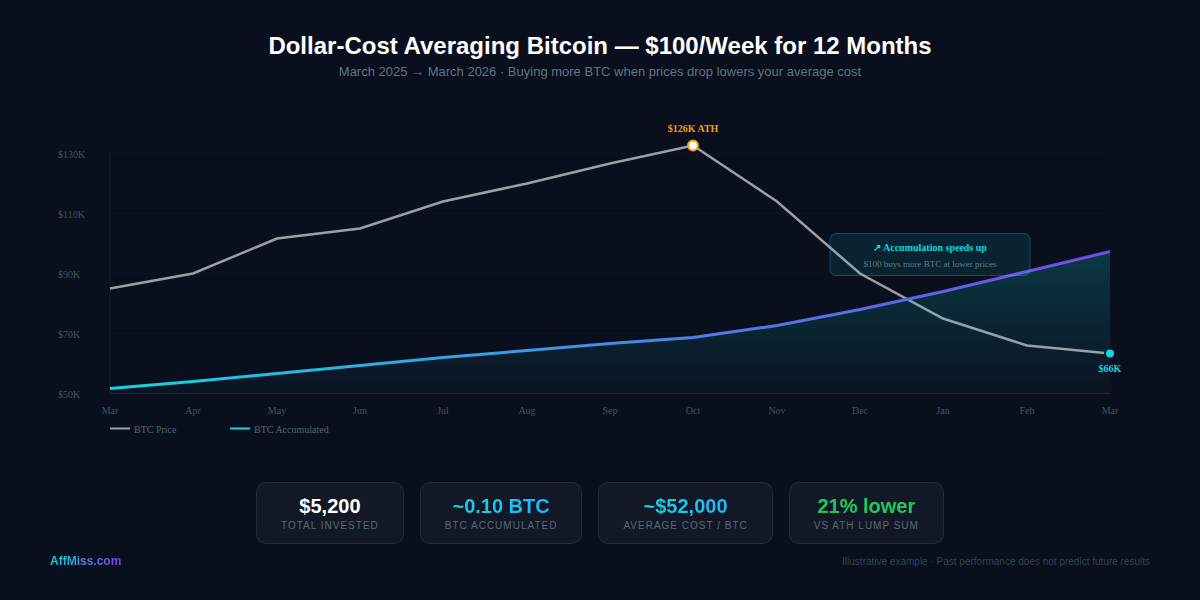
The standard risk management rule applies: invest only what you can afford to lose entirely. Bitcoin fell 77% from its 2021 high to its 2022 low ($69,000 → $15,500). It fell 47% from its October 2025 high ($126,025) to its March 2026 level (~$66,000). Volatility of this magnitude is normal in crypto markets. Position sizing should reflect this reality.
Bitcoin Buying Fees — Full Breakdown
The total cost of buying Bitcoin includes multiple layers. Many buyers focus on the trading fee and miss the deposit fee, spread, and withdrawal fee. The table below shows real costs for a $1,000 Bitcoin purchase across methods.
| Cost Layer | Binance (Bank Transfer) | Coinbase Standard (ACH) | Coinbase Advanced (ACH) | Credit Card (Any Exchange) |
|---|---|---|---|---|
| Deposit Fee | $0 (SEPA/P2P) | $0 (ACH) | $0 (ACH) | $18–$39.90 |
| Trading Fee | $1.00 (0.10%) | $6.00 (0.60%) | $1.50 (0.15%) | $1.00–$6.00 |
| Spread | ~$0.50 | ~$5.00 | ~$1.00 | ~$0.50–$5.00 |
| BTC Withdrawal Fee | ~$0.50–$2.00 | ~$1.00–$3.00 | ~$1.00–$3.00 | ~$0.50–$3.00 |
| Total Cost | ~$2.00 (0.20%) | ~$12.00 (1.20%) | ~$3.50 (0.35%) | ~$20–$49 (2%–5%) |
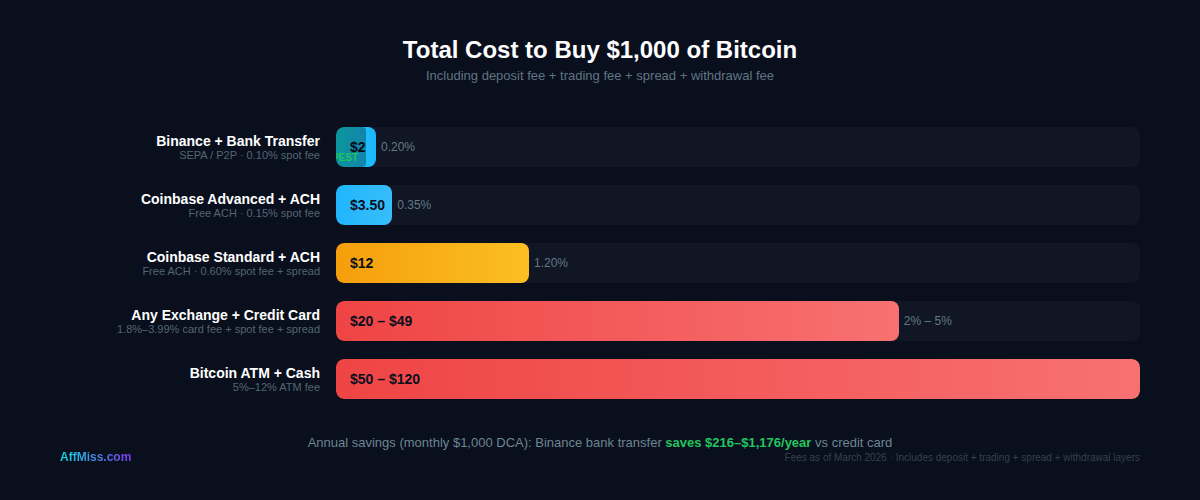
Binance with a bank transfer is the cheapest path: approximately $2 total for a $1,000 purchase (0.20%). Coinbase Standard with ACH costs $12 (1.20%). Credit card purchases on any exchange cost $20–$49 (2%–5%) due to card processing fees. Over a year of monthly $1,000 DCA purchases, the difference between Binance bank transfer ($24/year) and credit card ($240–$588/year) compounds significantly.
Fee Verdict
Use bank transfer (ACH, SEPA, or P2P) on a low-fee exchange like Binance or Bybit to minimise costs. Avoid credit card deposits unless speed outweighs the 2%–5% premium. For US users, Coinbase Advanced with ACH offers a regulated path at 0.35% total cost.
→ See our Lowest Fee Crypto Exchange ranking.
Tax Considerations When Buying Bitcoin
Buying Bitcoin is not a taxable event in most jurisdictions. Tax obligations arise when you sell BTC for profit, trade BTC for another cryptocurrency, or use BTC to purchase goods and services. Key considerations by region:
United States: The IRS treats cryptocurrency as property. Capital gains tax applies on disposal. Starting January 2026, brokers must issue Form 1099-DA reporting proceeds from crypto sales. Short-term gains (held under 1 year) are taxed as ordinary income. Long-term gains (held over 1 year) receive preferential rates (0%, 15%, or 20%). Coinbase, Kraken, and Binance.US provide tax reports compatible with TurboTax and CoinTracker.
United Kingdom: HMRC treats crypto as a capital asset. Capital Gains Tax applies when you sell, trade, or gift BTC. The annual CGT allowance is £3,000 (2025/2026 tax year). Gains above this threshold are taxed at 18% (basic rate) or 24% (higher rate).
European Union: Tax treatment varies by member state. Many EU countries tax crypto gains as capital gains. MiCA regulation (effective 2024–2025) standardised exchange licensing but did not harmonise tax rules. Check your country-specific requirements.
Keep records of every purchase: date, amount, price, fees, and exchange used. Most exchanges provide CSV or API exports for tax software. Maintaining accurate records from the first transaction prevents complications during tax filing.
7 Mistakes First-Time Bitcoin Buyers Make
1. Skipping 2FA. Two-factor authentication prevents the majority of account compromises. Enable it before depositing funds. Use an authenticator app, not SMS.
2. Buying with a credit card. Card fees (1.8%–3.99%) plus potential cash advance charges from your bank make this the most expensive deposit method. Use bank transfer or P2P instead.
3. Ignoring the spread. The displayed trading fee is not the full cost. The spread (difference between buy and sell price) adds 0.05%–0.50% depending on the platform. Compare total cost, not headline fee.
4. Panic selling during drops. Bitcoin has experienced drawdowns of 30%–80% in every market cycle. A 20% drop from $66,000 to $52,800 is within normal volatility. DCA buyers treat these drops as discounted accumulation periods.
5. Sharing seed phrases. Your seed phrase (12 or 24 words) grants full access to your wallet. No legitimate service will ask for it. Store it offline on paper or metal. Never photograph it or store it digitally.
6. Chasing micro-cap altcoins before holding BTC. Bitcoin represents over 60% of total crypto market capitalisation. New buyers who skip BTC to buy micro-cap tokens often learn an expensive lesson in volatility and liquidity risk. Establish a BTC position before exploring altcoins.
7. Leaving large amounts on exchanges long-term. Exchange wallets are convenient but depend on the platform’s security. FTX, Mt. Gox, and other exchange failures resulted in billions in permanent losses. For holdings above $1,000, consider transferring to a hardware wallet.
Which Exchange Should You Use to Buy Bitcoin?
The answer depends on your location, experience level, and priorities. US-based beginners benefit from Coinbase’s regulatory clarity (SEC cleared, FDIC on USD, all 50 states). Cost-conscious buyers worldwide save with Binance (0.10% fees, zero-fee BTC pairs, P2P deposits). Traders who also want futures or copy trading should consider Bybit (0.10% spot, 0.02%/0.055% futures, copy trading across spot and futures). The exchanges below each link to full reviews with detailed fee breakdowns, security assessments, and setup guides.
Binance — 4.6/5
Best For: Low fees, most coins
0.10% spot (0.075% w/ BNB). 500+ coins. $1B SAFU fund. P2P with 100+ payment methods. Available 100+ countries.
Coinbase — 4.4/5
Best For: US beginners, regulation
SEC cleared, FDIC on USD. Guided onboarding. Free ACH. Learn & Earn crypto rewards. 240+ coins. All 50 US states.
Bybit — 4.5/5
Best For: Traders, copy trading
0.10% spot. 1,000+ pairs. Copy trading (spot + futures). Unified Trading Account. VARA + MiCA licensed. 80M users.
→ Full ranking: Best Crypto Exchange for Beginners 2026
→ Compare any two: Exchange Comparison Tool
How to Buy Bitcoin — FAQ
What Is the Minimum Amount of Bitcoin I Can Buy?
Most exchanges allow purchases from $1–$10. Binance supports orders from $1. Coinbase from $2. You buy fractions of Bitcoin (satoshis) — there is no requirement to purchase a full coin.
Is It Safe to Buy Bitcoin in 2026?
Buying Bitcoin through a regulated exchange with 2FA enabled is safe. The primary risks are price volatility (BTC can drop 30%+ in a single month) and platform security (mitigated by choosing exchanges with insurance funds and strong regulatory standing). Never invest more than you can afford to lose.
How Much Is 1 Bitcoin Worth?
One Bitcoin costs approximately $66,000 (£52,500 / €59,400) as of March 2, 2026. The price changes constantly. Bitcoin reached an all-time high of $126,025 in October 2025. You do not need to buy 1 full BTC — most people buy fractions starting from $1.
Do I Pay Tax When I Buy Bitcoin?
In most jurisdictions, buying Bitcoin is not taxable. Tax obligations arise when you sell, trade, or spend BTC at a profit. Keep records of every purchase for accurate tax reporting. US buyers: brokers must issue Form 1099-DA starting 2026. UK buyers: CGT applies on gains above £3,000.
Should I Buy Bitcoin Now or Wait?
Bitcoin trades at approximately $66,000 in March 2026, down ~47% from its October 2025 all-time high of $126,025. No one can predict short-term price direction. Dollar-cost averaging removes timing pressure — invest a fixed amount at regular intervals regardless of price. Historically, buying during periods of market fear has produced better average entry prices than buying during euphoria.
What Is the Cheapest Way to Buy Bitcoin?
Bank transfer (ACH in the US, SEPA in the EU) to a low-fee exchange like Binance (0.10%) or Bybit (0.10%). Total cost: approximately 0.20% including spread. The most expensive method is a credit card purchase on a high-fee platform: 2%–5% total cost.
Can I Buy Bitcoin Without KYC Verification?
Some platforms allow limited purchases without full KYC. Bitcoin ATMs may allow small cash purchases (under $250) without ID. P2P platforms like Bisq operate without centralised KYC. Regulated exchanges require identity verification for fiat deposits and most withdrawals. No-KYC options carry higher fees and reduced legal protection.
Where Should I Store Bitcoin After Buying?
For small amounts and active trading: exchange wallet with 2FA enabled. For medium holdings ($500–$5,000): software wallet (Trust Wallet, Exodus). For significant holdings ($5,000+): hardware wallet (Ledger Nano X, Trezor Safe 3). The core principle: control your own private keys for any amount you cannot afford to lose.
Sources
1. CoinDesk — “BTC Price Analysis” — March 1, 2026 (BTC ~$66,000, ATH $126,025 Oct 2025)
2. CoinCodex — “Bitcoin Price Prediction March 2026” — March 1, 2026 (2026 range: $60,126–$71,901)
3. Crypto.com — “Can BTC Recover in March 2026?” — February 28, 2026 (ETF outflows $6.39B, Fear & Greed Index)
4. IndexBox — “How to Buy Bitcoin in 2026: A Step-by-Step Guide for Investors” — February 2026
5. NerdWallet — “How to Buy Bitcoin: Quick-Start Guide” — Updated 2026
6. 99Bitcoins — “Where, When, and How to Buy Bitcoin in 2026” — January 2026
7. Binance, Coinbase, Bybit — Official Fee Schedules — March 2026
8. Coin ATM Radar — Bitcoin ATM Statistics — 2026 (38,000+ ATMs worldwide)
9. Bitcoin.com — “How to Buy Bitcoin (2026): A Simple Step-by-Step Guide” — January 2026
