How to Buy Crypto in 2026: Complete Beginner Guide (7 Steps + Fees Compared)
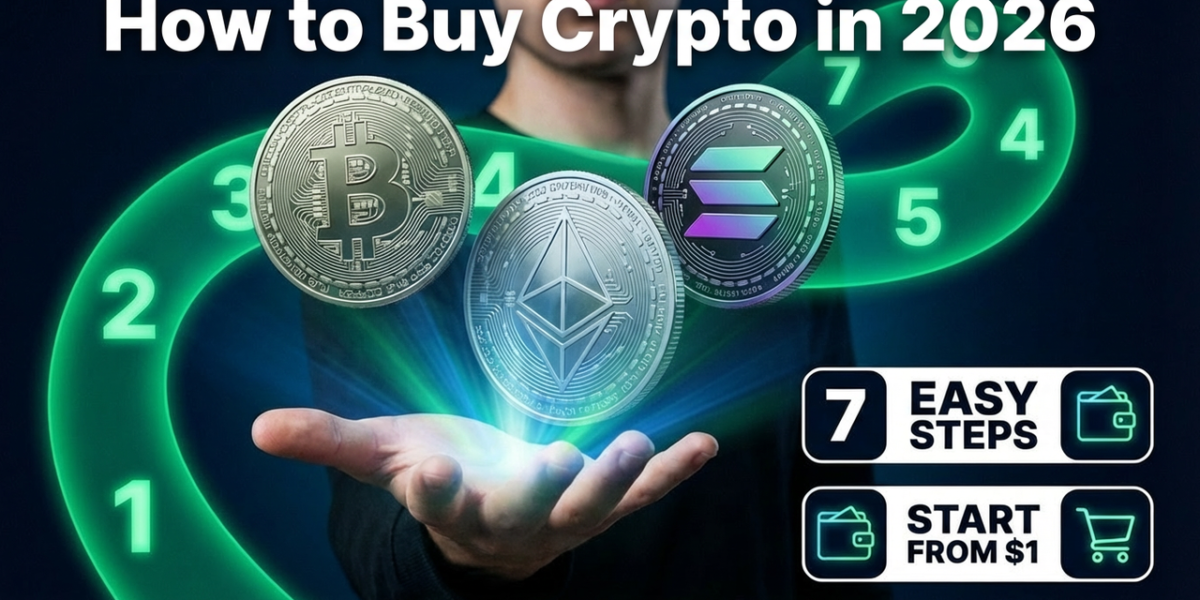
Buying cryptocurrency in 2026 takes under 10 minutes and starts from $1. The process follows seven steps: choose which crypto to buy, pick an exchange, create an account, verify your identity, deposit funds, place your first order, and move your coins to a secure wallet. The total crypto market holds $2.8 trillion across 15,000+ tokens — but beginners do best when they start with established coins like Bitcoin (BTC), Ethereum (ETH), or Solana (SOL) before exploring smaller projects. This guide covers each step, compares exchange fees from 0.08% to 3.99%, explains how to build a starter portfolio, and outlines the mistakes that cost new buyers money. Whether you plan to invest $10 or $10,000, the steps below apply to every budget and experience level.
What Is Cryptocurrency?
Cryptocurrency is digital money secured by cryptography and recorded on a blockchain — a distributed ledger maintained by thousands of computers worldwide. No single bank, government, or company controls the network. Bitcoin launched in 2009 as the first cryptocurrency. By March 2026, over 15,000 different cryptocurrencies exist, with a combined market capitalisation of approximately $2.8 trillion.
Three categories matter for beginners. Bitcoin (BTC) functions as a store of value — often called “digital gold” — with a fixed supply capped at 21 million coins. Ethereum (ETH) powers smart contracts and decentralised applications across finance, gaming, and identity. Stablecoins like USDT and USDC are pegged 1:1 to the US dollar and serve as the primary trading currency on most exchanges. Understanding these three categories covers roughly 75% of the market by capitalisation and gives you the foundation to evaluate every other token.
Which Cryptocurrency Should a Beginner Buy First?
Start with established, high-liquidity coins. New buyers who chase micro-cap tokens before understanding market structure tend to absorb losses that could have been avoided. The table below compares the top beginner-friendly cryptocurrencies by market cap, use case, and risk level.
| Cryptocurrency | Ticker | Market Cap | Primary Use Case | Risk Level | Why for Beginners |
|---|---|---|---|---|---|
| Bitcoin | BTC | ~$1.3T | Store of value, digital gold | Lower | 60% market dominance, most liquid, widest adoption |
| Ethereum | ETH | ~$380B | Smart contracts, DeFi, NFTs | Moderate | Largest ecosystem, staking yields 3–5%/year |
| Solana | SOL | ~$75B | High-speed transactions, DeFi | Moderate | 400ms finality, growing DeFi ecosystem |
| USDC | USDC | ~$45B | Stablecoin (USD-pegged) | Low | 1:1 USD peg, regulated by Circle, earns 4–5% yield |
| XRP | XRP | ~$35B | Cross-border payments | Moderate | SEC clarity (2024 settlement), bank partnerships |
A practical beginner allocation follows the 60/30/10 rule: 60% in Bitcoin for stability, 30% in Ethereum for ecosystem exposure, and 10% in one or two mid-cap altcoins you have researched. This structure gives you market exposure while limiting downside risk from unproven projects. Adjust as your knowledge grows — but resist the temptation to allocate heavily into tokens you cannot explain in one sentence.
Step 1: Choose a Crypto Exchange
An exchange is the platform where you buy, sell, and trade cryptocurrency. Four factors determine which exchange suits you: fees, regulation, available coins, and deposit methods in your country.
| Exchange | Spot Fee | Coins Listed | Deposit Methods | Regulation | Best For |
|---|---|---|---|---|---|
| Binance | 0.10% | 500+ | SEPA, Card, P2P, Apple Pay | 20+ licences globally | Lowest fees, most coins |
| Coinbase | 0.40–0.60% | 240+ | ACH, Wire, PayPal, Apple Pay | SEC cleared, FDIC on USD | US beginners, regulated |
| Bybit | 0.10% | 1,000+ | Card, P2P, Bank Transfer | VARA (UAE), MiCA (EU) | Traders, copy trading |
| OKX | 0.08% | 350+ | Card, P2P, SEPA | UAE, EU licences | Advanced traders, Web3 |
| Kraken | 0.25% | 200+ | ACH, Wire, SEPA | FinCEN (US), FCA (UK) | US/UK users, staking |
Best for Low Fees
Binance — 0.10% spot fee (0.075% with BNB). Zero-fee BTC trading on select pairs. 500+ coins. Available in 100+ countries. $1B SAFU insurance fund.
Best for US Beginners
Coinbase — SEC cleared, FDIC on USD deposits. Clean interface with guided onboarding. Free ACH deposits. Learn & Earn crypto rewards. All 50 US states.
→ Full breakdown: Best Crypto Exchange for Beginners 2026
Step 2: Create Your Account
Registration on most exchanges takes 2–5 minutes. You need an email address, a password (use 12+ characters with mixed case, numbers, and symbols), and acceptance of the terms of service. After signup, enable two-factor authentication (2FA) immediately — this prevents 95%+ of account compromises. Use an authenticator app (Google Authenticator, Authy) rather than SMS, as SIM-swap attacks remain a common attack vector.
Some exchanges offer signup bonuses or referral fee discounts. Binance referral codes reduce trading fees by 20% permanently. Bybit and OKX offer similar programmes. These discounts apply at registration and cannot be added later, so enter a referral code before clicking “Create Account.”
Step 3: Verify Your Identity (KYC)
Know Your Customer (KYC) verification is required by anti-money laundering regulations in most countries. The process involves three steps: select your country and document type, upload a photo of your government-issued ID (passport recommended for fastest processing), and complete a selfie or liveness check. Most exchanges verify within 5–15 minutes using automated systems. During peak periods, manual review may extend to 24 hours.
KYC enables full deposit and withdrawal limits. Without verification, most exchanges restrict access to trading features. Binance requires KYC for all fiat transactions. Coinbase requires verification before any activity. MEXC allows limited no-KYC trading with 10 BTC daily withdrawals — though without identity verification, you forfeit regulatory consumer protections.
Step 4: Deposit Funds
Choose a deposit method based on your region and cost tolerance. Bank transfers cost the least; card deposits cost the most but arrive instantly.
| Deposit Method | Fee | Speed | Available On |
|---|---|---|---|
| Bank Transfer (ACH / SEPA) | Free–$1 | 1–3 days (ACH) / Instant–1 day (SEPA) | Coinbase, Binance, Kraken, OKX |
| Debit / Credit Card | 1.8%–3.99% | Instant | All major exchanges |
| P2P (Peer-to-Peer) | 0% platform fee | 5–30 minutes | Binance, Bybit, OKX |
| PayPal / Apple Pay | 1.5%–3% | Instant | Coinbase, select others |
| Wire Transfer | $0–$25 | 1–3 business days | Coinbase, Kraken |
For a $1,000 deposit, the fee difference between a free bank transfer and a 3.99% card is $39.90. Over 12 months of monthly deposits, card fees accumulate to $478.80 — enough to buy approximately 7.2 million satoshis (0.0072 BTC) at current prices. Use bank transfer or P2P whenever possible.
Step 5: Buy Your First Cryptocurrency
Go to the trading page and select the coin you want to buy. On Binance: Trade → Spot → BTC/USDT (or ETH/USDT, SOL/USDT). You have two order types.
Market Order — executes at the current price. Best for beginners who want immediate execution. Enter the amount in your local currency or in crypto, confirm, and your coins appear in your exchange wallet within seconds.
Limit Order — sets a target price. The order fills only when the market reaches your level. Use this when you want to buy at a specific price below the current market (e.g., set a limit for ETH at $3,200 when it trades at $3,400).
For your first purchase, a market order removes decision complexity. Enter $50 or $100, review the fee (0.10% on Binance = $0.10 per $100), and confirm. The exchange credits coins to your Spot Wallet immediately.
→ Detailed walkthrough: How to Buy Bitcoin — Step-by-Step Guide
Step 6: Secure Your Crypto in a Wallet
After buying, decide where to store your coins. The three wallet types offer different trade-offs between convenience and security.
Exchange Wallet
Security: 3/5 · Convenience: 5/5
Coins stay on the exchange. Instant trading access. Risk: platform hack or insolvency (FTX lost $8B in 2022). Major exchanges maintain insurance: Binance $1B SAFU, Coinbase FDIC on USD.
Software Wallet (Hot)
Security: 3.5/5 · Convenience: 4/5
Apps like Trust Wallet, MetaMask, or Exodus. You hold private keys. Free. Internet-connected, so vulnerable to malware. Write your seed phrase on paper — never screenshot it.
Hardware Wallet (Cold)
Security: 5/5 · Convenience: 2/5
Devices like Ledger Nano X ($79 / £65) or Trezor Safe 3 ($79). Keys stored offline. Immune to remote attacks. Recommended for holdings above $1,000 / £800.
For holdings under $500, an exchange wallet with 2FA and withdrawal whitelisting provides adequate protection. Above $1,000, transfer to a hardware wallet. The crypto principle “not your keys, not your coins” reflects a real risk — exchange failures have resulted in billions in permanent losses.
Step 7: Learn Before You Trade More
Your first purchase is the start, not the end. Before investing more, build understanding in four areas.
Market Cycles. Bitcoin follows roughly 4-year cycles tied to halving events (the most recent: April 2024). Bull markets produce 300–1,000% gains from cycle lows. Bear markets erase 60–80% of those gains. Knowing where you are in the cycle informs position sizing and expectations.
Fees. Every transaction carries multiple cost layers: deposit fee, trading fee, spread, and withdrawal fee. A $1,000 purchase through Binance bank transfer costs approximately $2 total (0.20%). The same purchase via credit card costs $20–$49 (2%–5%). → See our Lowest Fee Crypto Exchange ranking.
Tax. In most jurisdictions, buying crypto is not taxable. Selling, trading, or spending crypto at a profit triggers capital gains tax. US: Form 1099-DA required from 2026. UK: CGT applies on gains above £3,000/year. Keep records from your first transaction.
Research. Before buying any altcoin, evaluate its market capitalisation, daily trading volume, team background, token supply schedule (inflationary vs deflationary), and real-world use case. If you cannot summarise what the project does in one sentence, you are not ready to invest in it.
How to Build a Beginner Crypto Portfolio
Three model portfolios serve different risk profiles. Each assumes a $500 starting investment and monthly $100 additions using dollar-cost averaging (DCA).
| Portfolio | Allocation | Risk Level | Best For |
|---|---|---|---|
| Conservative | 70% BTC / 20% ETH / 10% USDC (staked) | Lower | First-time investors, risk-averse |
| Balanced | 50% BTC / 30% ETH / 10% SOL / 10% altcoins | Moderate | Investors with 6+ months experience |
| Growth | 40% BTC / 25% ETH / 15% SOL / 20% altcoins | Higher | Experienced investors, higher risk tolerance |
DCA removes timing risk. A $100/week strategy accumulates roughly 0.08 BTC per month at $66,000 prices. If Bitcoin drops 20% to $52,800, the same $100 buys more satoshis — lowering your average entry. Historical data shows DCA produces better average prices than lump-sum investing during bear markets, while lump-sum wins approximately 60% of the time during sustained uptrends.
Crypto Buying Fees — Full Comparison
Total cost includes deposit fee + trading fee + spread + withdrawal fee. Many beginners compare headline trading fees and miss the other three layers.
| Exchange + Method | Deposit Fee | Trading Fee | Spread | Total per $1,000 |
|---|---|---|---|---|
| Binance + Bank Transfer | $0 | $1.00 (0.10%) | ~$0.50 | ~$2 (0.20%) |
| Bybit + P2P | $0 | $1.00 (0.10%) | ~$1.00 | ~$2.50 (0.25%) |
| OKX + Bank Transfer | $0 | $0.80 (0.08%) | ~$0.70 | ~$2 (0.20%) |
| Coinbase Advanced + ACH | $0 | $1.50 (0.15%) | ~$1.00 | ~$3.50 (0.35%) |
| Coinbase Standard + ACH | $0 | $6.00 (0.60%) | ~$5.00 | ~$12 (1.20%) |
| Any Exchange + Credit Card | $18–$39.90 | $1–$6 | ~$1–$5 | ~$20–$49 (2%–5%) |
Annual impact at $1,000/month DCA: Binance bank transfer costs $24/year. Coinbase Standard costs $144/year. Credit card deposits cost $240–$588/year. The cheapest route saves $216–$564 annually — enough to accumulate an extra 0.003–0.009 BTC at current prices.
8 Mistakes New Crypto Buyers Make
1. Skipping 2FA. Two-factor authentication stops the majority of account breaches. Enable it before depositing any funds. Use an authenticator app, not SMS.
2. Using credit cards to deposit. Card fees of 1.8%–3.99% plus potential cash advance charges from your issuer make this the most expensive path. A monthly $1,000 DCA via credit card wastes $216–$479 per year in avoidable fees.
3. Buying coins they cannot explain. If you cannot describe what the project does, who uses it, and why the token has value — in plain language — you are speculating, not investing. Start with BTC and ETH. Branch out only after you understand market structure.
4. Ignoring the spread. The displayed trading fee is not the full cost. The spread (gap between buy and sell price) adds 0.05%–0.50% depending on the exchange and coin. Low-volume altcoins carry wider spreads than BTC or ETH.
5. Panic selling during corrections. Bitcoin has dropped 30%–80% in every market cycle. A 25% drawdown from a recent high is within historical norms. DCA buyers treat corrections as discounted accumulation periods, not exit signals.
6. Sharing seed phrases. Your seed phrase (12 or 24 words) grants full access to your wallet. No exchange, support agent, or recovery service will ask for it. Store it offline on paper or stamped metal. Never store it digitally.
7. Concentrating in a single altcoin. Diversification across 3–5 coins reduces the risk that one project failure wipes your entire position. Even experienced traders limit individual altcoin allocations to 5%–15% of their portfolio.
8. Leaving large balances on exchanges. Exchange wallets depend on the platform’s security. FTX, Mt. Gox, and QuadrigaCX failures caused billions in permanent losses. Transfer holdings above $1,000 to a wallet where you control the private keys.
Which Exchange Should You Use?
Your location, experience level, and priorities determine the best fit. US-based beginners benefit from Coinbase’s regulatory clarity (SEC cleared, FDIC on USD). Cost-conscious buyers worldwide save with Binance (0.10% fees, zero-fee BTC pairs). Traders who want futures or copy trading should consider Bybit (copy trading across spot and futures, Unified Trading Account).
Binance — 4.6/5
Best For: Low fees, most coins
0.10% spot. 500+ coins. $1B SAFU fund. P2P with 100+ payment methods. Available 100+ countries. Zero-fee BTC pairs.
Coinbase — 4.4/5
Best For: US beginners, regulation
SEC cleared, FDIC on USD. Free ACH. Learn & Earn rewards. 240+ coins. All 50 US states. Coinbase One ($29.99/mo) removes fees.
Bybit — 4.5/5
Best For: Traders, copy trading
0.10% spot. 1,000+ pairs. Copy trading (spot + futures). UTA. VARA + MiCA licensed. 80M users. Demo trading available.
→ Full ranking: Best Crypto Exchange for Beginners 2026
→ Compare any two: Exchange Comparison Tool
Crypto vs Traditional Investments — Key Differences
Cryptocurrency operates on a different schedule and structure than stocks, bonds, or real estate. Understanding these differences prevents false expectations and poor decisions.
| Factor | Cryptocurrency | Stocks | Savings Account |
|---|---|---|---|
| Trading Hours | 24/7, 365 days | Market hours (9:30–16:00 EST) | N/A |
| Minimum Investment | $1 | $1 (fractional shares) | $0 |
| Annual Volatility | 50%–100%+ | 15%–25% | 0% |
| Custody | Self-custody possible | Broker holds shares | Bank holds funds |
| Insurance | Limited (exchange funds) | SIPC up to $500K | FDIC up to $250K |
| Yield Opportunities | Staking 3–12% APY | Dividends 1–4% | 4–5% APY (2026) |
| Settlement Time | Seconds to minutes | T+1 (1 business day) | Instant |
| Regulation | Evolving (MiCA, IRS 1099-DA) | SEC, FINRA regulated | FDIC insured |
Crypto’s 24/7 market means price can move while you sleep. This is a structural feature, not a flaw — but it requires different risk management than stock investing. Set price alerts rather than monitoring charts constantly. If 50%+ volatility exceeds your tolerance, limit crypto to 5%–10% of your total investment portfolio and allocate the remainder to traditional assets.
Earning Yield on Crypto — Staking and Savings
After buying crypto, you can earn passive yield through staking and savings products — similar to earning interest on a savings account, though with different risk profiles.
Staking means locking your coins to support a blockchain’s operations (validating transactions). In return, the network pays you rewards. Ethereum staking yields 3–5% APY. Solana staking yields 6–8% APY. You can stake through your exchange (Binance, Coinbase, Kraken all offer one-click staking) or through a dedicated wallet. Exchange staking is simpler; self-staking gives you more control and avoids platform risk.
Flexible Savings products on exchanges like Binance and Bybit let you deposit USDT or USDC and earn 4–8% APY with daily withdrawals. These rates fluctuate with market demand. The risk is platform-level: if the exchange fails, your deposited stablecoins are at risk. For savings above $5,000, consider splitting across two exchanges to reduce concentration.
Both staking rewards and savings interest are taxable income in most jurisdictions. In the US, staking rewards are taxed as ordinary income at the time you receive them (IRS Revenue Ruling 2023-14). In the UK, HMRC treats staking income as miscellaneous income. Track all yield earnings from day one.
Security Practices Every Beginner Must Follow
The largest losses in crypto come from security failures, not market downturns. Five practices protect your funds from the most common attack vectors.
Enable 2FA on every account. Use Google Authenticator or Authy — not SMS. SIM-swap attacks (where attackers port your phone number to their device) bypass SMS-based 2FA entirely. Authenticator apps generate codes locally on your device and remain secure even if your phone number is compromised.
Use different passwords per exchange. A password manager (Bitwarden, 1Password) generates and stores 16+ character passwords for each platform. If one exchange suffers a data breach, your other accounts remain unaffected.
Whitelist withdrawal addresses. Most exchanges allow you to restrict withdrawals to pre-approved wallet addresses. Enable this feature after your first deposit. Even if an attacker gains account access, they cannot withdraw funds to an unknown address. Binance enforces a 24-hour waiting period when adding new whitelist addresses.
Verify URLs before logging in. Phishing sites replicate exchange login pages to steal credentials. Bookmark your exchange’s URL and access it from the bookmark only. Never click login links from emails or social media messages. Binance’s official URL is binance.com — not binance-login.com, binancee.com, or similar variants.
Back up your seed phrase offline. Your wallet seed phrase (12 or 24 words) is the master key to your funds. Write it on paper or stamp it on metal. Store it in a fireproof safe or a separate physical location. Never store it in cloud services, screenshots, or notes apps. If someone obtains your seed phrase, they own your crypto — permanently and irreversibly.
How to Buy Crypto — FAQ
How Much Money Do I Need to Start Buying Crypto?
Most exchanges accept orders from $1–$10. Binance allows $1 minimum orders. Coinbase accepts $2. You buy fractions of any coin — there is no requirement to purchase a full Bitcoin ($66,000) or full Ethereum ($3,400). $50–$100 is enough to start learning.
Is It Safe to Buy Crypto in 2026?
Buying through a regulated exchange with 2FA enabled is safe from an operational standpoint. The primary risks are price volatility (coins can drop 30%+ in a single month) and platform security (mitigated by choosing exchanges with insurance funds and strong regulatory standing). Never invest more than you can afford to lose entirely.
Which Crypto Should I Buy as a Complete Beginner?
Start with Bitcoin (BTC) and Ethereum (ETH). Together they represent over 70% of total crypto market capitalisation, carry the deepest liquidity, and have the longest track records. A simple 70% BTC / 30% ETH split provides broad exposure with lower risk than altcoin-heavy portfolios.
What Is the Cheapest Way to Buy Crypto?
Bank transfer (ACH in the US, SEPA in the EU) to a low-fee exchange like Binance (0.10%) or OKX (0.08%). Total cost: approximately 0.20% per transaction including spread. The most expensive method is credit card + high-fee exchange: 2%–5% total.
Do I Pay Tax When I Buy Crypto?
Buying crypto is not a taxable event in most jurisdictions. Tax obligations arise when you sell, trade, or spend crypto at a profit. US: Form 1099-DA required from 2026. UK: Capital Gains Tax applies on gains above £3,000/year. Keep records of every purchase from day one.
What Is the Difference Between a Coin and a Token?
A coin operates on its own blockchain (Bitcoin on the Bitcoin network, Ethereum on the Ethereum network). A token is built on an existing blockchain (USDT, LINK, and UNI run on Ethereum). For buying purposes, the process is identical — the distinction matters when choosing withdrawal networks and understanding gas fees.
Can I Buy Crypto Without KYC?
Some exchanges allow limited trading without full KYC. MEXC permits email-only registration with 10 BTC daily withdrawals. Bitcoin ATMs may accept cash under $250 without ID. Decentralised exchanges (DEXs) like Uniswap require no account. No-KYC options carry higher fees and fewer consumer protections.
How Do I Convert Crypto Back to Cash?
Sell your crypto on the exchange (BTC → USDT or BTC → USD), then withdraw fiat to your bank account. Bank withdrawal takes 1–3 business days for ACH/SEPA. Some exchanges offer instant withdrawal to debit cards for a 1–2% fee. P2P selling is another option, with direct bank transfer from the buyer.
Sources
1. CoinGecko — Total Crypto Market Cap Data — March 2026 ($2.8T, 15,000+ tokens)
2. CoinMarketCap — Exchange Rankings and Volume Data — March 2026
3. Binance, Coinbase, Bybit, OKX, Kraken — Official Fee Schedules — March 2026
4. SoFi — “How to Buy Cryptocurrency: A 5-Step Guide for Beginners” — January 2026
5. Crypto.com — “How to Buy Cryptocurrency in the US: Beginners’ Guide” — January 2026
6. Charles Schwab — “How to Invest in Cryptocurrency: A Beginner’s Guide” — 2026
7. TechLoy — “Before You Buy Any Crypto in 2026, Read This Beginner’s Guide” — January 2026
8. IRS — Notice 2014-21 (Crypto as Property), Form 1099-DA Requirements (2026)
9. HMRC — Capital Gains Tax on Crypto Assets — 2025/2026 Tax Year
