Centralized vs Decentralized Exchanges: Ultimate Guide 2026
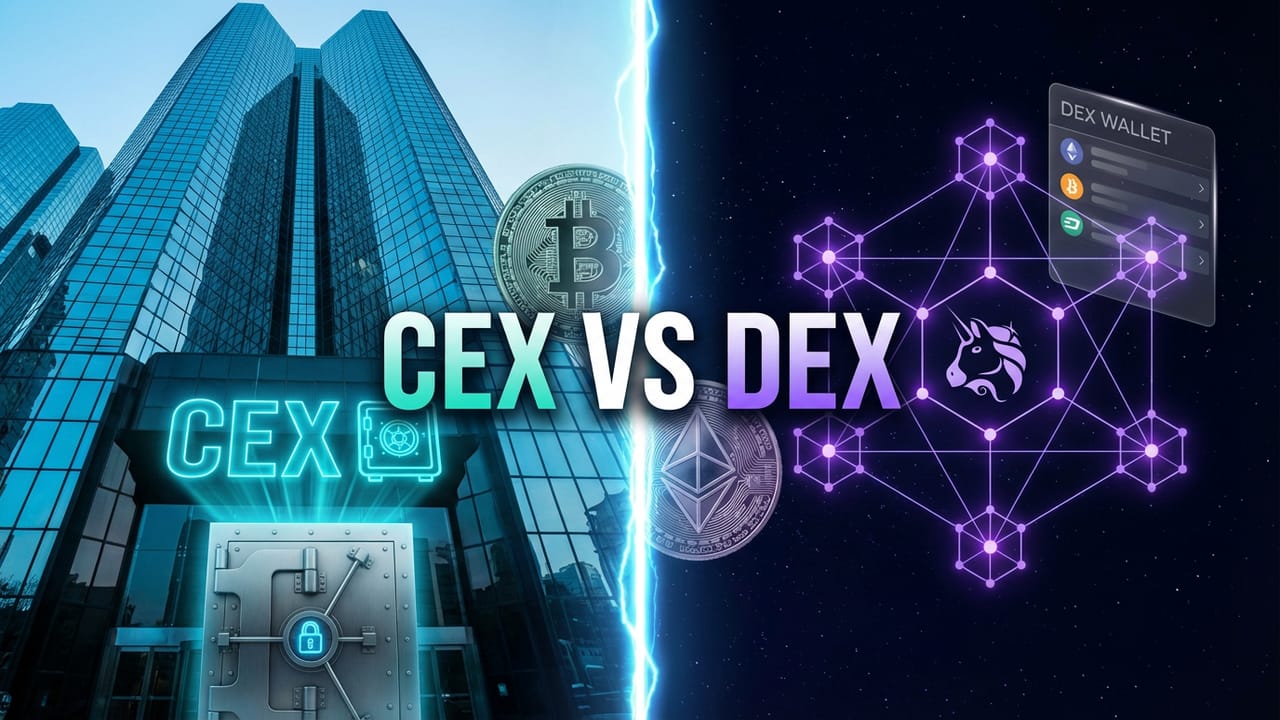
Centralized vs Decentralized Exchanges: Ultimate Trading Guide
Compare centralized exchange custody with decentralized exchange autonomy. Understand how CEX platforms like Binance differ from DEX protocols like Uniswap across liquidity, security, and regulatory frameworks.
Table of Contents
- → Understanding Centralized vs Decentralized Exchanges
- → CEX vs DEX Custody and Control Differences
- → Liquidity and Execution: Order Books vs AMM
- → Fee Structure Analysis: CEX vs DEX Costs
- → Security Architecture Comparison
- → Regulatory and Compliance Frameworks
- → Optimal Use Cases: When to Choose CEX or DEX
- → Leading CEX and DEX Platform Examples
- → Frequently Asked Questions
Centralized exchanges operate as intermediaries controlling user cryptocurrency deposits whilst facilitating trades through internal matching engines. Platforms like Binance, Coinbase, and Bybit exemplify centralized infrastructure processing $100+ billion combined daily volume through custodial accounts requiring KYC identity verification.
When comparing centralized vs decentralized exchanges, the core distinction centres on custody control. CEX platforms maintain private keys accessing user funds stored in hot wallets (5-10% online) and cold wallets (90-95% offline). Users receive internal account balances representing claims on exchange-held reserves rather than direct blockchain ownership.
Decentralized exchanges eliminate intermediaries through smart contracts executing trades directly between user wallets on blockchain networks. Protocols like Uniswap, PancakeSwap, and SushiSwap enable peer-to-peer trading without custody requirements, identity verification, or central authority control. According to CoinGecko DEX data, decentralized platforms process $5+ billion daily volume through automated market maker (AMM) algorithms replacing traditional order books.
The centralized vs decentralized exchange debate fundamentally addresses custody trade-offs determining who holds private keys accessing cryptocurrency funds. Centralized platforms absorb security responsibility creating single failure points alongside regulatory compliance benefits. Decentralized protocols preserve user custody eliminating counterparty risk whilst introducing smart contract vulnerabilities and reduced liquidity depth.
Centralized vs Decentralized Exchange Custody Models
Custody architecture represents the most fundamental difference separating centralized vs decentralized exchanges. This distinction determines liability assignment, security obligations, and asset recovery possibilities when issues arise.
Centralized Exchange Custody
- Exchange controls private keys
- Users receive account balances (claims on reserves)
- 90-95% cold storage offline protection
- Multi-signature withdrawal authorization
- Insurance fund coverage (SAFU $1B+ Binance)
Decentralized Exchange Custody
- Users control private keys via wallets
- Direct blockchain ownership (MetaMask, Ledger)
- Smart contracts facilitate atomic swaps
- No platform custody or insurance
- Instant withdrawal to user address
Centralized exchanges consolidate security risk into single entities requiring trust but providing recourse mechanisms (customer support, insurance, legal action). Decentralized protocols distribute risk to individual users eliminating single points of failure but removing recovery options when issues occur.
Liquidity and Execution: Centralized vs Decentralized Exchange Mechanisms
Trading execution architecture fundamentally differs between centralized order book matching and decentralized automated market makers. These mechanisms determine price discovery, slippage characteristics, and order type availability across CEX vs DEX platforms.
CEX Order Book Liquidity
Binance maintains $50+ billion daily volume enabling tight 0.01% BTC/USDT spreads. Matching engines process 1.4 million transactions per second pairing orders with sub-millisecond latency during normal market conditions.
DEX AMM Liquidity Pools
Uniswap V3 concentrates liquidity within specific price ranges improving capital efficiency. Liquidity providers deposit token pairs earning 0.30% trading fees on each swap executed through their pool positions.
Fee Structure Analysis: Centralized vs Decentralized Exchange Costs
Total trading costs differ substantially when comparing centralized vs decentralized exchanges. CEX platforms charge trading fees on internal ledgers whilst DEX protocols add blockchain gas costs and algorithmic slippage.
Centralized Exchange Fees
0.02-0.20%
0.02-0.05%
Fixed per coin
Included
Decentralized Exchange Fees
0.25-0.30%
$2-50+ variable
0.5-5%
$5-20 one-time
Security Architecture: Centralized vs Decentralized Exchange Risk Models
Security considerations differ fundamentally across centralized vs decentralized exchanges. Both models experience $100+ million annual losses through distinct attack vectors requiring different protective measures.
CEX Security Risks
- Exchange hacking (Mt.Gox, FTX precedent)
- Insider theft from employee access
- Platform insolvency freezing withdrawals
- Regulatory seizure of user funds
- Database breach exposing user data
CEX Security Protections
- SAFU insurance funds ($1B+ Binance)
- Cold storage majority (90-95% offline)
- Proof of reserves audits
- 2FA, withdrawal whitelisting
- Customer support recovery options
DEX Security Risks
- Smart contract vulnerabilities and exploits
- User error losing private keys permanently
- Phishing attacks targeting wallet connections
- Front-running MEV extraction
- Rug pulls from unaudited pools
DEX Security Protections
- Open-source contract code audits
- Hardware wallet cold storage (Ledger)
- Multi-signature wallet requirements
- Transaction simulation previews
- Revoke.cash token approval management
Both centralized and decentralized exchanges experience significant security breaches annually. CEX platforms consolidate risk into single entities requiring trust but providing recourse (insurance, legal action, customer support). DEX protocols distribute risk to individual users eliminating single points of failure but removing recovery mechanisms when private keys are lost or compromised.
Regulatory and Compliance: Centralized vs Decentralized Exchange Frameworks
Regulatory compliance represents a critical differentiator when comparing centralized vs decentralized exchanges. KYC requirements, tax reporting obligations, and jurisdictional restrictions vary substantially across both models.
CEX Compliance Requirements
Mandatory Procedures:
- KYC identity verification for all users
- AML transaction monitoring systems
- Tax form distribution (1099-MISC US)
- Geographical restrictions enforcement
- Transaction history preservation
- Law enforcement cooperation
Verification Tiers:
DEX Compliance Landscape
Current Status:
- No KYC requirements for protocol access
- Pseudonymous wallet-based trading
- User responsible for tax tracking
- Frontend IP restrictions increasing
- Smart contract immutability limits compliance
- Evolving regulatory uncertainty globally
Regulatory Targeting:
Centralized exchanges provide clear tax documentation simplifying annual reporting requirements. Decentralized platforms transfer tax tracking responsibility entirely to users requiring third-party tools like CoinTracker or Koinly for capital gains calculation. Both models require proper tax compliance regardless of KYC verification status.
Optimal Use Cases: When to Choose CEX or DEX Platforms
Platform selection depends on trading priorities balancing custody preferences, feature requirements, and cost considerations. Understanding when centralized vs decentralized exchanges excel enables optimal exchange selection for specific use cases.
Choose Centralized Exchange When:
- Trading large volumes requiring deep liquidity ($100K+ orders)
- Converting fiat currency to cryptocurrency via bank transfer
- Using advanced order types (stop-loss, limit, trailing stops)
- Trading derivatives (futures, options, perpetual contracts)
- Requiring customer support for account issues or disputes
- Preferring convenience over maximum self-custody
- Operating within clear regulatory frameworks with KYC compliance
- Needing mobile applications for trading on-the-go
Choose Decentralized Exchange When:
- Prioritising self-custody eliminating counterparty risk entirely
- Trading newly launched tokens unavailable on CEX platforms
- Avoiding KYC identity verification maintaining pseudonymity
- Providing liquidity earning passive trading fee income
- Operating from jurisdictions blocking centralized exchange access
- Requiring maximum transaction privacy via blockchain pseudonymity
- Participating in DeFi yield farming strategies across protocols
- Trading smaller amounts minimising gas cost impact (L2 solutions)
Leading Centralized and Decentralized Exchange Examples
Examining specific platforms illustrates how centralized vs decentralized exchanges implement custody models, liquidity mechanisms, and feature offerings across both architectural approaches.
Binance
Key Metrics:
- Daily Volume: $50+ billion
- Trading Pairs: 600+ spot markets
- Leverage: Up to 125x futures
- Supported Countries: 180+
- KYC: Tiered verification levels
Bybit
Key Metrics:
- Daily Volume: $15+ billion derivatives
- Focus: Perpetual contracts
- Margin: Unified margin accounts
- Features: Demo trading mode
- Interface: Simplified for beginners
Uniswap
Key Metrics:
- Daily Volume: $5+ billion
- Token Support: 1,000+ ERC-20 tokens
- Innovation: Concentrated liquidity V3
- Efficiency: Capital efficiency improvements
- KYC: No identity verification required
PancakeSwap
Key Metrics:
- Network: BNB Chain (BSC)
- Gas Fees: $0.10-0.50 per transaction
- Features: Yield farming pools
- Gamification: Lottery system
- NFT: Marketplace integration
Compare Top CEX Platforms
Review Binance, Bybit, OKX, and Coinbase across liquidity, fees, leverage options, and security features.
New to Crypto Trading?
Start with beginner-friendly CEX platforms offering education, demo accounts, and customer support.
Frequently Asked Questions
Which is safer: centralized or decentralized exchanges?
Both centralized vs decentralized exchanges present distinct trade-offs rather than absolute safety advantages. CEX platforms consolidate risk into single entities creating counterparty exposure (FTX $8B collapse) but providing insurance funds, customer support, and regulatory oversight. DEX protocols eliminate counterparty risk through self-custody but introduce smart contract vulnerabilities ($2B+ annual exploits) and permanent loss risks from user error. Neither model guarantees superior security—both require proper risk management practices appropriate to each architecture.
Do decentralized exchanges require KYC verification?
Pure DEX protocols like Uniswap eliminate KYC requirements through permissionless smart contract access. Users connect wallet addresses (MetaMask, Trust Wallet) without identity verification enabling pseudonymous trading. However, frontend restrictions increasingly implement IP-based geographical blocks responding to regulatory pressure. Liquidity providers earning trading fees face tax obligations requiring proper reporting despite lack of platform-mandated KYC. The distinction matters: protocol-level access remains permissionless whilst frontend interfaces add compliance layers.
Why are DEX fees typically higher than CEX fees?
Decentralized exchanges incur blockchain gas costs ($2-50 Ethereum, $0.10-0.50 BSC) absent from CEX internal ledgers plus 0.25-0.30% swap fees distributed to liquidity providers. Large orders face additional slippage (0.5-5%) from pool imbalance exceeding CEX order book depth. Example comparison: $10,000 trade costs $10-20 (0.10-0.20%) on Binance versus $50-150 (0.30% swap + gas + slippage) on Uniswap. Layer 2 solutions (Arbitrum, Optimism) reduce gas costs dramatically whilst maintaining self-custody benefits.
Can I trade derivatives and futures on decentralized exchanges?
Emerging DEX derivatives platforms like dYdX, GMX, and Gains Network enable perpetual futures trading with 20-50x leverage through decentralized architecture. However, liquidity remains substantially lower than CEX derivatives markets ($15B+ daily Bybit/Binance versus $500M-1B DEX derivatives). Order books depths, funding rate mechanisms, and liquidation systems differ from centralized equivalents requiring careful evaluation. Most traders prioritise CEX platforms for derivatives trading given superior liquidity, advanced order types, and cross-margin capabilities.
Should beginners start with CEX or DEX platforms?
Centralized exchanges provide simpler onboarding for cryptocurrency beginners through intuitive interfaces, fiat on-ramps, educational resources, and customer support resolving account issues. Platforms like Binance, Coinbase, and Bybit offer demo accounts, trading tutorials, and guided experiences unavailable on DEX protocols. Decentralized exchanges demand technical proficiency managing wallet security, gas fees, slippage settings, and smart contract interactions. Recommendation: Start with CEX platforms establishing fundamental trading knowledge before progressing to DEX protocols when self-custody priorities justify additional complexity.
Ready to Compare Exchange Platforms?
Explore detailed reviews of leading centralized exchanges or discover beginner-friendly platforms offering education, demo accounts, and customer support.
This comparison provides objective analysis for educational purposes. Neither centralized nor decentralized exchanges guarantee superior security, returns, or risk profiles. Both models present substantial risks requiring thorough due diligence. Conduct independent research understanding custody trade-offs, implement appropriate security measures (2FA, hardware wallets), and never invest more than you can afford to lose. Cryptocurrency trading involves significant risk of capital loss.
