Perpetual Futures vs Quarterly Futures: Complete Crypto Guide (2025)
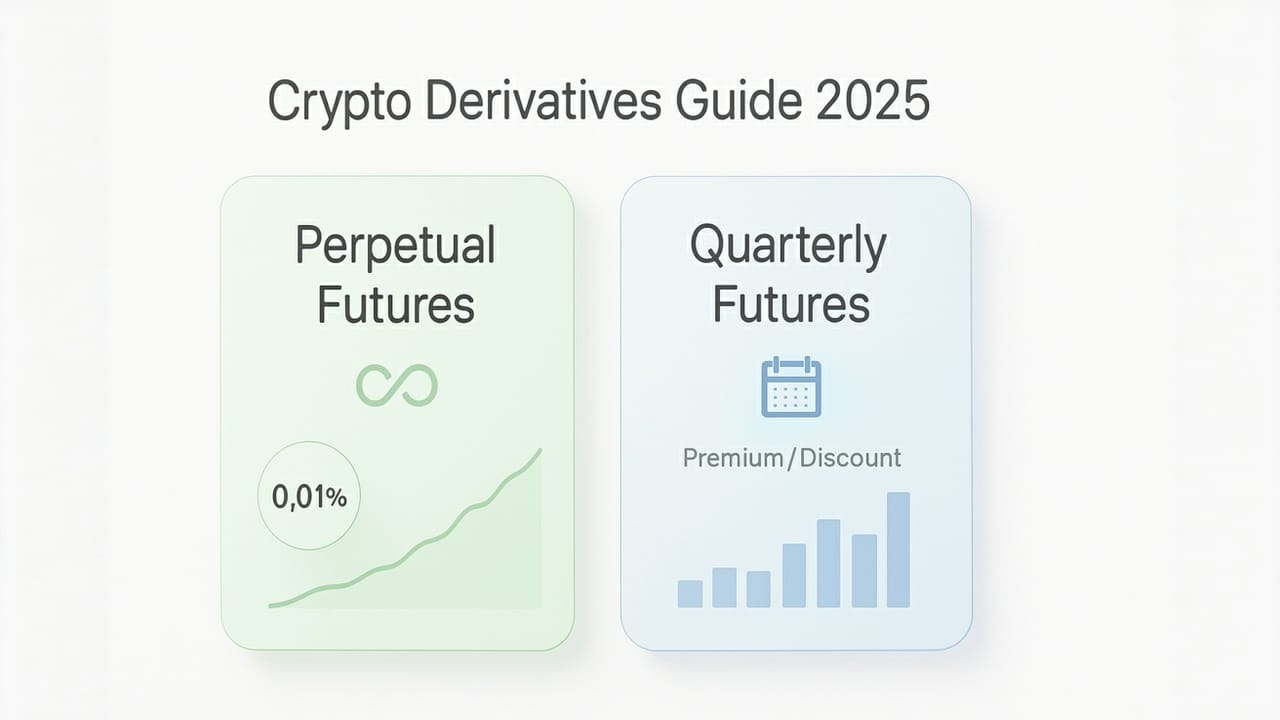
Understanding perpetual futures vs quarterly futures is essential for any crypto derivatives trader. These two contract types serve different purposes, have distinct cost structures, and suit different trading strategies. This comprehensive guide breaks down every difference to help you choose the right instrument.
In 2025, perpetual futures dominate 93% of crypto derivatives trading volume, but quarterly futures offer unique advantages for specific strategies. Whether you’re day trading or planning long-term hedges, understanding perpetual futures vs quarterly futures will significantly impact your profitability.
🎯 Quick Answer: Perpetual vs Quarterly Futures
| Main Difference: | Perpetuals never expire; Quarterlies expire every 3 months |
| Perpetual Best For: | Short-term trading, scalping, day trading |
| Quarterly Best For: | Long-term hedging, basis trading, cost efficiency |
| Key Cost Difference: | Perpetuals have funding fees; Quarterlies have no funding fees |
Last Updated: December 2025 | Reading Time: 12 minutes | Difficulty: Intermediate
📋 Table of Contents
- 1. What Are Perpetual and Quarterly Futures?
- 2. Perpetual Futures vs Quarterly Futures: Key Differences
- 3. Expiration: No Expiry vs Fixed Settlement
- 4. Funding Rates vs No Funding Fees
- 5. Pricing Mechanism: Spot Tracking vs Basis
- 6. Trading Strategies for Each Contract Type
- 7. Perpetual Futures vs Quarterly Futures: Which to Choose?
- 8. FAQ
World’s #1 Crypto Derivatives Exchange • Up to 50x Leverage • Lowest Fees • Free TestNet
1. What Are Perpetual and Quarterly Futures?
Before diving into perpetual futures vs quarterly futures, let’s understand what each contract type is:
⚡ Perpetual Futures
Perpetual futures (or “perps”) are derivative contracts that never expire. You can hold a position indefinitely as long as you maintain sufficient margin.
- No expiration date
- Uses funding rate mechanism
- Tracks spot price closely
- 93% of crypto derivatives volume
- 24/7 continuous trading
📅 Quarterly Futures
Quarterly futures (or “delivery futures”) are traditional contracts that expire every 3 months on a predetermined date.
- Fixed expiration (end of quarter)
- No funding fees
- Trades at premium/discount to spot
- Auto-settlement at expiry
- Better for long-term strategies
Brief History
Perpetual futures were invented by Deribit in 2016 specifically for crypto markets. Traditional quarterly futures have existed in commodities and financial markets for decades. The crypto industry adopted both, but perpetuals quickly dominated due to their simplicity and 24/7 trading nature.
2. Perpetual Futures vs Quarterly Futures: Key Differences
Here’s a comprehensive comparison of perpetual futures vs quarterly futures across all important factors:
| Feature | Perpetual Futures ⚡ | Quarterly Futures 📅 |
|---|---|---|
| Expiration | Never expires | Expires quarterly (Mar, Jun, Sep, Dec) |
| Funding Rate | Yes (every 8 hours) | No funding fees |
| Price Tracking | Closely tracks spot price | Trades at premium/discount (basis) |
| Settlement | No settlement (continuous) | Cash-settled at expiry |
| Rollover Required | No rollover needed | Must roll to new contract at expiry |
| Holding Cost (Bull Market) | Higher (positive funding) | Lower (no recurring fees) |
| Liquidity | Highest liquidity | Lower but adequate |
| Leverage | Up to 100-125x | Up to 50-100x |
| Best For | Day trading, scalping | Hedging, basis trading |
| Complexity | Simpler to understand | More complex (expiry management) |
3. Expiration: No Expiry vs Fixed Settlement
The most fundamental difference in perpetual futures vs quarterly futures is the expiration mechanism:
⚡ Perpetual Futures: No Expiration
Perpetual contracts have no expiration date. You can hold a position indefinitely as long as:
- You maintain sufficient margin (above maintenance margin)
- You’re not liquidated due to adverse price movement
- You continue paying/receiving funding rates
Example:
You open a BTC-PERP long position in January 2025. You can hold it through February, March, and beyond without any action required – unlike quarterly contracts that would force closure.
📅 Quarterly Futures: Fixed Expiration
Quarterly contracts expire on predetermined dates, typically:
| Q1 | Last Friday of March |
| Q2 | Last Friday of June |
| Q3 | Last Friday of September |
| Q4 | Last Friday of December |
What Happens at Expiry:
Your position is automatically closed (cash-settled) at the settlement price. If you want to maintain exposure, you must “roll over” to the next quarterly contract.
⚠️ Rollover Costs
Rolling over quarterly contracts incurs transaction fees and potential slippage. If the new contract trades at a different price (contango or backwardation), you may gain or lose value during rollover.
4. Funding Rates vs No Funding Fees
The cost structure is a crucial factor when comparing perpetual futures vs quarterly futures:
⚡ Perpetual Futures: Funding Rate Mechanism
Perpetuals use funding rates to keep the contract price anchored to spot price:
Funding Rate Schedule:
- Frequency: Every 8 hours (00:00, 08:00, 16:00 UTC)
- Typical Range: -0.1% to +0.1% per 8 hours
- Annual Equivalent: Can exceed 100% APR in extreme markets
- Who Pays: Depends on market sentiment and position
💡 Funding Rate Example
Position: 1 BTC Long at $100,000
Funding Rate: +0.01% (positive)
You Pay: $100,000 × 0.01% = $10 every 8 hours
Daily Cost: $30 ($10 × 3)
Monthly Cost: ~$900
📅 Quarterly Futures: No Funding Fees
Quarterly contracts have zero funding fees. Your only costs are:
- Trading fees: Maker/taker fees when opening/closing
- Settlement fee: Small fee at expiry (e.g., 0.015% on Deribit)
- Rollover fees: If you roll to next contract
Cost Advantage:
In bull markets with persistent positive funding, quarterly futures can save you thousands in funding costs for long-term positions.
Cost Comparison: 3-Month Hold
| Cost Type | Perpetual (3 months) | Quarterly (3 months) |
|---|---|---|
| Trading Fees (Open) | 0.03% | 0.03% |
| Trading Fees (Close) | 0.03% | 0.015% (settlement) |
| Funding Fees (avg 0.01%) | ~2.7% (270 × 0.01%) | $0 |
| Total Cost | ~2.76% | ~0.045% |
*Assumes average positive funding rate of 0.01% per 8 hours in bull market. Actual costs vary significantly based on market conditions.
5. Pricing Mechanism: Spot Tracking vs Basis
Understanding how prices are determined is key to trading perpetual futures vs quarterly futures effectively:
⚡ Perpetual Futures: Tracks Spot Price
The funding rate mechanism keeps perpetual prices very close to spot:
- If perp trades above spot → positive funding → incentivizes shorts → price falls toward spot
- If perp trades below spot → negative funding → incentivizes longs → price rises toward spot
- Result: Perpetual price typically stays within 0.1-0.5% of spot
📅 Quarterly Futures: Trades at Premium/Discount (Basis)
Quarterly contracts trade at a basis – the difference between futures price and spot price:
Basis Calculation:
Example:
BTC Spot: $100,000
BTC-DEC25 Futures: $105,000
Basis: +5% (Contango)
💡 Why Basis Matters
Convergence: At expiry, futures price converges to spot price (basis → 0). If you buy at +5% premium, you effectively “lose” that 5% as the contract approaches expiry (assuming spot doesn’t move).
Opportunity: Basis trading (buying spot + shorting futures) is a popular low-risk strategy to capture this premium.
Industry-Leading Liquidity • Low Fees • Free TestNet to Practice
6. Trading Strategies for Each Contract Type
Different strategies work better with perpetual futures vs quarterly futures:
⚡ Best Strategies for Perpetual Futures
📈 Day Trading / Scalping
High liquidity and tight spreads make perpetuals ideal for short-term trades. No need to worry about expiry during intraday positions.
🔄 Swing Trading
Hold positions for days to weeks. Monitor funding rates – they can add to or subtract from your profits significantly.
💰 Funding Rate Arbitrage
Go short perpetual + long spot when funding is high positive. Collect funding payments while being market-neutral.
🎯 High-Leverage Directional
Use higher leverage (50-100x) for short-term directional bets. Quick in-and-out to minimize funding impact.
📅 Best Strategies for Quarterly Futures
🛡️ Long-Term Hedging
Miners and holders use quarterly futures to hedge price exposure for months without paying recurring funding fees.
💵 Basis Trading (Cash & Carry)
Buy spot BTC + short quarterly futures in contango. Lock in the basis as risk-free profit. Popular institutional strategy.
📊 Calendar Spread Trading
Long one quarter, short another. Profit from changes in the term structure without directional exposure.
📆 Event Trading
Position for known events (halvings, ETF decisions) using specific expiry dates aligned with the event.
Strategy Comparison Table
| Strategy | Best Contract | Why |
|---|---|---|
| Scalping (minutes) | Perpetual | Highest liquidity, tightest spreads |
| Day Trading | Perpetual | No expiry concern, tracks spot |
| Swing Trading (days-weeks) | Either | Depends on funding rates |
| Position Trading (months) | Quarterly | No funding fees |
| Hedging Holdings | Quarterly | Cost-efficient for long periods |
| Basis/Carry Trade | Quarterly | Captures contango premium |
| Funding Arbitrage | Perpetual | Collects funding payments |
7. Perpetual Futures vs Quarterly Futures: Which to Choose?
Here’s a decision framework to help you choose between perpetual futures vs quarterly futures:
🎯 Choose Perpetual Futures If:
- ✅ You’re day trading or scalping (holding minutes to hours)
- ✅ You want the highest liquidity and tightest spreads
- ✅ You prefer simplicity without expiry management
- ✅ You want to collect funding in bear markets (short positions)
- ✅ You need maximum leverage (100x+)
- ✅ You’re trading volatile market conditions (quick adjustments)
📅 Choose Quarterly Futures If:
- ✅ You’re holding positions for weeks to months
- ✅ You want to avoid recurring funding fees
- ✅ You’re hedging spot holdings long-term
- ✅ You want to execute basis trading strategies
- ✅ You prefer predictable, fixed-term exposure
- ✅ You’re an institution needing structured products
Quick Decision Flowchart
💡 Pro Tip: Use Both!
Many professional traders use both contract types:
• Perpetuals for active trading and quick adjustments
• Quarterlies for longer-term hedges and basis trades
Deribit offers both perpetual and quarterly futures on BTC and ETH, allowing you to optimize your strategy.
8. FAQ: Perpetual Futures vs Quarterly Futures
❓ What is the main difference between perpetual and quarterly futures?
Expiration: Perpetual futures never expire and use funding rates to track spot price. Quarterly futures expire every 3 months and trade at a basis (premium or discount) to spot. Perpetuals are simpler but have recurring costs; quarterlies have no funding fees but require expiry management.
❓ Which is more expensive to hold long-term?
Perpetual futures are typically more expensive for long-term holds due to funding rates. In bull markets, positive funding can cost 2-3% per month for long positions. Quarterly futures have no funding fees, making them more cost-efficient for holding periods over 1 month.
❓ What happens if I hold a quarterly future until expiry?
Your position is automatically cash-settled at the settlement price (average of spot price around expiry time). You receive/pay the difference between your entry price and settlement price. No action required – but remember to roll over if you want to maintain exposure.
❓ How often are funding rates paid on perpetual futures?
Funding rates are exchanged every 8 hours on most exchanges (00:00, 08:00, 16:00 UTC). The rate varies based on market conditions – positive when longs pay shorts (bullish sentiment), negative when shorts pay longs (bearish sentiment). Typical range is -0.1% to +0.1% per 8 hours.
❓ Which has more liquidity – perpetual or quarterly?
Perpetual futures have significantly higher liquidity, accounting for 93% of crypto derivatives trading volume. This means tighter bid-ask spreads and lower slippage. Quarterly futures have adequate liquidity on major exchanges like Deribit but are less liquid than perpetuals.
❓ What is basis trading with quarterly futures?
Basis trading (or cash-and-carry) involves buying spot BTC and shorting quarterly futures when futures trade at a premium (contango). You lock in the basis as profit when the futures price converges to spot at expiry. This is a market-neutral strategy popular among institutions.
❓ Can I trade both perpetual and quarterly futures on the same exchange?
Yes, major exchanges like Deribit, Binance, and OKX offer both contract types. You can hold positions in both simultaneously and even use them together for spread strategies.
❓ Which is better for beginners?
Perpetual futures are generally easier for beginners because there’s no expiry to manage and the price closely tracks spot. However, beginners should start with low leverage and understand funding rates before trading. Practice on Deribit TestNet first.
World’s #1 Crypto Derivatives Exchange • Both Contract Types • Up to 50x Leverage • Free TestNet
Practice risk-free on TestNet • 24/7 Support
📝 Summary: Perpetual vs Quarterly Futures
| ⚡ Perpetual Futures | 📅 Quarterly Futures |
| No expiration | Expires every 3 months |
| Funding fees every 8h | No funding fees |
| Tracks spot price | Trades at basis |
| Higher liquidity | Lower liquidity |
| Best for: Day trading, scalping | Best for: Hedging, basis trading |
⚠️ Risk Warning & Disclaimer
Risk Warning: Trading crypto futures involves substantial risk of loss. Leverage amplifies both gains and losses. You can lose more than your initial investment. Only trade with funds you can afford to lose.
Not Financial Advice: This article is for educational and informational purposes only. It does not constitute financial, investment, or trading advice. Always do your own research.
Affiliate Disclosure: This article contains affiliate links. We may earn a commission if you sign up through our links at no additional cost to you.
Last updated: December 2025
📚 Related Guides
