Crypto News Today: Trump Orders Navy Tanker Escorts, CFTC Clears Path for Perpetual Futures, Binance Launches AI Trading Skills
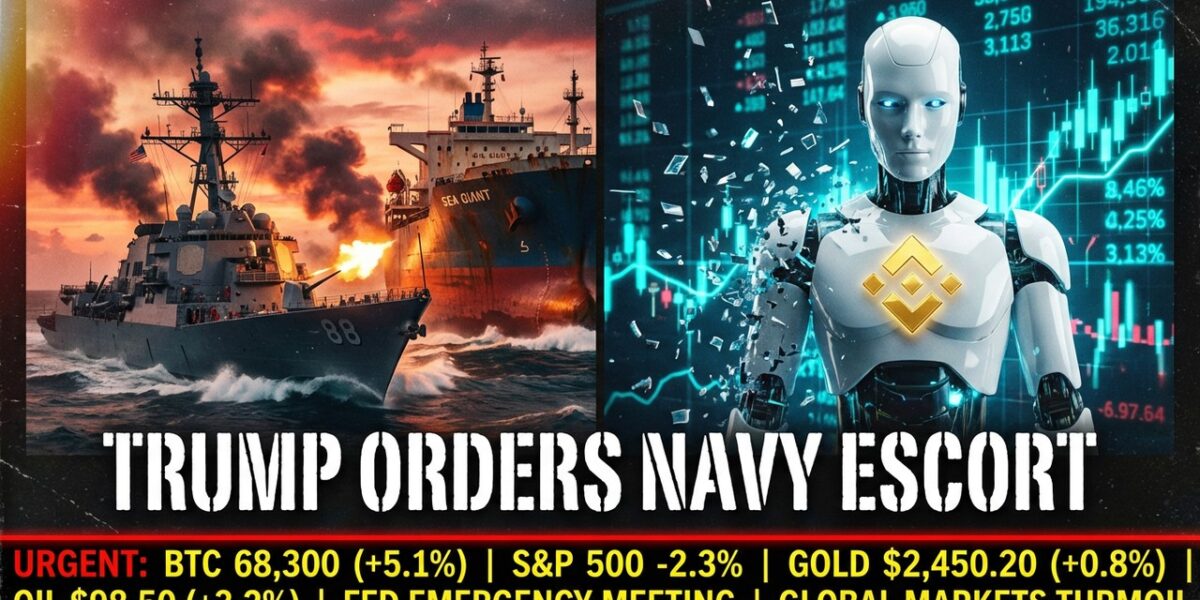
Crypto News Today: Trump Orders Navy Tanker Escorts, CFTC Clears Path for Perpetual Futures, Binance Launches AI Trading Skills
Written by AffMiss Editorial · Updated: · 10 min read
BTC Price
$68,300
-0.7% / 24h
S&P 500
-2.3%
Equities sell-off
Brent Crude
$80/bbl
+15% since Fri
US Gas Price
$3.11/gal
+$0.11 in 24h
The crypto market held relative ground on Tuesday while traditional markets buckled under Iran-war pressure. Bitcoin traded near $68,300 — down less than 1% — while the S&P 500 fell 2.3% and the Nasdaq lost 2.5%. Gold, which hit record highs last week, dropped 4.3% as traders liquidated to cover margin calls. Brent crude hovered near $80 per barrel after the Strait of Hormuz entered its fourth consecutive day of functional closure.
Seven stories shaped crypto markets today. Here is what each one means for traders and the broader market.
1. Trump Orders Navy to Escort Oil Tankers Through Strait of Hormuz
President Trump posted on Truth Social that he had directed the US Development Finance Corporation (DFC) to provide political risk insurance for all maritime trade in the Gulf. He added that the US Navy would begin escorting tankers through the Strait of Hormuz if needed. The announcement follows four straight days of near-total shipping halt through the strait, which handles roughly 20% of the world’s oil supply — around 20 million barrels per day.
The context: shipping insurers have withdrawn war-risk coverage. Maersk, Hapag-Lloyd, and NYK have suspended all Gulf transits. Multiple tankers have been struck or damaged since Operation Epic Fury began on 28 February. IRGC commander Ebrahim Jabari declared the strait closed and threatened to attack any vessel that attempts passage.
Oil prices briefly retreated after Trump’s announcement, with Brent dipping from $82 to $80. However, analysts at Rapidan Energy Group warned that implementation would take time — the US Navy must first suppress Iran’s anti-ship missile and drone capability before safe escort corridors can operate. Meanwhile, US gasoline prices jumped 11 cents in 24 hours to $3.11 per gallon, per AAA data. Rising fuel costs ahead of 2026 midterm elections create political urgency for the White House.
Crypto impact: Bitcoin showed relative resilience compared to equities. While the Nasdaq fell 2.5%, BTC held above $66,000 support and recovered to $68,000 by end of US trading. The decoupling from stock markets during geopolitical stress mirrors June 2025, when a similar Iran strike saw BTC dip below $100,000 but rally to $123,000 within weeks.
2. Trump Threatens to Cut All Trade with Spain over Iran Base Dispute
During an Oval Office meeting with German Chancellor Friedrich Merz, Trump announced he had ordered Treasury Secretary Scott Bessent to cut off all trade with Spain. The trigger: Madrid refused to allow the US military to use jointly operated bases at Rota and Moron in southern Spain for strikes on Iran. The US relocated 15 aircraft, including refuelling tankers, from Spanish territory.
Spanish Prime Minister Pedro Sanchez called the US-Israel strikes on Iran an “unjustifiable military intervention.” Foreign Minister Jose Manuel Albares stated that the bases fall under Spanish sovereignty and UN Charter rules. Madrid responded that the US must respect international law and EU-US bilateral trade agreements.
Bilateral trade between the US and Spain totals roughly $40 billion annually. Spain exports olive oil, auto parts, steel, and chemicals to the US. Analysts view the trade threat as political pressure rather than imminent policy — any full embargo would require Congressional action or invocation of the International Emergency Economic Powers Act (IEEPA). However, the escalation adds to global trade uncertainty at a time when markets are already fragile.
Crypto impact: Trade war rhetoric adds to risk-off sentiment across equity markets. European indices fell hard — Italy’s IBEX 35 dropped 5.2%, Germany’s DAX lost 4.1%. Crypto markets absorbed the shock better than stocks, reinforcing Bitcoin’s role as a liquid alternative during forced risk reduction.
3. CFTC Chair Says US Crypto Perpetual Futures Coming Within a Month
CFTC Chairman Mike Selig announced at the Milken Institute’s Future of Finance conference that the agency will issue guidance for crypto perpetual futures within weeks. He expects regulated perpetual contracts to launch in the US within approximately four weeks. Selig currently acts as the sole commissioner on the five-member CFTC panel, giving him unilateral authority to issue guidance.
Perpetual futures are contracts without expiration dates — the dominant instrument on offshore exchanges like Bybit, Binance, and OKX. These platforms process over $50 billion in daily perpetual volume. US traders have been largely excluded from regulated perpetual markets, pushing liquidity offshore.
The move is part of Project Crypto, a joint CFTC-SEC initiative launched in January 2026 by Selig and SEC Chair Paul Atkins. The framework will include leverage limits, transparency requirements, and registration standards. Selig also indicated that DeFi developer guidance and prediction market rules are coming alongside the perpetual futures framework.
Crypto impact: This is the most significant US derivatives regulation development since spot Bitcoin ETF approval. If regulated perpetuals launch, institutional capital currently parked in CME futures ($15B+ open interest) could shift to perpetual markets for 24/7 hedging. Exchanges already CFTC-registered — including Coinbase and potentially Crypto.com — stand to capture this flow. Offshore exchanges may face volume migration as US-based traders shift to regulated venues.
4. ECB Warns Stablecoin Adoption Could Undermine Eurozone Monetary Policy
The European Central Bank published a working paper on 3 March titled “Stablecoins and Monetary Policy Transmission.” The paper warns that growing stablecoin adoption is linked to measurable declines in retail bank deposits and reduced lending to firms across the eurozone.
The numbers: the global stablecoin market cap has doubled in three years to $312 billion. Over 97% of that value is pegged to the US dollar. The ECB estimates that for every 10% increase in stablecoin market cap, bank lending drops by 0.2%. If stablecoin market cap reaches $2–$4 trillion by 2030 (as projected), the effect on monetary policy transmission could become non-linear and difficult to manage.
The core concern is deposit substitution. When individuals move euros into dollar-pegged stablecoins, European banks lose low-cost deposit funding. They shift to wholesale funding — which is more expensive and more volatile. This weakens the channel through which ECB interest rate decisions reach the real economy. The paper also warns that dollar-denominated stablecoins effectively import US monetary conditions into the eurozone, eroding ECB sovereignty.
Crypto impact: The ECB warning arrives as US lawmakers debate the CLARITY Act on stablecoin regulation. Banking lobbyists want a yield ban on stablecoins to protect deposits; TD Cowen analysts say banks will lose that fight. For crypto traders, stablecoin growth is a structural tailwind — more fiat entering the stablecoin ecosystem means more liquidity for crypto markets.
5. Bank of Japan to Test Blockchain Settlement for Central Bank Reserves
Bank of Japan Governor Kazuo Ueda announced at FIN/SUM 2026 in Tokyo that the BOJ will launch a sandbox to test blockchain-based settlement for central bank current account deposits — the reserves financial institutions hold at the central bank. This is wholesale infrastructure, not a retail digital yen.
The timeline: prototype development starts Q2 2026. Testing with selected financial institutions runs through 2027. Findings will be published by early 2028. The BOJ is also participating in Project Agora, a BIS-led experiment exploring tokenized central bank money for cross-border wholesale settlement with smart contracts.
Governor Ueda emphasised both the potential and the risks. He noted that blockchain could enable 24/7 atomic settlement (instant, irrevocable transfers) but warned that flawed smart contract design could threaten financial stability. Japan began CBDC experiments in 2021 and is expected to decide this year whether to issue a retail digital yen.
Crypto impact: Central bank blockchain adoption validates the core technology underpinning crypto markets. The BOJ joining the UK and Hong Kong in issuing sovereign infrastructure on distributed ledgers signals institutional acceptance. For the broader market, it accelerates the tokenisation narrative — real-world assets settled on-chain alongside crypto native assets.
6. Binance Launches 7 AI Agent Skills for Automated Trading
Binance and Binance Wallet rolled out seven AI Agent Skills that allow any AI agent to access real-time market data, execute trades, and monitor on-chain activity through a single interface. The launch positions Binance as the first major exchange to offer a unified AI-trading API layer.
The seven skills cover: (1) spot trading execution with OCO/OPO/OTOCO order types, (2) wallet address analysis with holdings and concentration data, (3) token information queries, (4) smart contract risk detection (flagging mint functions, freeze capabilities, ownership concentration), (5) market ranking data, (6) smart money signal tracking (whale buy/sell activity with trigger price and gain metrics), and (7) trading signal monitoring.
CZ (Changpeng Zhao) endorsed the rollout on X. Competitors are racing to match: OKX launched its OnchainOS AI platform the same day, Coinbase recently deployed agentic wallets, and Bitget added natural-language AI agent skills.
Crypto impact: AI-driven trading is shifting from experimental to production. The smart money signal tracking and automated contract audit features could reduce retail exposure to rug pulls and scam tokens. For active traders on Binance, the AI skills create an automated research-to-execution pipeline that was previously available only to institutional desks.
Market Outlook — What to Watch This Week
| Catalyst | Date | Potential Impact |
|---|---|---|
| Hormuz Navy escort implementation | This week | Oil price direction → inflation expectations → rate cut probability |
| CFTC perpetual futures guidance | Within 4 weeks | Regulated perpetuals could onshore $50B+ daily volume |
| Spain trade embargo details | TBD | Escalation hits EU risk assets; crypto may benefit as alternative |
| US CPI data | 12 March | Oil pass-through to inflation determines Fed March 18 stance |
| Fed rate decision | 18 March | Rate hold expected; any hawkish shift pressures risk assets |
Bitcoin has held the $65,000–$70,000 range through four days of escalating Middle East conflict, multiple equity sell-offs, and commodity volatility. This relative stability, while equities fall 2–5% daily, suggests crypto is building a floor. The CFTC perpetual futures announcement provides a medium-term structural catalyst. If regulated perpetuals launch within a month, expect renewed institutional interest in crypto derivatives — particularly from US-based funds currently limited to CME products.
The risk remains energy prices. If Brent crude breaks above $90 and US gasoline exceeds $3.50, the inflationary impact could force the Fed to delay rate cuts indefinitely — a headwind for all risk assets including crypto. Watch the Hormuz corridor reopening as the single most important macro variable this week.
Trade the News on Binance
Access AI-powered trading skills, real-time data, and the lowest fees in the market.
Affiliate link. 20% fee discount for AffMiss readers.
Crypto News Today — FAQ
Why is Bitcoin holding up while stocks are falling?
Bitcoin operates 24/7 and already absorbed the initial shock over the weekend (dropping to $63,000 on Feb 28). By Tuesday, it had rebounded to $68,000 while equities were still pricing in the geopolitical risk. Historically, BTC acts as a liquid weekend shock absorber, then decouples as traditional markets catch up.
What are crypto perpetual futures?
Perpetual futures are derivative contracts that track crypto prices without an expiration date. Traders use them to go long or short with leverage. Funding rates — paid every 8 hours — keep the contract price anchored to spot. They are the most traded instrument on offshore exchanges, with over $50 billion in daily volume.
How does the ECB stablecoin warning affect crypto?
The ECB warning is a signal that central banks view stablecoin growth as a structural threat to traditional banking. For crypto markets, this is paradoxically positive: stablecoin adoption means more fiat is entering the crypto ecosystem, increasing on-exchange liquidity. Regulatory friction could slow growth in Europe but accelerate it in the US and Asia.
What are Binance AI Agent Skills?
Seven automated tools that allow AI-powered trading bots to access Binance data and execute trades through a single interface. Skills include real-time market data, smart money tracking (whale activity), contract risk detection (rug pull flags), and advanced order execution (OCO/OTOCO). The tools are available through Binance API for developers and institutional traders.
Disclaimer: This article is for informational purposes only and does not constitute financial advice. Crypto trading involves risk. You can lose your entire capital. AffMiss may earn commissions through affiliate links. Always conduct your own research.
