Bybit vs MEXC 2026: Fees, Derivatives & Security Compared — Which Exchange Wins?
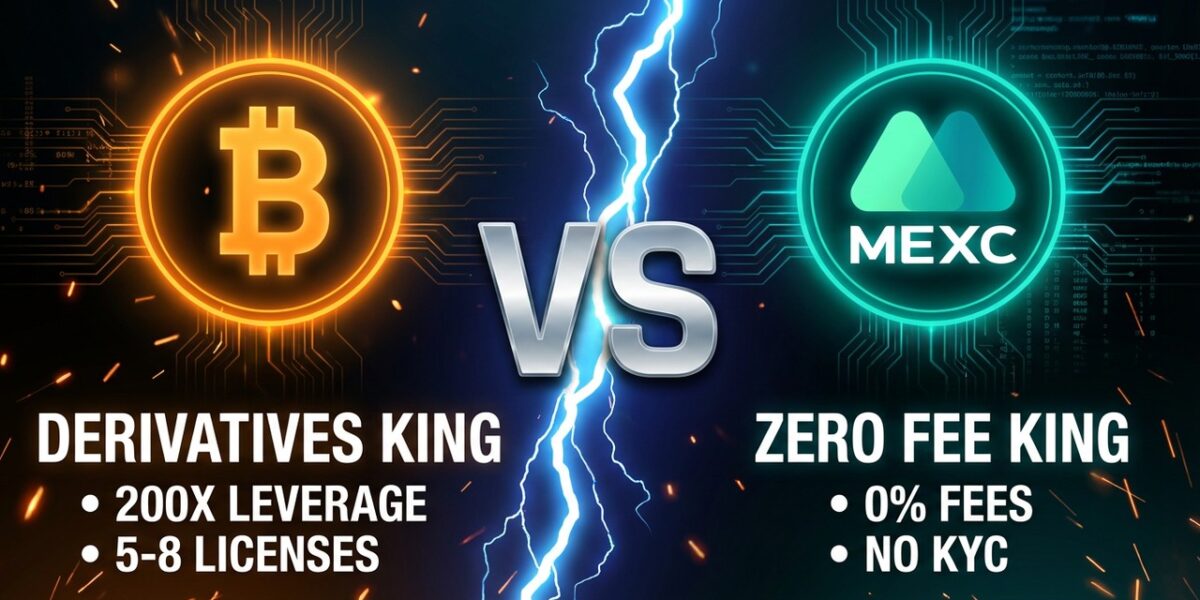
Bybit and MEXC both launched in 2018, but they serve different trading profiles. Bybit is the second-largest exchange by derivatives volume, processing $5–10 billion daily with 200× leverage, options contracts, and a Unified Trading Account (UTA) that manages margin across spot, futures, and options in one wallet. MEXC charges zero maker fees on spot and futures, lists 2,900+ coins (roughly 3× Bybit’s count), and allows trading without KYC verification. The core trade-off: Bybit offers derivatives sophistication and stronger regulatory coverage (UAE VARA, MiCA via Austria); MEXC offers lower costs and faster access to new tokens. This comparison breaks down fees, products, leverage, security, and user experience across both platforms.
Choose Bybit If
You trade derivatives seriously and need options contracts, UTA margin management, 200× leverage with dual-price liquidation, and regulatory backing from VARA and MiCA.
Choose MEXC If
You want zero maker fees on spot and futures, first-to-list access to 2,900+ coins, no-KYC trading with 10 BTC daily withdrawals, and up to 200× leverage on major pairs.
Quick Overview — Bybit vs MEXC at a Glance
The table below summarises how Bybit and MEXC compare across 15 categories. Both exchanges launched in 2018, but Bybit has grown to 80 million users while MEXC serves 40 million. Their fee structures, product depth, and regulatory positions differ in ways that matter for daily trading decisions.
| Metric | Bybit | MEXC | Winner |
|---|---|---|---|
| Founded | 2018 | 2018 | — |
| CMC Rank | #2 | #7 | Bybit |
| Registered Users | 80M+ | 40M+ | Bybit |
| Daily Volume | $5–10B | $3–5B | Bybit |
| Spot Trading Pairs | 1,000+ | 2,900+ | MEXC |
| Futures Contracts | 500+ | 1,400+ | MEXC |
| Spot Maker Fee | 0.10% | 0% | MEXC |
| Spot Taker Fee | 0.10% | 0.02% | MEXC |
| Futures Maker Fee | 0.02% | 0% | MEXC |
| Futures Taker Fee | 0.055% | 0.02% | MEXC |
| Max Leverage | 200× | 200× (500× select) | MEXC |
| Options Trading | ✅ (BTC, ETH) | ❌ | Bybit |
| KYC Required | Yes | Optional (10 BTC/day without) | MEXC |
| Regulatory Licences | 5–8 (VARA, MiCA, others) | 0 major licences | Bybit |
| Trustpilot Score | 3.4/5 | 1.8/5 | Bybit |
Bybit vs MEXC — Fee Comparison
MEXC wins on fees at every standard tier. Zero maker fees on both spot and futures is not a promotional event — it is MEXC’s standard policy. Bybit charges 0.10%/0.10% on spot and 0.02%/0.055% on USDT-M futures. The difference compounds for active traders.
Bybit Fees
Spot: 0.10% maker / 0.10% taker
MNT Discount: 25% off fees
Futures (USDT-M): 0.02% maker / 0.055% taker
VIP Tiers: Volume-based discounts from VIP1+
MEXC Fees
Spot: 0% maker / 0.02% taker
MX Discount: 50% off futures, 20% off spot taker
Futures (USDT-M): 0% maker / 0.02% taker
Zero-Fee Events: Periodic 0%/0% on 100+ pairs
At $1 million in monthly futures volume, a trader on Bybit pays approximately $550 in fees per month ($6,600 per year at the 0.055% taker rate). The same volume on MEXC costs roughly $200 ($2,400 per year at the 0.02% taker rate). The annual difference of $4,200 is significant for scalpers and high-frequency traders. Bybit’s VIP programme reduces fees at higher tiers, but MEXC’s base rates remain lower than Bybit’s VIP1 level for most traders.
Withdrawal Fees
| Coin / Network | Bybit | MEXC |
|---|---|---|
| BTC (On-chain) | 0.0002 BTC | 0.0001 BTC |
| ETH (Arbitrum) | 0.0001 ETH | 0.0003 ETH |
| USDT (TRC-20) | 1 USDT | 1 USDT |
| SOL | 0.01 SOL | 0.01 SOL |
Withdrawal fees are similar across both platforms, with marginal differences depending on the network. MEXC offers lower BTC withdrawal costs; Bybit offers lower ETH fees on Arbitrum. Neither exchange charges for crypto deposits.
Fee Verdict: MEXC Wins
Zero maker fees on spot and futures is the most aggressive fee policy among major exchanges. MEXC saves active traders $4,200 annually at $1M monthly futures volume compared to Bybit’s standard rates. Bybit’s VIP programme narrows the gap for high-volume traders but cannot match MEXC’s 0% maker baseline.
→ See our Lowest Fee Crypto Exchange ranking for full cost analysis.
Products and Features
Bybit started as a derivatives exchange and maintains that focus. It offers BTC and ETH options — a product MEXC does not support. Bybit’s Unified Trading Account (UTA) lets traders manage spot, futures, and options margin from a single wallet, reducing capital fragmentation. MEXC focuses on listing breadth and cost efficiency.
| Feature | Bybit | MEXC |
|---|---|---|
| Spot Pairs | 1,000+ | 2,900+ |
| Futures Contracts | 500+ | 1,400+ |
| Options Trading | ✅ (BTC, ETH) | ❌ |
| Unified Trading Account | ✅ | ❌ |
| Copy Trading | ✅ (Spot + Futures + Gold + FX) | ✅ (Futures only) |
| Demo Trading | ✅ | ✅ |
| Trading Bots | ✅ (Grid, DCA, Martingale) | ✅ (Grid, limited) |
| Earn Products | ✅ (Savings, Staking, Dual Asset) | ✅ (Staking, limited range) |
| NFT Marketplace | ✅ | ❌ |
| Web3 Wallet | ✅ | ❌ |
| Crypto Card | ✅ (Mastercard) | ❌ |
| Listing Speed | Moderate | Fastest (often first-to-list) |
| No-KYC Trading | ❌ | ✅ (10 BTC/day) |
| Meme Coin Zone | ❌ | ✅ (MEXC Meme+) |
Bybit’s copy trading covers spot, futures, gold, and FX pairs. MEXC copy trading is restricted to futures contracts only. Bybit also offers a crypto debit card (Mastercard), an NFT marketplace, and a Web3 wallet — products MEXC does not provide. For traders focused on the full crypto experience beyond spot and futures, Bybit offers a more complete ecosystem.
MEXC’s strength is listing speed. New tokens appear on MEXC days or weeks before Bybit. The MEXC Meme+ zone gives early access to trending meme coins. For altcoin hunters, this first-mover access translates to entry at lower prices before wider exchange availability drives demand. Bybit lists more selectively, which means higher average token quality but fewer early opportunities.
Products Verdict: Bybit Wins
Bybit offers options trading, UTA, broader copy trading (spot + futures + gold + FX), a Web3 wallet, an NFT marketplace, and a crypto card — products MEXC does not support. MEXC wins on coin count (2,900+ vs 1,000+) and listing speed. For derivatives depth and ecosystem breadth, Bybit leads. For altcoin discovery, MEXC leads.
→ Browse all platforms in our Exchange Comparison tool.
Leverage and Margin
Both exchanges offer 200× leverage on major pairs. MEXC additionally provides 500× on select USDT-M contracts — the highest among major exchanges. The core difference is not the leverage ceiling but the margin infrastructure.
Bybit Margin
Max Leverage: 200×
Margin Modes: Cross, Isolated, Portfolio (UTA)
Unified Trading Account: ✅
Dual-Price Liquidation: ✅
Options Hedging: ✅
MEXC Margin
Max Leverage: 200× (500× select pairs)
Margin Modes: Cross, Isolated
Unified Trading Account: ❌
Dual-Price Liquidation: ❌
Options Hedging: ❌
Bybit’s UTA allows margin sharing across spot, futures, and options positions. A profitable futures position offsets margin requirements on a losing options position — reducing total margin needed and preventing unnecessary liquidations. MEXC keeps spot and futures margin separate, requiring more total capital for the same combined exposure.
Bybit’s dual-price liquidation mechanism uses both the mark price and the last traded price to trigger liquidations. During sudden market wicks (like the February 2026 BTC flash crash from $67K to $63K), this system prevented premature liquidations that single-price systems triggered on other exchanges. MEXC uses standard mark-price liquidation only.
MEXC’s 500× leverage on select pairs is the highest available. At 500×, a 0.2% price movement against your position triggers a full loss. This level of leverage suits experienced scalpers with strict stop-loss discipline and is not appropriate for most traders.
Leverage Verdict: Bybit Wins
Bybit’s UTA margin management, dual-price liquidation, and options hedging provide superior capital efficiency and liquidation protection. MEXC’s 500× ceiling on select pairs is higher, but the margin infrastructure is less sophisticated. For derivatives-focused traders, Bybit’s margin system protects capital better under volatile conditions.
→ See our Best Crypto Futures Exchange ranking.
Security and Regulation
Bybit holds regulatory licences from UAE’s Securities and Commodities Authority (SCA via VARA), MiCA registration through Austria (effective June 2025), and 3–5 additional jurisdictions. MEXC holds no major regulatory licences. BaFin (Germany), FSA (Japan), SFC (Hong Kong), and ASIC (Australia) have flagged MEXC for operating without authorisation.
Bybit Security
Major Incident: $1.5B hack (Feb 2025) — 72-hour recovery, zero user losses
Insurance Fund: ✅
Proof of Reserves: ✅ (third-party audited, 1:1+)
Licences: 5–8 jurisdictions (VARA, MiCA, others)
Cold Storage: Fireblocks, Copper custodians
MEXC Security
Major Incident: Zero breaches since 2018 launch
Insurance Fund: $100M Guardian Fund (2025)
Proof of Reserves: ✅ ($2.32B+ reserves)
Licences: 0 major licences (multiple regulatory warnings)
Cold Storage: Multi-signature wallets, 2FA
Regional Availability
| Region | Bybit | MEXC |
|---|---|---|
| United States | Restricted | Restricted |
| United Kingdom | Restricted (withdrew 2023) | Restricted (app removed) |
| European Union | Licensed (MiCA via Austria) | Available (no MiCA licence) |
| UAE / Dubai | VARA licensed | Available (no licence) |
| Japan | Available | Restricted (FSA warning) |
| Australia | Available | Available (ASIC warning) |
| No-KYC Access | No | Yes (10 BTC/day withdrawal) |
Bybit suffered a $1.5 billion hack in February 2025 — the largest exchange breach in crypto history. Bybit restored all user funds within 72 hours with zero user losses, demonstrating crisis management that no previous exchange had matched. The incident was severe, but the response rebuilt confidence. Since that breach, Bybit has upgraded to Fireblocks and Copper custodians for cold storage management.
MEXC has never experienced a major security breach — a clean record since 2018. In 2025, MEXC introduced a $100 million Guardian Fund to cover potential losses from security incidents. While smaller than exchange funds at Binance or Bitget, it marks MEXC’s first formal insurance mechanism. The absence of regulatory licences remains the larger concern: without licences, users have limited legal recourse if the exchange fails.
MEXC’s no-KYC access attracts privacy-conscious traders. The trade-off: no identity verification means no regulatory consumer protection. Bybit requires KYC for full access but provides a regulatory paper trail that enforceable jurisdictions can act on.
Security Verdict: Bybit Wins
Bybit’s 5–8 regulatory licences (VARA, MiCA), third-party audited Proof of Reserves, and proven crisis response ($1.5B hack → 72-hour full recovery) outweigh MEXC’s clean hack record. MEXC’s $100M Guardian Fund is a positive step but smaller than Bybit’s insurance pool. The absence of regulatory licences at MEXC represents real counterparty risk for traders holding significant capital.
→ See our Most Secure Crypto Exchange ranking.
User Experience
MEXC wins on onboarding friction. Email-only signup, no KYC requirement, and trading access in under 2 minutes. Bybit requires identity verification before full trading access — a process that takes 10 minutes to several hours depending on queue volume.
Onboarding
Bybit: 3.5/5
MEXC: 4.5/5
Winner: MEXC
Trading UI
Bybit: 4.5/5
MEXC: 4.0/5
Winner: Bybit
Mobile App
Bybit: 4.6/5
MEXC: 4.3/5
Winner: Bybit
Bybit’s trading interface is built for derivatives traders. The UTA dashboard displays spot, futures, and options positions with combined P&L and margin metrics in a single view. TradingView-integrated charting, one-click order placement, and customisable layouts make the interface efficient for active trading sessions. MEXC’s interface is clean and minimal — functional for spot and futures but lacking the derivatives depth Bybit provides.
Trustpilot tells a clear story: Bybit holds 3.4/5 from thousands of reviews. MEXC sits at 1.8/5, though the exchange responds to 82% of negative reviews within one week. Common MEXC complaints centre on withdrawal holds and KYC-triggered account restrictions. Bybit’s higher Trustpilot score reflects stronger customer satisfaction across onboarding, trading, and support interactions.
UX Verdict: Bybit Wins
Bybit wins on trading UI quality (UTA dashboard, derivatives integration), mobile app rating (4.6 vs 4.3), and Trustpilot score (3.4 vs 1.8). MEXC wins on onboarding speed (email-only, no KYC). For traders who value interface polish and customer support, Bybit delivers a stronger experience.
Bybit vs MEXC — Which Should You Choose?
Choose Bybit if you trade derivatives seriously and need options contracts, a Unified Trading Account for cross-product margin, dual-price liquidation protection, and regulatory backing from VARA and MiCA. Bybit costs more per trade but provides deeper liquidity ($5–10B daily), a proven security crisis response, and a complete product ecosystem — copy trading across spot, futures, gold, and FX; a Web3 wallet; a crypto debit card; and structured earn products.
Choose MEXC if you hunt altcoins early and want first-to-list access to 2,900+ tokens, zero trading fees on spot and futures, no-KYC entry, and the broadest coin selection among major exchanges. MEXC suits cost-conscious spot traders and altcoin discoverers who accept higher counterparty risk for lower costs. Many traders use both: Bybit for derivatives and large-cap positions (deeper liquidity, regulated, insured), and MEXC for altcoin spot trading at zero fees.
Bybit — 4.5/5
Best For: Derivatives, Options, UTA, Regulatory Coverage
Professional derivatives exchange with 200× leverage, dual-price liquidation, options trading, and 5–8 regulatory licences. Higher fees offset by superior margin infrastructure and crisis-tested security.
MEXC — 4.2/5
Best For: Fees, Altcoins, No-KYC, Listing Speed
Zero maker fees, 2,900+ coins, fastest listing speed. No options trading. $100M Guardian Fund. Ideal for altcoin hunting and cost-efficient spot trading.
Related Comparisons
Bybit vs MEXC FAQ
Is MEXC Safer Than Bybit?
MEXC has a clean hack record since 2018 and a $100M Guardian Fund. Bybit suffered a $1.5 billion hack in February 2025 but restored all user funds within 72 hours — zero user losses. Bybit holds 5–8 regulatory licences (VARA, MiCA); MEXC holds no major licences and has received warnings from BaFin, FSA, SFC, and ASIC. For regulatory protection and proven crisis response, Bybit is the safer choice.
Which Exchange Has Lower Fees — Bybit or MEXC?
MEXC charges 0% maker fees on both spot and futures. Bybit charges 0.10%/0.10% on spot and 0.02%/0.055% on futures. At $1 million in monthly futures volume, MEXC saves approximately $4,200 per year compared to Bybit’s standard rates. Bybit’s VIP programme reduces fees at higher tiers but cannot match MEXC’s zero-maker baseline.
Does Bybit Offer Options Trading?
Yes. Bybit offers BTC and ETH options contracts — a product MEXC does not support. Options allow traders to hedge positions and implement strategies like covered calls, protective puts, and straddles. Bybit’s Unified Trading Account manages options margin alongside spot and futures positions in one wallet.
Does MEXC Require KYC?
No. MEXC allows trading with email-only registration and up to 10 BTC in daily withdrawals without KYC. Primary KYC increases the limit to 80 BTC; Advanced KYC raises it to 200 BTC. Bybit requires KYC for full trading access but offers higher withdrawal limits (up to $2M/day at Advanced KYC). No-KYC access on MEXC provides convenience but removes regulatory consumer protection.
Which Exchange Lists More Coins?
MEXC lists 2,900+ coins across 3,000+ trading pairs — roughly 3× more than Bybit’s 1,000+ tokens. MEXC adds new tokens faster than any major exchange, often listing coins days or weeks before Bybit. Bybit applies stricter listing criteria, which produces higher average token quality but fewer early-access opportunities.
Can I Use Both Bybit and MEXC?
Yes. Many traders use Bybit for derivatives trading (options, UTA margin, deeper liquidity) and MEXC for altcoin spot trading (zero fees, 2,900+ coins, first-to-list access). This dual-platform approach uses each exchange’s core strength without concentrating all capital on a single platform.
Sources
1. Bybit Official — Fee Schedule, UTA Documentation, Proof of Reserves — March 2026
2. MEXC Official — Fee Schedule, Guardian Fund, Proof of Reserves — March 2026
3. CoinMarketCap — Exchange Rankings (#2 Bybit, #7 MEXC) — February 2026
4. CryptoNinjas — “MEXC vs Bybit: Features, Fees & Security Compared” — April 2025
5. Datawallet — “Bybit vs MEXC 2025: Compare Features, Futures & Fees” — September 2025
6. NFT Evening — “Bybit vs MEXC 2025: Fees, Features, and Security Comparison” — October 2025
7. CoinBureau — “Bitget vs Bybit 2026” (Bybit licence data) — January 2026
8. Trustpilot — Bybit (3.4/5) and MEXC (1.8/5) Reviews — February 2026
