Bitcoin News: Weekly Market Update & Onchain Data Analysis (January 19-26, 2026)
Bitcoin News: Weekly Market Update & Onchain Data Analysis (January 19-26, 2026)
Trump’s Strategic Bitcoin Reserve Marks Historic Policy Shift
The most significant Bitcoin news this week centers on President Trump’s January 23 executive order establishing the Strategic Bitcoin Reserve, fundamentally altering the United States government’s relationship with digital assets. This marks the first time a major world power has officially designated cryptocurrency as a strategic national asset comparable to gold or foreign currency reserves.
Executive Order Key Provisions
According to White House Crypto Czar David Sacks, the Strategic Bitcoin Reserve will be capitalized exclusively with Bitcoin seized through criminal and civil asset forfeiture proceedings, estimated at approximately 200,000 BTC worth roughly $17.6 billion at current prices. The executive order explicitly prohibits selling any Bitcoin deposited into the reserve, positioning it as a long-term store of value analogous to Fort Knox gold reserves.
The broader executive order titled “Strengthening American Leadership in Digital Financial Technology” establishes several critical frameworks. The Presidential Working Group on Digital Asset Markets, chaired by Sacks and including Treasury Secretary, SEC Chair, and CFTC Chair, faces aggressive 60-day and 180-day deadlines to recommend comprehensive regulatory frameworks for digital assets and stablecoins. This represents a fundamental shift from the Biden administration’s approach, which Trump’s order explicitly revokes including Executive Order 14067 and Treasury’s Framework for International Engagement on Digital Assets.
Central Bank Digital Currency Ban and Banking Access
The executive order prohibits federal agencies from pursuing Central Bank Digital Currencies, characterizing CBDCs as threats to financial stability, individual privacy, and national sovereignty. This policy stance contrasts sharply with digital asset development strategies in China, Europe, and other major economies currently piloting CBDC systems.
Critically for crypto industry participants, the order mandates fair and open access to banking services for law-abiding individuals and crypto-sector entities. This directly addresses “Operation Chokepoint 2.0” concerns where banks allegedly restricted services to cryptocurrency businesses under regulatory pressure. Acting FDIC Chairman Travis Hill has already signaled more transparent approaches to fintech partnerships and digital asset banking relationships.
SEC Policy Transformation
Coordinated with the White House executive order, SEC actions represent equally dramatic policy shifts. The agency eliminated Staff Accounting Bulletin 121, which had effectively prevented banks from offering crypto custody services by requiring full balance sheet recognition of customer crypto assets. This removal opens institutional custody markets worth trillions in potential assets under management.
Additionally, the SEC under Acting Chairman Uyeda announced “Crypto 2.0” initiatives including a new Crypto Task Force. Within weeks, approximately 89 cryptocurrency enforcement cases were either dropped or frozen, including high-profile lawsuits against Coinbase and Kraken dismissed without penalty. This represents a complete reversal from the enforcement-focused “regulation by enforcement” approach that characterized the previous administration.
Bitcoin Price Analysis: Consolidation Around $88,000 Support
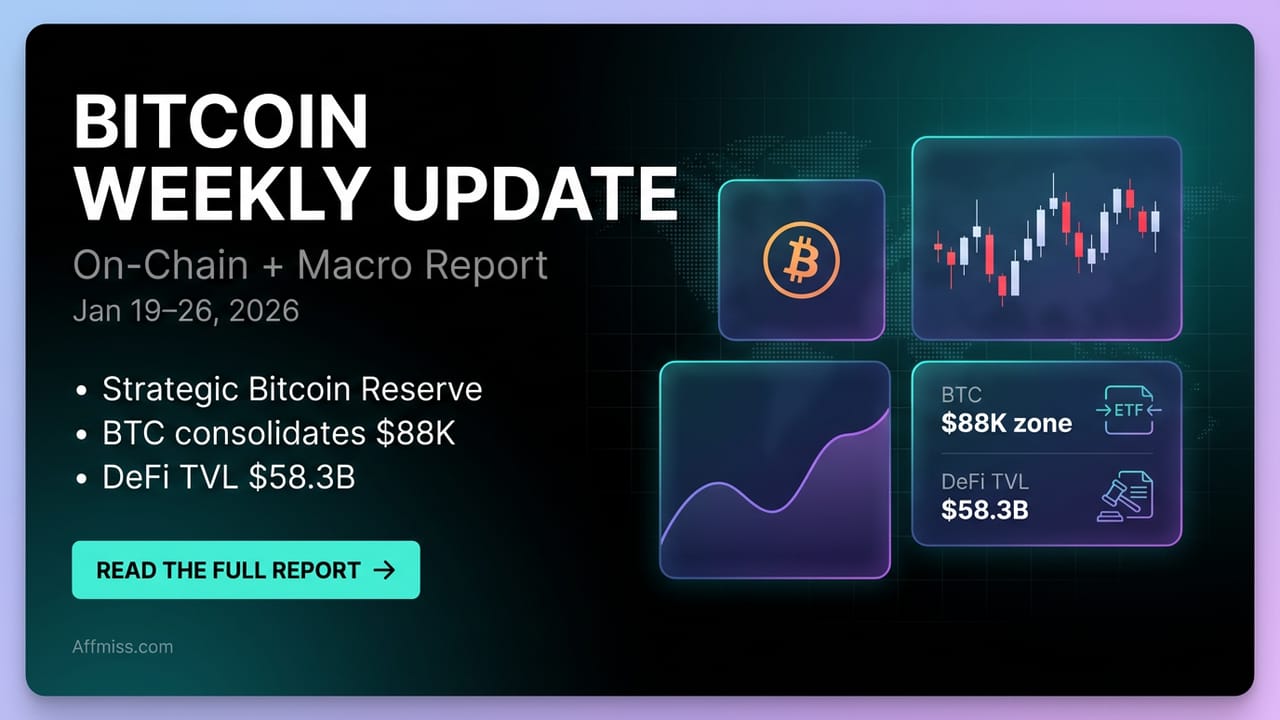
This week’s Bitcoin weekly update shows price action consolidating in the $87,000-$90,000 range after retreating from October 2025’s all-time high near $126,000. As of January 26, Bitcoin trades at approximately $88,500, representing a 3% gain year-to-date but down significantly from Q4 2025 peaks. Market structure analysis reveals this consolidation reflects healthy correction patterns rather than fundamental weakness.
Technical Analysis and Market Structure
Bitcoin dominance has climbed to 59.8%, indicating relative strength against altcoins as investors seek quality amid uncertainty. This metric represents Bitcoin’s market capitalization share of total cryptocurrency markets and typically increases during risk-off periods or when institutional capital favors established assets over speculative alternatives.
The 30% maximum drawdown from all-time highs compares favorably to previous cycles where corrections exceeded 60%. This compression in volatility signals market maturation as institutional participation provides deeper liquidity and reduces price whipsaws. Standard Chartered analyst Geoff Kendrick notes this price action remains “within expected bounds” for the current cycle phase.
Leverage Liquidation and Market Cleansing
The October-January correction liquidated significant over-leveraged positions accumulated during 2025’s rally. Many investors borrowed heavily using existing crypto holdings as collateral, creating liquidation cascades when prices dropped. This market cleansing event has strengthened the foundation for future price appreciation by removing weak hands and reducing systemic leverage risk.
Onchain data from DeFi lending protocols shows total liquidations collapsed to just $0.5 million over seven days ending January 26, near zero despite 7-10% price movements. This indicates conservative loan-to-value positioning and healthy collateral buffers across the ecosystem, suggesting lessons learned from previous liquidation cascade events.
Institutional vs Retail Dynamics
Current market structure reflects institutional dominance over retail speculation. Bitcoin spot ETFs absorbed more than the total number of mined coins in 2025, representing approximately $23 billion in net inflows. This patient, sticky capital from wealth management platforms, pension funds, and corporate treasuries provides price support absent in previous retail-driven cycles.
However, organic network growth metrics show limited expansion in 2025, with the number of Bitcoin owners not significantly rising despite price appreciation and institutional adoption. This concentration of ownership in institutional vehicles rather than individual wallets represents both strength through sophisticated capital and potential vulnerability through centralized holdings.
Onchain Data Reveals Strong Bitcoin Network Fundamentals
Comprehensive Bitcoin news analysis requires examining onchain metrics that reveal network health beyond price action. January 2026 data demonstrates robust fundamentals across mining, transactions, and long-term holder behavior patterns that support bullish medium-term outlooks despite short-term price consolidation.
Mining and Network Security
Bitcoin’s network hash rate remains near all-time highs, indicating sustained miner investment in securing the blockchain. The upcoming mining of the 20 millionth Bitcoin in March 2026 represents a significant milestone, with only 1 million BTC remaining to be mined over the next century-plus timeframe. Bitcoin’s annual issuance rate has dropped below 1%, now less than gold’s inflation rate, strengthening its “digital gold” narrative.
The halving cycle’s impact continues diminishing as each quadrennial event cuts progressively smaller absolute amounts. Analysts from VanEck and 21Shares note that while the four-year cycle still matters symbolically, it no longer serves as the primary engine driving crypto prices. Instead, institutional adoption, regulatory clarity, and macroeconomic factors increasingly determine market trajectories.
Long-Term Holder Behavior
Onchain analysis reveals that long-term holders who accumulated Bitcoin at lower prices have largely completed their distribution phase. Nexo analyst Iliya Kalchev explains that these holders’ sales were absorbed by institutional investors, creating a more stable ownership base. Bitcoin enters 2026 with reduced supply risk from this cohort and a broader capital base less susceptible to panic selling.
This shift from speculative retail holders to institutional allocators fundamentally changes Bitcoin’s market dynamics. Strategy (formerly MicroStrategy) leads corporate treasury adoption with 671,268 BTC worth approximately $58.9 billion. Eleven other companies maintain Bitcoin treasuries exceeding $1 billion each, creating persistent bid-side demand independent of retail sentiment.
Exchange Flows and Supply Dynamics
Bitcoin exchange reserves continue declining as investors move coins to cold storage and institutional custody solutions. This reduction in available selling supply on exchanges creates supply-demand imbalances that historically precede price appreciation. However, the pace of exchange outflows has moderated compared to 2024, suggesting markets may be reaching equilibrium between liquid and illiquid supply.
DeFi Total Value Locked Surges to $58.27 Billion
Decentralized finance represents a critical component of this Bitcoin weekly update as the ecosystem demonstrates robust growth and institutional validation. Total value locked across DeFi protocols reached $58.27 billion, up 6.6% week-over-week, reflecting renewed confidence in decentralized financial infrastructure and increasing institutional participation.
Lending Protocol Performance
DeFi lending protocols show healthy metrics with $20.68 billion borrowed against $58.27 billion in deposits, leaving $37.59 billion in available lending capacity. Aave v3 Ethereum utilization sits at 38.8%, a healthy range indicating ample capacity for credit expansion without rate pressure or liquidation cascade risk. Active users totaling 25,652 generated $15.18 million in protocol revenue, confirming genuine economic activity beyond TVL farming.
Leading protocols by total value locked include Lido ($27.5 billion), Aave ($27 billion), and EigenLayer ($13 billion), showing concentrated value capture in permissionless lending and restaking. Ethereum maintains dominance with approximately 68% of total DeFi TVL ($71 billion as of December 2025), though Layer 2 solutions increasingly capture market share.
Layer 2 Ecosystem Migration
Significant capital rotation from Ethereum mainnet to Layer 2 solutions continues accelerating. Ethereum mainnet experienced $688.7 million in TVL outflows as users migrate to lower-cost alternatives, while Arbitrum gained $266 million, Base $73.4 million, and Polygon $62.2 million. This migration reflects the maturing L2 ecosystem offering substantially lower transaction costs while maintaining Ethereum security guarantees.
Solana’s DeFi ecosystem has grown to approximately $9.19 billion TVL, making it the fastest-growing alternative after Ethereum. The Solana ecosystem benefits from high throughput, low transaction costs, and increasing institutional adoption through partnerships like Western Union’s US Dollar Payment Token launch on the network.
Stablecoin Supply Reaches $269.7 Billion
Stablecoin markets have expanded dramatically, with total supply reaching $269.7 billion, representing 50% growth over 2025. This “dry powder” of sidelined capital available for deployment into crypto markets represents substantial buying pressure when risk appetite returns. USDT maintains 68.8% dominance ($185.5 billion) while USDC holds 23.7% ($64 billion).
The persistent USDT/USDC divergence, with USDT gaining while USDC redeems, indicates retail and offshore preference over institutional and regulated flows. Weekly stablecoin mints exceeding $1 billion sustained would signal significant capital formation and institutional re-engagement. Current regime shows tactical expansion with offshore bias, supporting continued rally liquidity.
Real-World Asset Tokenization Growth
Real-world asset tokenization continues breaking into mainstream capital markets. Fortune 500 companies including banks, cloud providers, and e-commerce platforms are launching corporate Layer-1 blockchains settling over $1 billion in real economic activity annually. Major banks are beginning to accept tokenized equities as collateral equivalent to traditional securities, with the SEC expected to grant exemptive relief enabling institutional RWA adoption.
Institutional Crypto Adoption Accelerates With Major Bank Entries
The week’s most significant Bitcoin news in institutional adoption includes Morgan Stanley filing for Bitcoin and Solana ETFs, UBS evaluating cryptocurrency trading for private banking clients, and Goldman Sachs advising on Ledger’s potential $4 billion NYSE listing. These developments signal deepening integration between traditional finance and digital assets.
Bitcoin ETF Performance
Bitcoin spot ETFs have become the default structure for institutional exposure, absorbing more than total mined coins in 2025 with approximately $23 billion in net inflows. This patient, sticky capital from wealth management intermediaries contrasts sharply with retail speculation patterns. However, recent weeks show XRP ETFs experienced $40.6 million in weekly outflows, suggesting institutional profit-taking and rotation rather than loss of confidence.
The approval of ETF staking capabilities represents another watershed moment. U.S. policymakers clarified in 2025 that liquid staking activities do not constitute securities transactions, and the IRS confirmed investment trusts may stake digital assets. This benefits leading protocols like Lido and Jito while making custodial staking through ETPs the default structure for Proof-of-Stake token investment.
Corporate Treasury Adoption
Strategy leads corporate Bitcoin adoption with 671,268 coins worth $58.9 billion, but faces challenges as valuations decline. Standard Chartered analyst Geoff Kendrick suggests Digital Asset Treasury companies’ buying is “likely over” as valuations no longer support further expansion. Instead, expect consolidation rather than outright selling, but DAT buying unlikely to provide further market support.
GameStop’s transfer of $420 million in Bitcoin to Coinbase Prime sparked speculation about potential selling or internal asset management restructuring. While blockchain data confirms the movement, transfers to institutional custody platforms could indicate various strategic decisions beyond immediate liquidation plans.
Traditional Finance Integration
UBS Group’s evaluation of cryptocurrency trading for select private banking clients represents significant validation for the asset class. The Swiss lender is selecting partners to support buying and selling Bitcoin and Ether for clients in Switzerland, with potential expansion to Asia-Pacific and United States markets if demand holds. This follows similar moves by JPMorgan and Morgan Stanley expanding digital asset offerings.
Ledger’s planned NYSE listing potentially valuing the French hardware wallet maker above $4 billion (from $1.5 billion in 2023) underscores shifting sentiment toward crypto infrastructure firms. Goldman Sachs, Jefferies, and Barclays advising on the deal signals mainstream finance comfort with cryptocurrency ecosystem companies.
Bitcoin Price Predictions Range From $150,000 to $250,000 for 2026
Leading analysts maintain bullish outlooks despite recent price consolidation, with Bitcoin news showing price targets spanning $150,000 to $250,000 for 2026. These predictions reflect expectations for institutional adoption acceleration, regulatory clarity benefits, and macroeconomic tailwinds from potential Federal Reserve rate cuts.
Institutional Analyst Forecasts
Fundstrat’s Tom Lee predicts Bitcoin will hit new all-time highs by end of January 2026, calling for $150,000-$200,000 targets. Lee remains especially bullish on Ethereum, arguing the asset is entering a supercycle similar to Bitcoin’s 2017-2021 run, with potential for 10x appreciation. Standard Chartered maintains a $150,000 target while JPMorgan projects $170,000, though both have revised earlier more aggressive calls.
CoinShares Head of Research James Butterfill expects Bitcoin trading between $120,000-$170,000 in 2026, with more constructive price action likely in the second half. Butterfill emphasizes that investors will watch new SEC Chair appointments and regulatory framework implementation as key catalysts.
Wide Prediction Range Reflects Uncertainty
Bit Mining Chief Economist Youwei Yang projects an exceptionally wide range of $75,000 to $225,000, acknowledging continued volatility and multiple potential outcomes. This range reflects genuine uncertainty around macroeconomic conditions, regulatory implementation success, and institutional adoption pace.
Bears point to Bitcoin’s failure to serve as a “safe haven” during recent market stress, noting it behaves more like an “ATM” with investors quickly selling to raise cash during uncertain times rather than holding as a store of value like gold. The 2022 inflation crisis saw Bitcoin drop 77% while gold declined only 20%, undermining the digital gold narrative.
Catalysts and Risk Factors
Key bullish catalysts include completion of Trump administration regulatory frameworks, passage of comprehensive crypto legislation in Congress, continued institutional adoption through ETFs and corporate treasuries, and Federal Reserve interest rate cuts improving risk asset valuations. The mining of the 20 millionth Bitcoin in March 2026 provides symbolic support for scarcity narratives.
Risk factors include potential crypto winter if institutional enthusiasm wanes, regulatory challenges at state levels despite federal clarity, macroeconomic headwinds if inflation remains persistent requiring tight monetary policy, and concentration risks as ownership centralizes in large institutional holders rather than distributed individual ownership.
Altcoin Market Shows Relative Weakness as Bitcoin Dominance Rises
This week’s Bitcoin weekly update reveals significant altcoin underperformance as Bitcoin dominance climbs to 59.8%. Ethereum trades near $2,900, down over 12% year-over-year, while major altcoins including XRP, Solana, and others face selling pressure despite positive fundamental developments in their ecosystems.
Ethereum’s Valuation Disconnect
Ethereum demonstrates a notable disconnect between improving fundamentals and price performance. While TVL on Ethereum reached $71 billion and liquid staking grew 4% year-to-date with 33% peak growth in August-September 2025, ETH price remains under pressure. Analyst Christopher Perkins notes institutions favor blockchains offering reliability, security, and risk management where Ethereum continues leading.
Sharplink Gaming co-CEO Joseph Chalom believes Ethereum’s TVL could increase 10x in 2026, supported by rising stablecoin usage, expanding real-world asset tokenization, and institutional DeFi adoption. However, analyst Benjamin Cowen warns broader market conditions, particularly Bitcoin’s cycle timing, could delay major Ethereum breakouts despite strengthening fundamentals.
Solana Ecosystem Growth
Solana has established itself as the leading smart contract alternative to Ethereum, with 2026 price predictions ranging from $195 to $325+ depending on Internet Capital Markets adoption. Solana’s DeFi TVL of $9.19 billion makes it the fastest-growing alternative ecosystem, benefiting from high throughput, low costs, and increasing institutional partnerships like Western Union’s stablecoin launch.
XRP Volatility and ETF Speculation
XRP experienced 4% decline as Bitcoin fell below $88,000, with spot XRP ETF outflows of $40.6 million suggesting institutional profit-taking rather than fundamental concerns. Standard Chartered projects the most bullish XRP target at $8 by end-2026, representing 330% upside, though this remains highly speculative. XRP consolidates between $1.88-$1.95 support/resistance with fading volume pointing to a larger move once the current stalemate resolves.
Congressional Crypto Legislation Advances With Bipartisan Support
Regulatory clarity represents the most transformative aspect of recent Bitcoin news as Congress advances comprehensive cryptocurrency legislation with unusual bipartisan cooperation. The GENIUS Act for stablecoins passed the Senate in June 2025 with 18 Democratic votes, demonstrating crypto’s evolution from partisan issue to mainstream financial policy concern.
Stablecoin Regulatory Framework
The GENIUS Act establishes comprehensive federal frameworks for dollar-backed stablecoins, addressing issuer requirements, reserve standards, and regulatory oversight. This legislation positions the United States to maintain dollar dominance in digital forms as stablecoins become primary settlement assets for payments, remittances, and DeFi transactions globally.
Senate Banking Chair Tim Scott announced January 15, 2026 markup for additional market structure legislation, aiming to establish clear regulatory boundaries between SEC and CFTC jurisdiction over digital assets. This regulatory clarity allows traditional financial institutions to participate confidently in crypto markets within established compliance frameworks.
State vs Federal Dynamics
Despite federal progress, state-level regulations add complexity layers. Money transmission licensing, tax treatment variations, and consumer protection rules differ significantly across jurisdictions. Companies operating nationally must navigate this patchwork alongside federal requirements, creating ongoing compliance challenges even as federal frameworks improve.
International Regulatory Competition
The United States’ regulatory approach contrasts with international strategies. The European Union’s MiCA framework provides comprehensive rules across member states, while Asian jurisdictions including Singapore, Hong Kong, and Japan implement varying approaches balancing innovation with consumer protection. U.S. positioning as the “crypto capital of the world” depends on maintaining regulatory competitiveness while ensuring adequate safeguards.
Outlook: Bitcoin Positioned for Growth Despite Near-Term Volatility
This comprehensive Bitcoin weekly update reveals an asset class at an inflection point. While prices consolidate following 2025’s significant gains, fundamental developments including institutional adoption, regulatory clarity, and maturing market infrastructure position Bitcoin for continued long-term appreciation. The establishment of the Strategic Bitcoin Reserve represents the United States government’s first explicit acknowledgment of cryptocurrency as a strategic asset class, fundamentally changing the investment landscape.
Short-term volatility remains likely as markets digest rapid policy changes, institutional positioning adjusts to new regulatory frameworks, and macroeconomic conditions evolve. However, the combination of limited supply (only 1 million BTC remaining to be mined), growing institutional adoption through ETFs and corporate treasuries, improving regulatory clarity through comprehensive federal legislation, and expanding use cases through DeFi, stablecoins, and RWA tokenization creates compelling medium to long-term bullish thesis.
Investors should monitor key catalysts including SEC regulatory framework implementation, Congressional legislation passage, Federal Reserve interest rate decisions, institutional ETF flows, and Bitcoin’s approach to the 20 millionth coin mining milestone in March 2026. The transition from retail speculation to institutional allocation represents a fundamental market structure change that may reduce volatility while supporting sustained price appreciation over multi-year timeframes.
Frequently Asked Questions About Bitcoin News This Week
What is Trump’s Strategic Bitcoin Reserve?
President Trump’s Strategic Bitcoin Reserve, established via executive order on January 23, 2026, designates Bitcoin as a strategic national asset. The reserve will hold approximately 200,000 BTC seized through criminal and civil asset forfeiture, valued at roughly $17.6 billion. The government will not sell these holdings, treating Bitcoin as a long-term store of value similar to gold reserves at Fort Knox.
Why is Bitcoin price around $88,000 instead of new highs?
Bitcoin consolidated around $88,000 after retreating from October 2025’s all-time high near $126,000. This 30% correction reflects healthy market structure with over-leveraged positions liquidated, institutional accumulation replacing retail speculation, and markets awaiting regulatory framework implementation. Analysts view this consolidation as building foundation for future appreciation rather than fundamental weakness.
What is DeFi total value locked and why does it matter?
Total Value Locked (TVL) measures dollar value of assets deposited in DeFi protocols. At $58.27 billion (up 6.6% week-over-week), rising TVL indicates growing confidence in decentralized finance infrastructure. Healthy lending metrics with $37.59 billion available capacity and minimal liquidations ($0.5 million over 7 days) demonstrate robust ecosystem fundamentals supporting long-term growth.
Should I invest in Bitcoin in 2026?
Investment decisions depend on individual risk tolerance, time horizon, and financial circumstances. Leading analysts project Bitcoin prices between $150,000-$250,000 for 2026 based on institutional adoption, regulatory clarity, and limited supply. However, cryptocurrency remains volatile with significant downside risks. Consider consulting financial advisors and only invest amounts you can afford to lose. Bitcoin suits long-term holders better than short-term traders given volatility patterns.
How does the Bitcoin halving affect price in 2026?
Bitcoin’s four-year halving cycle continues diminishing in impact as each event cuts progressively smaller absolute amounts. With annual issuance below 1% (less than gold’s inflation rate), the halving remains symbolically important but no longer serves as the primary price driver. Instead, institutional adoption, regulatory frameworks, and macroeconomic conditions increasingly determine Bitcoin’s trajectory according to analysts from VanEck and 21Shares.
Start Trading Bitcoin on Top Exchanges
Ready to invest in Bitcoin after reading this weekly update? Compare the best cryptocurrency exchanges with competitive fees, high liquidity, and advanced trading features.
